
Week 1 of My AWS Cloud Foundations Journey Module 1: Cloud Concepts Overview
This module sets the foundation for everything else in the course: what cloud computing actually is, why organizations use it, and how they move to it.
Series: My AWS Cloud Foundations Journey (5 articles)
- 1Week 1 of My AWS Cloud Foundations Journey Module 1: Cloud Concepts Overview This article


Key concepts
Cloud computing — This refers to getting computing resources like servers, storage, and databases over the internet, on demand, and paying only for what you use, instead of buying and maintaining your own hardware.
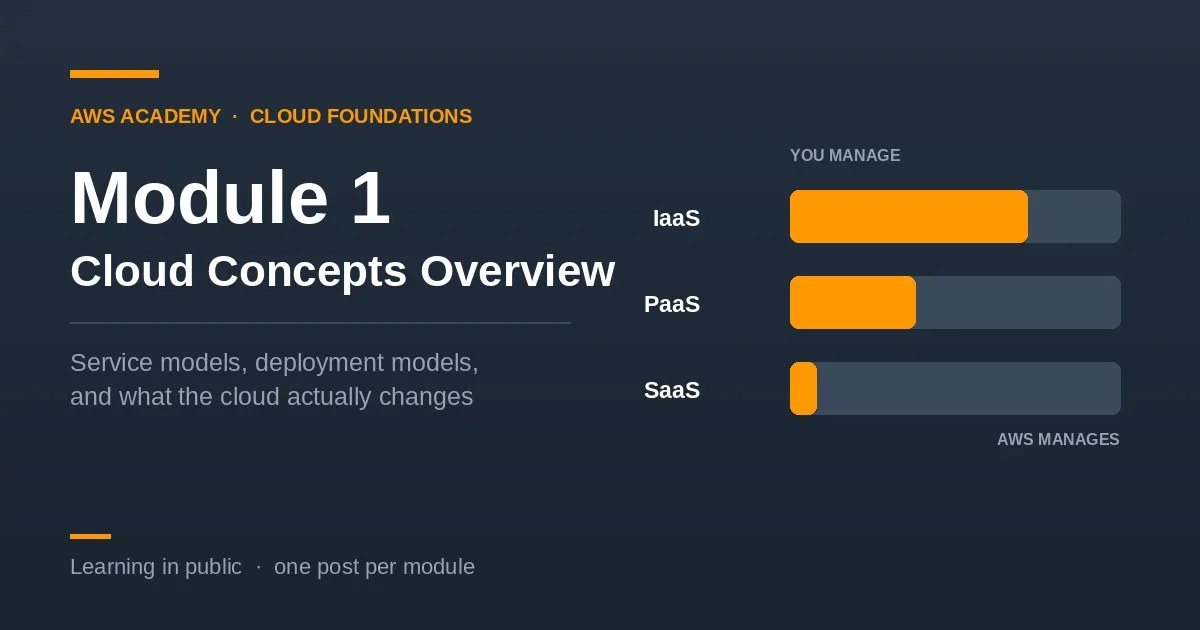
The three service models — These differ in how much you manage yourself:
- IaaS (Infrastructure as a Service): You get the raw building blocks, such as virtual machines, storage, and networking. You manage the operating system and everything above it. Amazon EC2 is an example.
- PaaS (Platform as a Service): The provider manages the servers and operating system. You just deploy your code. AWS Elastic Beanstalk is an example.
- SaaS (Software as a Service): A finished application you simply use, like Gmail.
The three deployment models:
- Cloud: Everything runs in the cloud.
- On-premises: Everything runs on your own hardware in your own facility.
- Hybrid: A mix, where cloud resources connect to existing on-premises systems.
The six advantages of cloud computing — Pay as you go instead of large upfront investment, lower costs through AWS's economies of scale, no more guessing how much capacity you need, faster experimentation, no data centers to run and maintain, and the ability to deploy globally in minutes.
Moving to the cloud — The AWS Cloud Adoption Framework (CAF) organizes a migration into six perspectives: Business, People, and Governance on the organizational side, and Platform, Security, and Operations on the technical side. The point is that moving to the cloud is not only a technical project. Skills, processes, and decision-making have to change too.
What clicked for me
The service models made sense once I connected them to something I had already done. This week I set up an Ubuntu virtual machine in VirtualBox for a Python networking project. I had to configure its network settings, install software, and manage everything on it myself.
That is essentially what IaaS gives you, except AWS provides the machine instead of my laptop. Moving to PaaS means handing more of that work to the provider, and SaaS means handing over all of it. The models are not three separate things to memorize. They are one scale of how much responsibility you keep.
Connecting it
This module is mostly vocabulary, but it frames the rest of the course. Every service covered later sits somewhere on the IaaS–PaaS–SaaS scale, and knowing where helps explain what you still have to manage yourself.
Part of my AWS Academy Cloud Foundations learning series.
Series: My AWS Cloud Foundations Journey (5 articles)
- 1Week 1 of My AWS Cloud Foundations Journey Module 1: Cloud Concepts Overview This article
Enjoyed reading this content? Let the author know!
Your likes, comments, shares, and saves help creators reach more builders.

Loading recommendations
Loading article