
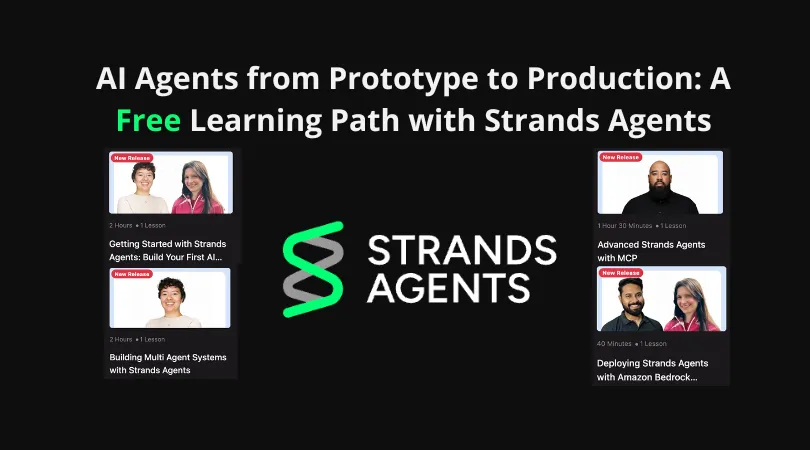
AI Agents from Prototype to Production: A Free Learning Path with Strands Agents
Learn to build AI agents that reason, use tools, and scale in production. 4 hands-on courses with Strands Agents & Amazon Bedrock: from your first agent to complex multi-agent systems and serverless deployment. Features MCP integration, persistent memory, observability, and enterprise architectures. Practical labs with code on GitHub. 100% free, self-paced. Perfect for Python developers ready to build production-grade agents

AI agents are moving from proof-of-concept demos to production systems. If you build autonomous agents that reason, use tools, and operate at scale, this learning path with ( https://strandsagents.com ) and Amazon Bedrock AgentCore provides a practical foundation.
This four-course series covers building your first agent, integrating MCP servers, implementing agent-to-agent communication, and deploying to production. Here's what each course covers and what you'll actually learn.
Course 1: Getting Started with Strands Agents
What you'll build: Your first functional AI agent with tool integration and model flexibility.
This course covers the fundamentals of the Strands framework. You'll learn to:
- Configure agents with custom prompts and behaviors
- Connect to multiple model providers (Anthropic Claude, Amazon Bedrock, LiteLLM, Ollama)
- Integrate AWS services like S3 and DynamoDB into your agent workflows
- Implement Model Context Protocol (MCP) to extend agent capabilities
- Enable agent-to-agent communication
- Add observability with LangFuse and evaluation with RAGAS
You'll work with production-ready integrations throughout the course. Requires basic Python knowledge.
Further reading:
Course 2: Advanced Strands Agents with MCP

What you'll build: Production-ready agents with custom logic, stateful memory, and lifecycle hooks.
This intermediate course focuses on production system internals:
- Understanding the agent class, agentic loop, and execution lifecycle
- Implementing hooks to control agent behavior at specific event points
- Managing stateful conversations with sliding window and summarization
- Configuring persistent storage for session data
- Building tool orchestration with Model Context Protocol
- Tracking costs and monitoring agent performance
You'll work with multiple model providers including OpenAI, Anthropic, Amazon Bedrock, and Ollama. The course covers the architectural patterns that separate prototype agents from production-grade systems.
Further reading:
Course 3: Building Multi-Agent Systems

What you'll build: Collaborative agent networks that solve complex problems through coordination.
Complex workflows require coordination between multiple agents. This advanced course explores architectural patterns for multi-agent coordination:
- Swarm intelligence: Parallel agent groups that process tasks faster through collective behavior
- Graph-based coordination: Managing complex dependencies between agents
- Agents as tools: Wrapping entire agents into reusable components that other agents can invoke
- Workflow orchestration: Coordinating distributed agent networks
You'll learn how autonomous agents communicate, negotiate, and exhibit emergent behaviors. The course emphasizes practical patterns for real-world distributed systems.
Further reading:
Course 4: Deploying with Amazon Bedrock AgentCore

What you'll build: Serverless agent deployments with enterprise-grade security and monitoring.
Moving agents to production introduces new challenges. This course covers deployment with Amazon Bedrock AgentCore:
- Operating agents at scale with serverless infrastructure
- Understanding AgentCore architecture: runtime, gateway, memory systems
- Implementing session isolation and production-grade security
- Adding observability for monitoring and debugging
- Managing credentials and integrations with AWS services
AgentCore handles infrastructure management and provides enterprise features. You'll learn the operational aspects that matter when agents serve real users.
Further reading:
The Learning Path
These courses form a progression from fundamentals to production deployment. You'll start with basic agent configuration, add advanced capabilities like memory and hooks, scale to multi-agent architectures, and finally deploy with managed infrastructure.
Each course includes hands-on labs with code samples available on GitHub . You'll work with actual AWS services, real model providers, and production-grade frameworks.
The courses are free and self-paced. This series provides a practical foundation for building AI agents and understanding how autonomous systems work in production.
Happy building! 🚀
¡Gracias!
Enjoyed reading this content? Let the author know!
Your likes, comments, shares, and saves help creators reach more builders.

Loading recommendations
Loading article