
Enterprise Swarm Intelligence: Building Resilient Multi-Agent AI Systems
A guide on Agentic AI Swarm Architecture.


Executive Summary/TL;DR
Swarm Agentic AI pattern is a decentralized multi-agent architecture where autonomous AI agents collaborate through self-organization and local interactions to achieve complex goals. This transformative approach, inspired by biological systems like ant colonies and bird flocks, enables emergent intelligence—where collective behavior arises from simple agent rules rather than centralized control. Unlike traditional AI frameworks that rely on a central orchestrator, swarm agents leverage distributed decision-making, dramatically enhancing adaptability and resilience.As enterprises scale AI capabilities in 2025, swarm architectures offer unprecedented resilience, adaptability, and efficiency for mission-critical workflows. The field is rapidly evolving from orchestration-heavy frameworks to model-driven approaches that harness advanced LLM capabilities, reducing development time from months to weeks. Swarm Agentic AI is poised to become a foundational pattern for next-generation enterprise AI solutions.
Introduction
The evolution from single-agent to swarm-based AI systems marks a fundamental shift in how enterprises approach complex problem-solving. Unlike traditional monolithic AI systems, swarm architectures distribute intelligence across multiple specialized agents that self-organize and adapt dynamically. This whitepaper examines the technical foundations, implementation patterns, and strategic considerations for deploying swarm AI in enterprise environments.
With the emergence of model-driven frameworks like Amazon Strands SDK in 2025, the complexity of building swarm systems has dramatically decreased, enabling organizations to deploy production-ready multi-agent systems in weeks rather than months.
Core Advantages of Swarm AI
1. Resilience Through Redundancy
- No Single Point of Failure: The decentralized nature of swarm architectures ensures that the system can continue operating even if some agents fail or become unavailable.
- Graceful Degradation: When an agent encounters an issue, its responsibilities can be dynamically redistributed among the remaining agents, helping maintain overall system performance.
- Real-World Impact: For example, in drone operations or industrial robotics, swarms can continue functioning and adapt to disruptions without centralized intervention.
2. Dynamic Adaptability
- Self-Organization: Agents autonomously adjust their roles and strategies in response to changes in the environment or task requirements.
- Emergent Problem-Solving: Solutions arise from the collective behavior of agents, enabling the system to tackle problems without relying on rigid, predetermined workflows.
- Performance Gains: Swarm systems can often resolve complex challenges more efficiently than monolithic or centrally controlled approaches.
3. Linear Scalability
- Horizontal Scaling: Additional agents can be incorporated into the system without requiring fundamental architectural changes, supporting growth and increased workload.
- Resource Optimization: Computational tasks are intelligently distributed, making efficient use of available resources.
- Elastic Workloads: Swarm architectures are well-suited for environments with fluctuating demand, such as e-commerce or customer support.
4. Context Window Expansion
- Distributed Memory: By sharing information across multiple agents, swarm systems can collectively manage and utilize a broader context than individual agents alone.
- Parallel Processing: Agents can analyze large datasets or complex documents simultaneously, increasing throughput and responsiveness.
- Cross-Verification: Multiple agents can validate each other’s outputs, helping to reduce the likelihood of errors or oversights.
5. Accelerated Development and Iteration
- Model-Driven Frameworks: Modern frameworks, such as Amazon Strands SDK, streamline the creation and deployment of agentic systems, minimizing the need for complex orchestration code.
- Reduced Complexity: Agents can leverage advanced language models to handle coordination and planning, simplifying the development process.
- Faster Iteration: Developers can define agent behaviors and workflows with simple prompts and tool assignments, enabling rapid experimentation and adaptation to changing requirements.
Limitations and Considerations
1. Convergence Challenges
- No guaranteed optimal solutions; potential for local optima
- Requires sophisticated coordination mechanisms to ensure global optimization
2. Communication Overhead
- Message-passing bottlenecks emerge at scale (100+ agents)
- Network latency impacts real-time coordination
- Bandwidth requirements grow exponentially with agent count
3. Parameter Sensitivity
- Performance heavily dependent on tuning (agent count, communication protocols, decision thresholds)
- Poor configuration leads to resource waste or premature convergence
4. Ambiguity Management
- Open-ended objectives risk misinterpretation without clear boundaries
- Requires robust goal specification and constraint frameworks
Implementation Patterns
When to Deploy Swarm AI
| Use case | Why Swarm? | Example Applications |
|---|---|---|
| Dynamic Environments | Real-time adaptation to changing conditions | Autonomous traffic management, disaster response coordination |
| Distributed Systems | Fault tolerance and geographic distribution | IoT networks, edge computing, global supply chains |
| Complex Analytics | Multi-perspective analysis and validation | Financial trading, fraud detection, scientific research |
| Collaborative Workflows | Specialized agents enhancing collective output | Customer support, content generation, software development |
When to Avoid Swarm Patterns
- Deterministic tasks with single correct solutions
- Resource-constrained environments
- Simple, sequential workflows
- Regulatory environments requiring explainable decisions
Swarm Pattern Types
1. Hierarchical Swarms: Coordinator agents managing specialized sub-agents
2. Parallel Swarms: Multiple agents working simultaneously on different aspects
3. Sequential Swarms: Pipeline-based processing with handoffs
4. Adaptive Swarms: Dynamic team composition based on task requirements
Modern frameworks like Amazon Strands support all these patterns through its swarm tool, enabling models to reason about when a task requires a specific swarm configuration.
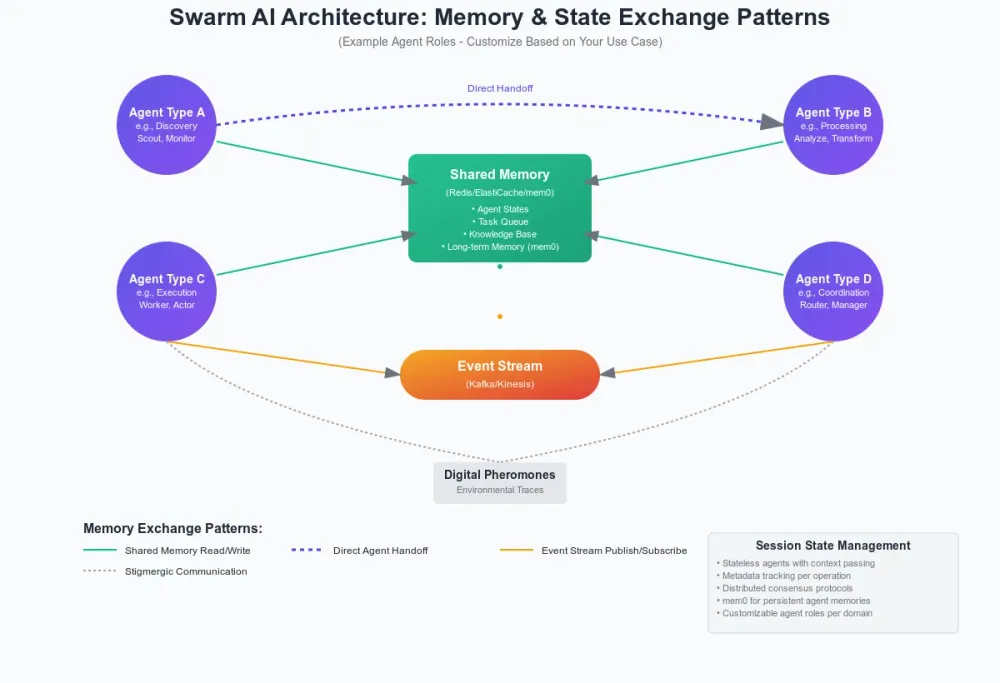
Technical Architecture: Memory & State Management
Agent Role Flexibility
Swarm architectures don't prescribe specific agent types. Instead, agents are defined by their capabilities and roles within your specific use case. Common patterns include:
- Task Discovery: Agents that identify work, explore data sources, or monitor for triggers
- Analysis & Processing: Agents specialized in data transformation, validation, or computation
- Decision Making: Agents that evaluate options, route tasks, or coordinate workflows
- Action Execution: Agents that interact with external systems or perform concrete tasks
- System Maintenance: Agents that monitor health, manage resources, or handle failures
Examples by domain:
- Financial Services: Risk assessors, trade executors, compliance monitors, market analyzers
- E-commerce: Product recommenders, inventory managers, pricing optimizers, fraud detectors
- Healthcare: Diagnostic agents, treatment planners, patient monitors, resource schedulers
1. Shared Memory Architecture
Modern implementations leverage distributed databases for centralized knowledge:
Technologies:
- Short-term State: Redis Cluster, AWS ElastiCache, Apache Ignite
- Long-term Memory: mem0 (for persistent agent memories across sessions)
- Vector Storage: Pinecone, Weaviate (for semantic search capabilities)
2. Stigmergic Communication
Agents modify shared environments, leaving digital traces for coordination:
- Digital Pheromones: Decay-based priority signals
- Gradient Fields: Attraction/repulsion mechanisms
- Shared Artifacts: Collaborative document editing
3. Direct Handoff Protocols
Stateless agents transfer context through structured handoffs:
- Context Serialization: Complete state transfer between agents
- Capability Matching: Dynamic routing based on agent specializations
- Conversation Threading: Maintaining coherent multi-turn interactions
- Model-Driven Handoffs: Modern frameworks like Amazon Strands enable models to autonomously decide when tasks require workflow, graph, or swarm patterns
1
2
3
4
5
6
7
8
9
10
11
12
13
14
15
Example of model-driven approach with Amazon Strands:
from strands import Agent, Tool

# Define agents with simple prompts - the model handles orchestration
support_agent = Agent(
    model="claude-3",
    prompt="You are a customer support specialist.",
    tools=[transfer_to_billing, check_ticket_status]
)

billing_agent = Agent(
    model="claude-3",
    prompt="You are a billing expert.",
    tools=[process_refund, check_payment]
)
# The model autonomously decides when to handoff between agents
# No complex orchestration logic needed
4. Hybrid Event-Driven Coordination
- Event Streams: Apache Kafka, AWS Kinesis for real-time coordination
- State Machines: Explicit workflow definitions with conditional branching
- Consensus Protocols: Distributed agreement mechanisms (Raft, Paxos variants)
5. Persistent Memory with mem0
mem0 provides a crucial capability for swarm systems by enabling:
- Cross-Session Context: Agents retain memories across conversations and restarts
- User-Specific Memory: Personalized agent behaviors based on historical interactions
- Organizational Memory: Shared knowledge that persists across the entire swarm
- Automatic Relevance: Vector-based retrieval of contextually relevant memories
Modern Framework Landscape
OpenAI Swarm (2024)
- Philosophy: Lightweight, client-side orchestration
- Key Features: Agent handoffs, stateless design, routine-based coordination
- Best For: Rapid prototyping, educational purposes, research
Amazon Strands SDK (2025)
- Philosophy: Model-driven approach leveraging advanced LLM capabilities
- Key Features:
- Multi-agent support (workflow, graph, and swarm patterns)
- 20+ pre-built tools with MCP server integration
- Production-ready with built-in observability via OpenTelemetry
- Flexible model support (Bedrock, Anthropic, OpenAI, Ollama)
- Agent2Agent (A2A) protocol support (coming soon)
- Production Use: Amazon Q Developer, AWS Glue, VPC Reachability Analyzer
- Industry Support: Accenture, Anthropic, Langfuse, mem0.ai, Meta, PwC, Ragas.io, Tavily
- Best For: Enterprise deployments requiring fast time-to-market (months to weeks)
Enterprise Frameworks
- Amazon Strands SDK: Model-driven, open-source, and production-ready. Supports flexible deployment (local, cloud, hybrid), full observability, and multi-agent collaboration with built-in state management and memory sharing. Integrates with AWS services, Amazon Bedrock, Anthropic, OpenAI, and more
- Swarms.ai: Production-ready with hierarchical, parallel, and sequential patterns
- Microsoft AutoGen: Complex workflow automation with code generation
- CrewAI: Role-based agent teams with built-in collaboration patterns
- LangGraph: Graph-based agent orchestration for complex state machines
Memory Management Solutions
- mem0: Persistent memory layer for maintaining agent context across sessions
- Vector Databases: Pinecone, Weaviate for semantic memory retrieval
- Traditional Stores: Redis, ElastiCache for ephemeral state management
Real-World Implementations
Customer Support Revolution
- 60% faster ticket resolution through collaborative agent teams
- Specialized agents for billing, technical support, and escalation
- Seamless handoffs maintaining conversation context
Developer Tools & Infrastructure
- Amazon Q Developer: Using Amazon Strands for code generation and assistance
- AWS Glue: Multi-agent data integration and ETL workflows
- VPC Reachability Analyzer: Network analysis through agent collaboration
- Development time reduced from months to weeks with model-driven approaches
Financial Trading Systems
- Multiple agents analyzing different market signals
- Consensus mechanisms preventing rogue trades
- Real-time adaptation to market volatility
Smart Manufacturing
- Quality control agents detecting defects across production lines
- Predictive maintenance through distributed sensor analysis
- Dynamic resource allocation based on demand patterns
Conclusion
Swarm Agentic AI represents the next evolution in enterprise AI architecture. While challenges remain in parameter tuning and convergence guarantees, the benefits of resilience, scalability, and adaptive intelligence position swarm patterns as essential for organizations navigating complex, dynamic environments.
The field is rapidly evolving from orchestration-heavy frameworks to model-driven approaches that leverage the native reasoning capabilities of advanced LLMs. Amazon Strands SDK exemplifies this shift, reducing development cycles from months to weeks by trusting models to handle complex agent coordination autonomously.
Success requires thoughtful implementation, starting with well-defined use cases and gradually expanding to enterprise-scale deployments. As we advance toward increasingly autonomous systems, swarm AI provides the architectural foundation for resilient, intelligent, and ethically-aligned artificial intelligence that augments human capabilities while maintaining robust safeguards.
Enjoyed reading this content? Let the author know!
Your likes, comments, shares, and saves help creators reach more builders.

Loading recommendations
Loading article