
Which Gen AI App Should You Build on AWS in 2026?
Chatbot, agent, voice or summarizer? A beginner's guide to picking your first Gen AI app on AWS, and the services each one needs.

DevOps Engineer
You want to build something with Gen AI on AWS, but the list of services and models keeps growing. The real first question is not which model to use. It is which kind of app to build. This guide gives you a short answer and the AWS services each kind needs.
The 30-second answer
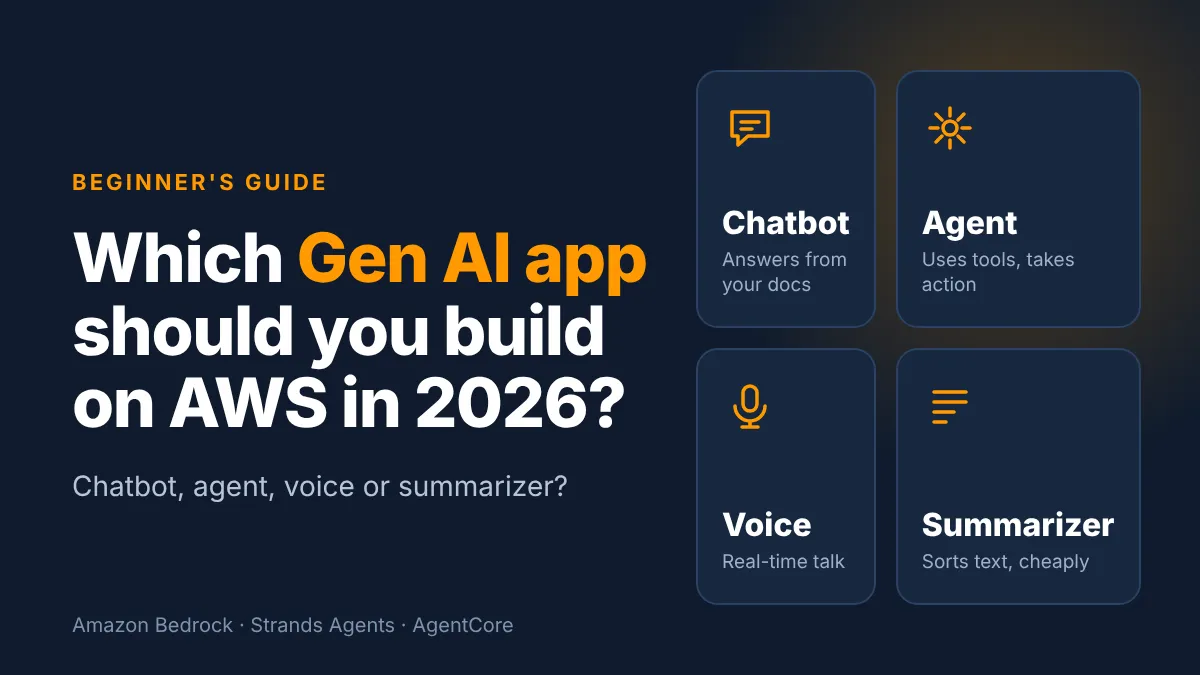
- Want users to ask questions about your documents? Build a document Q&A chatbot with Amazon Bedrock Knowledge Bases.
- Want software that takes actions and uses tools? Build an AI agent with Strands Agents, hosted on Amazon Bedrock AgentCore Runtime.
- Want people to talk to your app out loud? Build a voice agent with Amazon Nova 2.5 Sonic and Strands Bidi Agents.
- Have lots of text to sort, extract or summarize? Build a batch summarizer or classifier with a small, fast model such as Claude Haiku 5.5.
Not sure? Start with the document Q&A chatbot. It is the simplest of the four, and you will learn ideas you can reuse in the others.
1. Document Q&A chatbot (RAG)
What it does: answers questions using your own documents, such as a course handbook, a policy folder or product manuals.
How it works: the app finds the parts of your documents that match the question, then gives them to the model, so the answer is based on your content. This is called Retrieval-Augmented Generation, or RAG.
AWS services: Amazon Bedrock Knowledge Bases to connect and search your documents, and a foundation model on Amazon Bedrock to write the answers.
Good to know: Bedrock Knowledge Bases can now refresh data sources daily, weekly or monthly. It also has native connectors for SharePoint, OneDrive, Confluence, ServiceNow, Salesforce and Zendesk, so you do not have to copy files by hand.
Watch out for: poor answers usually come from poor documents or poor retrieval, not the model. Test with real questions, and make the app say when it does not know.
2. AI agent
What it does: decides what to do, calls tools such as APIs or files, and repeats until the task is done.
How it works: you write the tools, and the agent decides when to use them. If you have read my beginner guide on Strands, this is the same idea.
AWS services: Strands Agents, an open source SDK, to build the agent. Amazon Bedrock AgentCore Runtime to run it. AgentCore Runtime bills only for actual usage and scales to zero when idle. AWS Agent Registry is a new catalog where agents can find MCP servers and skills at runtime.
Good to know: Strands Box is an open source sandbox for agents, currently in developer preview. It limits what an agent can do and attaches credentials at an egress gateway instead of storing them in the agent's environment.
Watch out for: an agent that can take actions can also take wrong actions. Start with two or three simple tools, and keep a human approval step for anything that changes data or spends money.
3. Voice agent
What it does: lets people talk to your app and hear answers in real time, such as a language tutor or a phone helper.
How it works: Amazon Nova 2.5 Sonic is a speech-to-speech model. It supports expressive voices in seven languages, controllable turn-taking, and a 256K context window. Strands Bidi Agents, now generally available, pairs with it to build voice agents with little code.
AWS services: Amazon Nova 2.5 Sonic on Amazon Bedrock and Strands Bidi Agents.
Watch out for: voice is the hardest of the four to test, because speed, interruptions and accents all matter. Try it with real people early.
4. Batch summarizer or classifier
What it does: works through many items, such as support tickets, reviews or documents. It sorts them, pulls out fields or writes short summaries.
How it works: pick a small, fast, low-cost model. Claude Haiku 5.5 is built for high-volume, cost-sensitive work. It is the first Haiku with effort controls, so you can balance cost and quality per task, and AWS says it costs about 75% less than Claude Haiku 4.5 for most tasks. OpenAI GPT-6.1 Luna on Bedrock is also aimed at extraction, summarization, classification and routing.
AWS services: Amazon Bedrock. Claude models on Bedrock now support structured outputs, so the model can return JSON that follows your schema and you do not need extra parsing code.
Watch out for: check a sample of the results by hand before you run the whole batch.
Which one should you build?
If you want to... | Build a... | Main AWS services |
|---|---|---|
Answer questions from your documents | Document Q&A chatbot | Bedrock Knowledge Bases + a Bedrock model |
Let software take actions | AI agent | Strands Agents + AgentCore Runtime |
Let people talk to your app | Voice agent | Nova 2.5 Sonic + Strands Bidi Agents |
Process lots of text cheaply | Batch summarizer or classifier | Bedrock + Claude Haiku 5.5 |
Before you build anything
- Model access: turn on model access for the Bedrock models you want to use.
- Cost: every model call can cost money. Set a budget alert, and start with a small, cheap model.
- Permissions: give your app only the IAM permissions it needs. Never put keys in your code.
- Test with real questions before you show it to anyone.
Where to go next
- New to agents? Read What Is an AI Agent? A Simple Guide for AWS Beginners .
- Ready to build one? Follow Build Your First AI Agent with Strands: A Beginner's Guide .
Your turn
Which of the four will you build first? Tell me in the comments.
Sources
- AWS Weekly Roundup, October 26, 2026 (AWS News Blog)
- AWS Weekly Roundup, October 13, 2026 (AWS News Blog)
- AWS Weekly Roundup, October 5, 2026 (AWS News Blog)
Details are taken from the sources above as of Oct 30, 2026. Models and features change often, so check the official AWS pages before you build.
Enjoyed reading this content? Let the author know!
Your likes, comments, shares, and saves help creators reach more builders.

Loading recommendations
Loading article