

Real-Time Interaction, Response Streaming, and WebSockets in Amazon Bedrock
Learn how to minimize Time-to-First-Token (TTFT) using Amazon Bedrock InvokeModelWithResponseStream and ConverseStream, implement persistent connections with API Gateway WebSockets, Lambda, and DynamoDB, evaluate Server-Sent Events (SSE), handle mid-stream ModelStreamErrorException failures, and enforce Bedrock Guardrails in real time.
Series: AIP-C01 | Task 2.4: Implement FM API integrations (2 articles)
- 2Real-Time Interaction, Response Streaming, and WebSockets in Amazon Bedrock This article
AWS Certified Generative AI Developer - Professional - Exam Guide (AIP-C01)
Content Domain 2: Implementation and Integration
Task 2.4: Implement FM API integrations.
Skill 2.4.2: Develop real-time AI interaction systems to provide immediate feedback from FM (for example, by using Amazon Bedrock streaming APIs for incremental response delivery, WebSockets or server-sent events to generate text in real time, API Gateway to implement chunked transfer encoding).
Article Overview
- What You Will Learn: How to design and implement serverless streaming architectures on AWS for the AIP-C01 exam; mitigate Time-to-First-Token (TTFT) bottlenecks using
InvokeModelWithResponseStreamandConverseStream; orchestrate persistent bidirectional connections with Amazon API Gateway WebSocket APIs coupled with AWS Lambda and Amazon DynamoDB; evaluate WebSockets versus Server-Sent Events (SSE) via Lambda Response Streaming; handle mid-stream exceptions such asModelStreamErrorException; and enforce Bedrock Guardrails at runtime without degrading end-user latency.
Introduction: The Challenge of Latency and Timeouts in Production
Modern conversational experiences require instantaneous responsiveness. In legacy architectures or traditional synchronous calls using
InvokeModel, the client application submits a prompt and remains blocked on a standard HTTP request while the Foundation Model (FM) processes the input (prefill phase) and decodes the entire response token by token. For lengthy text generations, detailed reports, or source code, this synchronous paradigm creates the perception of a frozen application for several seconds.Even worse, within the AWS REST API ecosystem, synchronous invocations run directly into the Amazon API Gateway hard limit: an unconfigurable 29-second integration timeout. If full model generation takes 30 seconds, API Gateway terminates the connection with an HTTP 504 Gateway Timeout error before the first byte ever reaches the client.
The production-grade solution decouples conventional HTTP transport by adopting streaming inference and persistent connection protocols.

To implement a reactive, real-time communication mesh with Amazon Bedrock, AWS provides native integration paths through Amazon API Gateway WebSocket APIs and Server-Sent Events (SSE).
Reducing Time-to-First-Token (TTFT)
Inference latency in Large Language Models (LLMs) is governed by two critical metrics:
- TTFT (Time-to-First-Token): The elapsed duration from the moment the user sends the request until the first output token arrives at the client.
- TPOT (Time Per Output Token) / TPS (Tokens Per Second): The decoding throughput at which subsequent tokens are generated by the underlying GPU or AWS Trainium/Inferentia accelerators and transmitted sequentially.
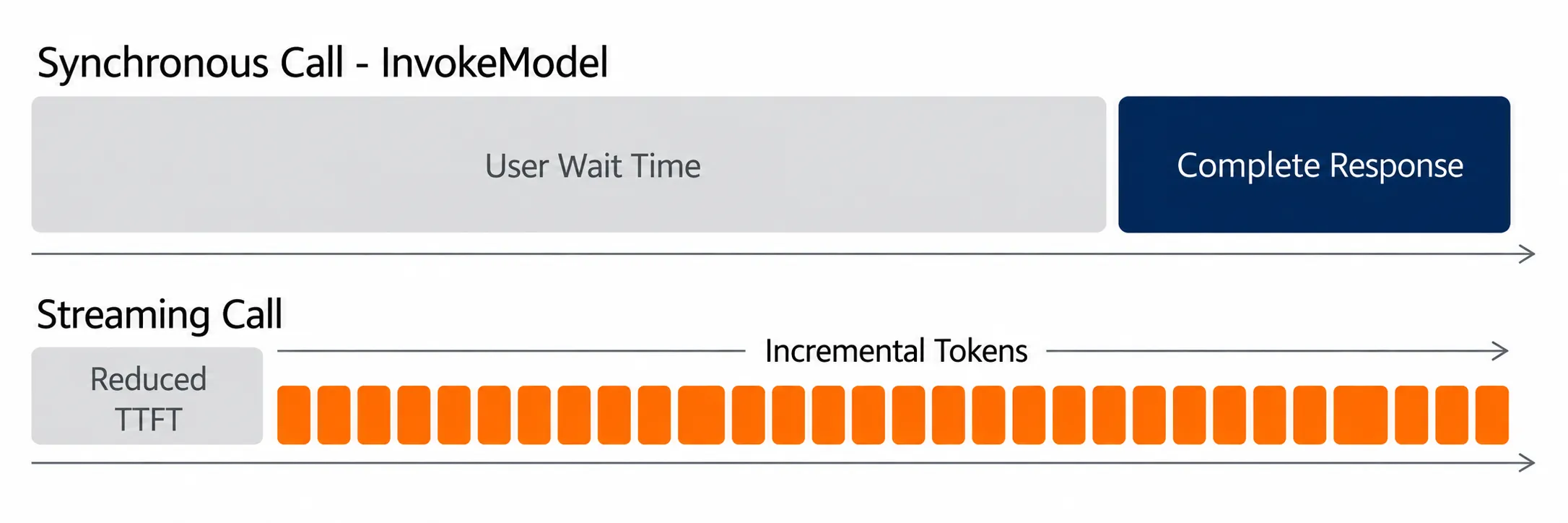
In a synchronous invocation using
InvokeModel, user idle time equals the full generation duration of the entire response. In contrast, with streaming enabled, as soon as the prefill stage finishes and the first token is decoded, the payload begins streaming progressively in incremental chunks.- Dramatically Improved UX: Replaces a static waiting spinner with an active typewriter effect.
- Immediate Feedback: Perceived latency drops significantly because the user begins reading content while the model continues decoding remaining tokens.
- Timeout Mitigation: Because data frames flow immediately, downstream HTTP clients, reverse proxies, and gateways keep connections alive without triggering idle timeouts.
💡 Exam Tip #1: If an AIP-C01 exam scenario specifies requirements such as "provide immediate character-by-character user feedback," "achieve a sub-1 second initial response requirement," or "users report that the application appears frozen during generation," immediately eliminate options based on polling or standard
InvokeModel. The correct architecture will invariably leverage InvokeModelWithResponseStream or ConverseStream.Amazon Bedrock Streaming APIs: InvokeModelWithResponseStream vs. ConverseStream
Amazon Bedrock provides two streaming execution APIs at runtime:
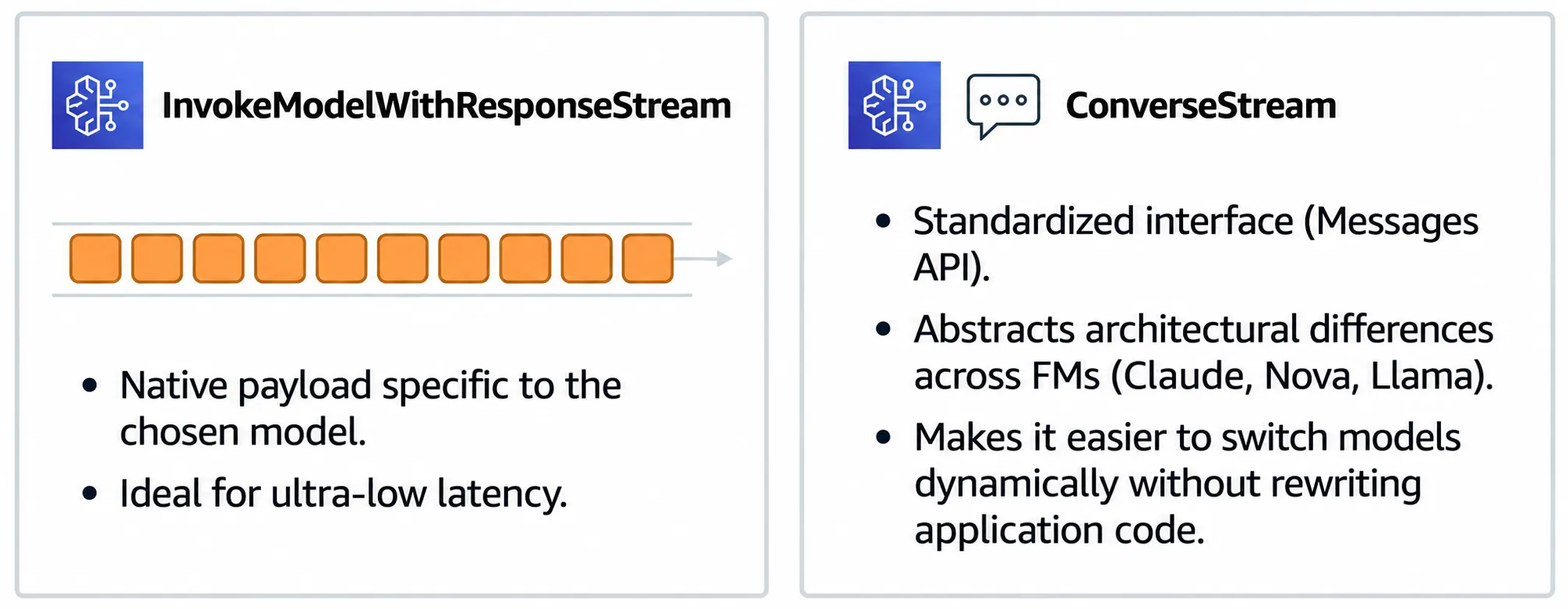
1. InvokeModelWithResponseStream
- Uses native model payloads structured according to the specific FM provider schema (e.g., Anthropic Claude, Meta Llama, Amazon Titan, Amazon Nova).
- Delivers the lowest internal payload serialization overhead, making it ideal for ultra-low latency scenarios.
- Requires the client application code to handle provider-specific request and response structures directly.
2. ConverseStream
- Provides a unified, standardized interface (Messages API) within the Bedrock Runtime.
- Abstract away syntactic and schema discrepancies across heterogeneous model families (Claude, Nova, Llama).
- Enables dynamic switching of the underlying model ID (
modelId) or intelligent model routing without refactoring application-tier parsing logic.
Both APIs yield asynchronous, event-driven streams structured around discrete event primitives (
contentBlockDelta, messageDelta, messageStop), progressively delivering the generated response in lightweight chunks.Persistent Connections with Amazon API Gateway WebSocket APIs
While traditional HTTP follows a unidirectional, ephemeral request-response pattern, Amazon API Gateway WebSocket APIs establish a persistent, bidirectional full-duplex communication channel over a single long-lived TCP connection.
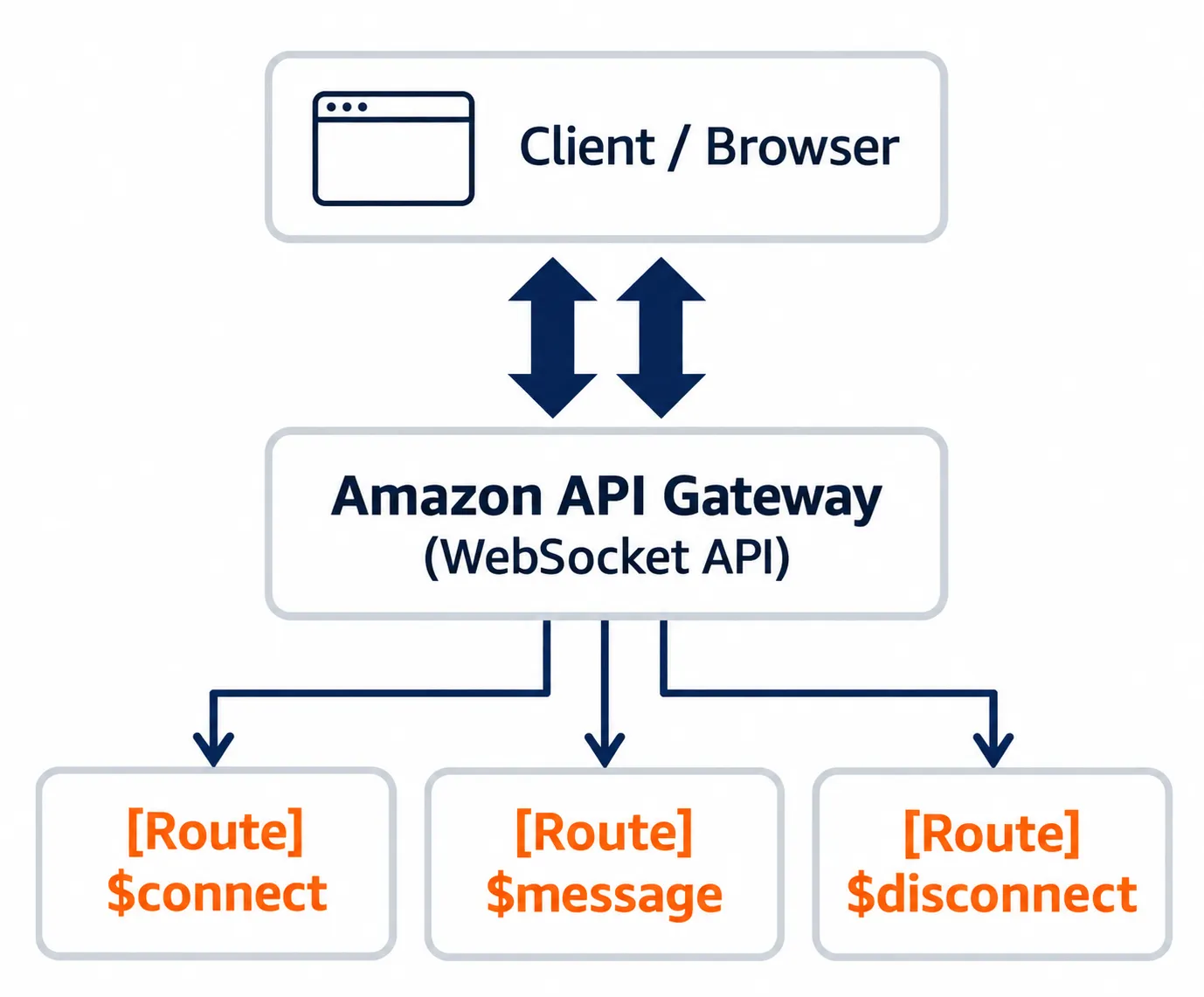
Native WebSocket API Routes
API Gateway manages the connection lifecycle through predefined system routes:
$connect: Triggered when the client establishes the initial TCP handshake. This route is ideal for authenticating the client (via query parameters or authorization headers) and recording session identifiers.$disconnect: Automatically fired when either the client or server terminates the socket, or upon an abnormal network drop.$message(or custom routes): Routes incoming data frames sent by the client to designated backend targets, such as AWS Lambda functions.
This topology eliminates the overhead of continuous client-side polling and empowers the backend to push Bedrock-generated tokens the instant they are decoded.
Server-Sent Events (SSE) and Chunked Transfer Encoding
Not every streaming use case demands simultaneous bidirectional communication. When a client only needs to issue a single prompt and receive a continuous incoming data stream, Server-Sent Events (SSE) provide an efficient, lightweight mechanism.
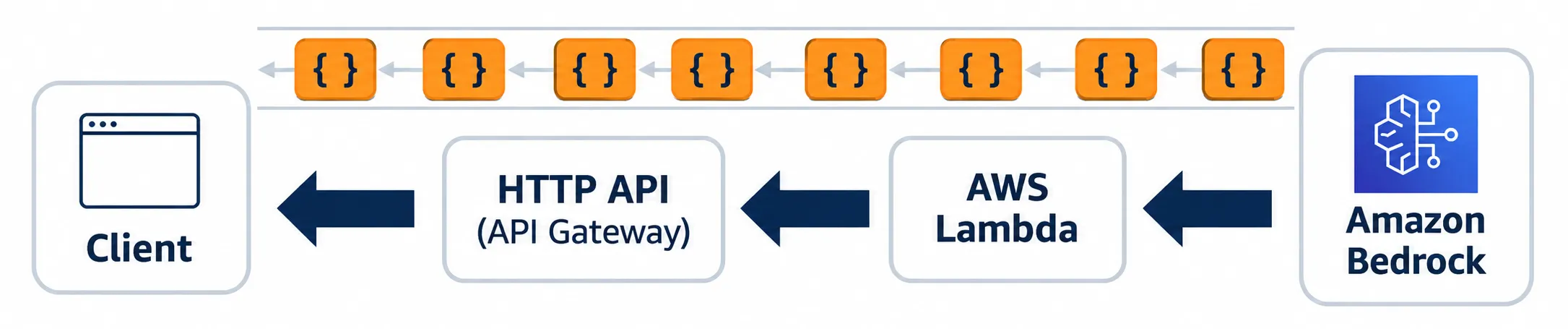
- Lambda Response Streaming: AWS Lambda natively supports response streaming (
responseStream), bypassing the conventional 6 MB synchronous payload limit and allowing payload sizes up to 20 MB. - Chunked Transfer Encoding: Operates over standard HTTP/1.1 or HTTP/2 using the
Transfer-Encoding: chunkedheader, breaking payloads into delimited segments without requiring the upstream server to calculate aContent-Lengthheader in advance. - Unidirectional Data Flow: Data travels strictly from server to client. Once the initial HTTP request is established, the connection functions as a read-only stream from the perspective of the client.
- Operational Simplicity: Eliminates the need for connection state tables (such as DynamoDB connection registries) required by WebSockets.
Serverless State Management with Amazon DynamoDB
Unlike traditional servers that maintain long-lived stateful processes in memory, AWS Lambda functions are ephemeral and stateless. API Gateway terminates and manages the underlying TCP socket connection. However, for a Lambda function to push streamed data frames back to the client outside of the original invocation lifecycle, it must target the client logical endpoint: the
connectionId.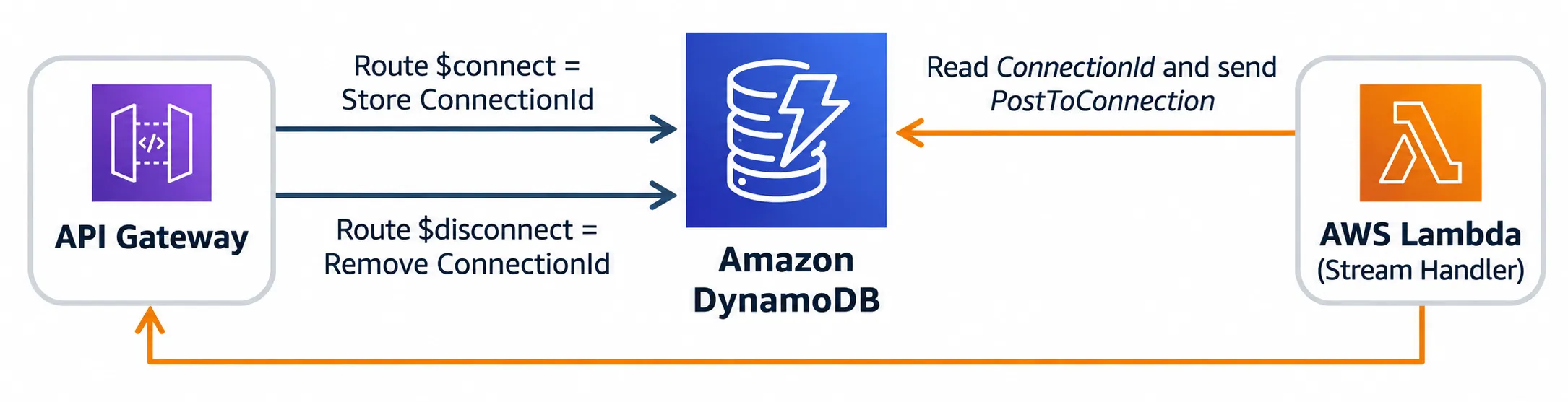
The end-to-end orchestration follows a four-step lifecycle:
- Connection Registration: On the
$connectroute, API Gateway generates a uniqueconnectionIdand triggers a Lambda authorizer/registration function, which persists this identifier in Amazon DynamoDB. - Asynchronous Invocations: When a prompt arrives on the
$messageroute, the orchestrator function retrieves the activeconnectionIdfrom DynamoDB and invokes the Bedrock streaming API. - SDK Push Delivery: As incremental chunks arrive from Bedrock, the Lambda function invokes the API Gateway
@connectionsendpoint (PostToConnection) via the AWS SDK (ApiGatewayManagementApi), pushing individual frames directly down the active socket. - Disconnection and Teardown: On the
$disconnectroute, the correspondingconnectionIdis purged from the DynamoDB table.
💡 Exam Tip #2: To prevent orphaned records in Amazon DynamoDB caused by abnormal network drops where the
$disconnect route fails to fire cleanly, always configure DynamoDB Time-To-Live (TTL) on session records for automatic cleanup. If an AIP-C01 exam scenario involves a GraphQL-centric ecosystem, remember that the standard AWS managed solution for native real-time streaming without manual DynamoDB connection tracking is AWS AppSync with Subscriptions.Resilience and Mid-Stream Error Handling
With standard synchronous HTTP requests, an inference failure produces a distinct HTTP 4xx or 5xx status code during the initial handshake. Streaming introduces a fundamentally different operational challenge: the HTTP connection is established successfully with status 200, the initial tokens render on screen, and generation fails abruptly mid-stream.

The ModelStreamErrorException Phenomenon
The
ModelStreamErrorException exception surfaces after the stream has already started emitting data frames. Common triggers include runtime quota exhaustion mid-generation, internal model decoding timeouts, or socket connection resets.- No Partial Retries: Amazon Bedrock does not support resuming an interrupted stream from the last generated token. The model runtime does not expose an intermediate decoding cursor to the client.
- Reconnection Strategy: The client application must handle stream breaks gracefully by initiating a new generation request containing the updated conversational history or by presenting a user-facing retry option.
- Static Fallback and Routing: The backend orchestration layer can intercept
ModelStreamErrorExceptionto push a pre-configured contingency message or dynamically route the remaining context to a secondary, more resilient foundation model.
Real-Time Bedrock Guardrails
Applying ethical boundaries, content moderation, and sensitive data protections (Responsible AI) must not compromise response fluidity. Amazon Bedrock Guardrails integrates natively and operates in parallel with response streams.

Bidirectional Security Processing
- Input Prompt Filters: Evaluated synchronously as a blocking gate before prompt delivery to the FM. If the prompt contains prompt injection attempts, jailbreaks, or prohibited topics, execution halts immediately without consuming inference compute.
- Output Stream Filters: As the model decodes tokens, output filters evaluate text blocks asynchronously in real time.
- Automated Intervention (
guardrailIntervened): If the foundation model outputs text violating configured PII masking rules, hate speech thresholds, or denied topic policies, Bedrock immediately aborts the active stream, replaces or masks violating content with a predefined response, and flags theguardrailIntervenedevent. - Impact on TTFT: Security filtering operates in an optimized pipeline that introduces negligible overhead to the Time-to-First-Token latency.
End-to-End Architecture and Decision Matrix
The complete integration topology connecting front-end clients, API Gateway edge services, Lambda orchestration, and Bedrock foundation models is illustrated below:

The diagram outlines the serverless streaming request lifecycle:
- The client establishes a WebSocket connection via
$connect. The uniqueConnectionIdis stored in Amazon DynamoDB alongside a TTL attribute for automated expiration. - The user submits a prompt, triggering an API Gateway custom application route that delegates execution to AWS Lambda.
- The Lambda function queries DynamoDB for the session endpoint and invokes
ConverseStreamon Amazon Bedrock. - As Bedrock emits incremental text chunks, the Lambda handler consumes each event and invokes
PostToConnectionon API Gateway, which pushes the frames directly down the active WebSocket connection to the client UI.
Protocol Decision Matrix
| Protocol | Data Direction | Underlying Connection | Network Overhead | State Management | Primary GenAI Use Case |
|---|---|---|---|---|---|
| Amazon API Gateway WebSocket APIs | Bidirectional (Full Duplex) | Persistent TCP | Extremely Low | Requires connection table (e.g., DynamoDB) | Interactive, multi-turn conversational chat interfaces |
| SSE via AWS Lambda Response Streaming | Unidirectional (Server-to-Client) | Long-lived HTTP/1.1 or HTTP/2 Chunked | Very Low | Stateless at the network connection layer | Long-form text generation, real-time logging, and notification feeds |
| REST API Polling | Simulated Unidirectional | Repeated discrete HTTP requests | Extremely High (Highly inefficient) | Stateless | Legacy environments constrained by strict egress proxy firewalls (anti-pattern) |
AIP-C01 Practice Exam Questions
Question 1
A financial technology enterprise built an interactive investment analysis assistant using Amazon Bedrock. The web interface communicates with a REST API hosted on Amazon API Gateway, integrated synchronously with an AWS Lambda function running
InvokeModel. When users request comprehensive financial analyses, the foundation model takes approximately 35 seconds to generate the full report, causing API Gateway to respond with an HTTP 504 Gateway Timeout error.Which architectural refactoring eliminates the timeout error with the lowest network overhead while ensuring users receive analysis output in real time?
A) Increase the Amazon API Gateway REST API integration timeout from 29 seconds to 60 seconds in the AWS Management Console.
B) Place an Amazon SQS queue in front of the Lambda function to buffer incoming requests, having the client poll the queue synchronously for the result.
C) Migrate the endpoint to an Amazon API Gateway WebSocket API, record the
connectionId in Amazon DynamoDB, invoke Amazon Bedrock using InvokeModelWithResponseStream or ConverseStream, and stream incremental chunks using the @connections API.D) Replace the foundation model with a smaller model in the Bedrock Playground and configure Provisioned Concurrency on the Lambda function.
Question 2
A Generative AI Developer is building a customer support platform integrated with multiple foundation models in Amazon Bedrock (Meta Llama and Amazon Nova) and requires streaming token responses. The development team wants to switch between models dynamically without refactoring backend code to handle model-specific request and response payload schemas.
Which Bedrock Runtime API satisfies this standardization requirement?
A)
InvokeModelWithResponseStreamB)
ConverseStreamC)
StartAsyncInvokeD)
BedrockAgentRuntimeStreamQuestion 3
A real-time code generation assistant is deployed using Amazon API Gateway WebSocket APIs and AWS Lambda. During peak load, client applications begin receiving generated code tokens progressively, but transmission abruptly halts mid-stream, and the Lambda function logs a
ModelStreamErrorException.What is the fundamental characteristic of this failure, and what is the AWS-recommended remediation?
A) Bedrock supports automated mid-stream retries from the last decoded token; the Lambda function must re-request the stream using the last byte offset.
B) The error occurs strictly prior to the HTTP handshake; the client must reconnect using an alternative TCP port.
C) The error occurs after an initial HTTP 200 connection has already been established; because Bedrock does not support partial stream resumption from the point of failure, the application must initiate a new generation request or invoke a fallback model.
D) The exception indicates that DynamoDB capacity limits were exceeded; the developer must increase Read Capacity Units (RCUs) on the session table.
Question 4
An enterprise is designing a mobile application that renders summaries of long-form articles generated by Amazon Bedrock. The system only requires the server to stream generated text to the mobile client as it becomes available; the mobile app does not need to send additional data back over the same connection. The development team wants to minimize operational complexity and avoid managing connection state tables in DynamoDB.
Which architectural solution meets these requirements with the lowest operational overhead?
A) Implement an Amazon API Gateway WebSocket API utilizing
$connect and $disconnect routes.B) Implement Server-Sent Events (SSE) using AWS Lambda Response Streaming with Chunked Transfer Encoding.
C) Provision an Amazon SQS FIFO queue and configure the mobile application to execute long-polling requests every 500 ms.
D) Deploy self-managed WebSockets on Amazon EC2 instances behind a Classic Load Balancer.
Question 5
A cloud security architect requires that an externally facing conversational chatbot utilize Amazon Bedrock Guardrails to prevent PII leakage and block sensitive topics during streaming responses. The team is concerned that Guardrails will introduce unacceptable latency to the Time-to-First-Token (TTFT).
How does Amazon Bedrock Guardrails operate during streaming API calls?
A) Guardrails blocks the entire response stream until the complete text generation finishes and is evaluated in a sandboxed batch environment.
B) Input filters evaluate the prompt prior to generation, while output filters evaluate streaming text blocks asynchronously in real time; if a violation occurs, transmission terminates immediately with a
guardrailIntervened event.C) Guardrails does not support streaming calls; it can only be applied to synchronous blocking invocations using
InvokeModel.D) Bedrock requires developers to manually implement output moderation in an intermediate Lambda function using regular expressions.
Detailed Answer Key and Explanations
Question 1 Answer Key
- Correct Answer: C
- Explanation: Amazon API Gateway REST and HTTP APIs enforce an unalterable hard limit of 29 seconds on integration timeouts. Migrating to WebSocket APIs combined with streaming APIs (
ConverseStreamorInvokeModelWithResponseStream) bypasses this constraint by establishing a long-lived TCP connection and pushing data chunks as they are generated by Bedrock. - Why Other Options Are Incorrect:
- A: The 29-second integration timeout in API Gateway REST APIs is a non-adjustable quota.
- B: SQS polling introduces substantial latency, degrades real-time responsiveness, and increases unnecessary API call volume.
- D: Changing models or adding Provisioned Concurrency does not eliminate the hard 29-second ceiling if deep analytical generations exceed 29 seconds.
Question 2 Answer Key
- Correct Answer: B
- Explanation: The
ConverseStreamAPI provides a unified, cross-model interface (Messages API) that normalizes input and output schemas across all supported foundation models on Bedrock. - Why Other Options Are Incorrect:
- A:
InvokeModelWithResponseStreamrequires code to conform to each model provider's proprietary JSON schema. - C:
StartAsyncInvokeis designed for asynchronous batch inference using Amazon S3 storage, not interactive real-time applications. - D:
BedrockAgentRuntimeStreamis not a standard cross-model conversational Bedrock Runtime API.
- A:
Question 3 Answer Key
- Correct Answer: C
- Explanation:
ModelStreamErrorExceptionis raised after the initial HTTP 200 handshake succeeds and data delivery is already underway. Because Amazon Bedrock does not persist intermediate decoding cursors for resumed streaming, the system must either restart the request or trigger a fallback mechanism. - Why Other Options Are Incorrect:
- A: Amazon Bedrock does not support partial resumption or offset-based reconnection mid-stream.
- B: The exception explicitly manifests mid-stream during active data transmission, well after the handshake.
- D: This exception originates from the Bedrock Runtime inference service, not from DynamoDB capacity limits.
Question 4 Answer Key
- Correct Answer: B
- Explanation: For unidirectional server-to-client streaming where managing connection state in DynamoDB is unnecessary, Server-Sent Events (SSE) powered by AWS Lambda Response Streaming provides the cleanest and most cost-effective serverless architecture.
- Why Other Options Are Incorrect:
- A: WebSockets add operational overhead by requiring connection state tracking across
$connectand$disconnectroutes. - C: SQS polling introduces unnecessary latency and excessive polling requests.
- D: Self-managed EC2 instances introduce operational management overhead and break serverless principles.
- A: WebSockets add operational overhead by requiring connection state tracking across
Question 5 Answer Key
- Correct Answer: B
- Explanation: Amazon Bedrock Guardrails evaluates input prompts prior to model invocation and streams output tokens through real-time asynchronous evaluation. If prohibited content or PII is detected mid-stream, Bedrock halts the stream and raises
guardrailIntervened, preserving low TTFT without buffering the full response. - Why Other Options Are Incorrect:
- A: Buffering the full response would defeat the latency benefits of streaming.
- C: Guardrails natively supports
InvokeModelWithResponseStreamandConverseStream. - D: Bedrock Guardrails provides fully managed, automated scanning without requiring custom Lambda regex functions.
AIP-C01 Exam Preparation Checklist
- TTFT and User Experience: If an exam question highlights reducing perceived user latency or delivering "typewriter-style character feedback," choose
InvokeModelWithResponseStreamorConverseStream. - Bidirectional Streaming vs. Polling: To replace polling with low-overhead real-time delivery in serverless environments, choose Amazon API Gateway WebSocket APIs.
- Stateless Connection Management: Because AWS Lambda functions are stateless, coupling Lambda with API Gateway WebSocket APIs requires Amazon DynamoDB to track
connectionIdvalues. Always enable DynamoDB TTL to clean up stale records. - AppSync and GraphQL Scenarios: In architectures utilizing GraphQL, choose AWS AppSync with Subscriptions for real-time managed streaming without manual DynamoDB state tracking.
- Handling Mid-Stream Failures: Remember that Bedrock does not support partial retries for
ModelStreamErrorException. Applications must trigger a complete retry or initiate a fallback route.
Conclusion
Architecting enterprise-grade Generative AI solutions on AWS extends far beyond selecting a high-performing foundation model; it requires edge transport layers capable of delivering tokens with sub-second responsiveness.
Response streaming is a foundational architectural pattern. It dramatically reduces Time-to-First-Token (TTFT), bypasses the rigid 29-second API Gateway integration timeout, and prevents connection starvation. Combining Amazon API Gateway WebSocket APIs, AWS Lambda, and Amazon DynamoDB establishes the standard serverless reference architecture for bidirectional conversational workloads.
By mastering the differences between
InvokeModelWithResponseStream and ConverseStream, understanding zero-latency-penalty Guardrails enforcement, and handling mid-stream exceptions like ModelStreamErrorException, you are fully prepared to build high-performance streaming applications and achieve top marks on the AWS Certified Generative AI Developer Professional (AIP-C01) exam.Series: AIP-C01 | Task 2.4: Implement FM API integrations (2 articles)
- 2Real-Time Interaction, Response Streaming, and WebSockets in Amazon Bedrock This article
Enjoyed reading this content? Let the author know!
Your likes, comments, shares, and saves help creators reach more builders.

Loading recommendations
Loading article