
Architecting Amazon Bedrock Invocations: From Synchronous to Asynchronous at Enterprise Scale
Learn how to address the 29s Amazon API Gateway timeout using streaming, eliminate throttling (HTTP 429) using Amazon SQS and Amazon EventBridge, bypass 256 KB message limits with the Claim Check pattern in Amazon S3, optimize latency using SDK connection pooling, and implement fail-fast edge validation with JSON Schema.
Series: AIP-C01 | Task 2.4: Implement FM API integrations (2 articles)
- 1Architecting Amazon Bedrock Invocations: From Synchronous to Asynchronous at Enterprise Scale This article

AWS Certified Generative AI Developer - Professional - Exam Guide (AIP-C01)
Content Domain 2: Implementation and Integration
Task 2.4: Implement FM API integrations.
Skill 2.4.1: Create flexible model interaction systems (for example, by using Amazon Bedrock APIs to manage synchronous requests from various compute environments, language-specific AWS SDKs and Amazon SQS for asynchronous processing, API Gateway to provide custom API clients with request validation).
Article Overview
- What you will learn: How to translate business requirements and latency constraints into resilient AWS architectures for the AIP-C01 exam; choose decisively between synchronous and asynchronous invocations; bypass hard timeout limits (29 seconds for Amazon API Gateway and 15 minutes for AWS Lambda) using streaming (
InvokeModelWithResponseStream); decouple inference workloads subject to burst traffic using Amazon SQS and Amazon EventBridge to eliminate throttling (HTTP 429); implement the Claim Check architectural pattern with Amazon S3 to overcome the 256 KB message ceiling; optimize persistent network connections through Connection Pooling in native SDKs; and apply fail-fast preventive filtering at the edge using JSON Schema.
Introduction: The Production Integration Challenge
Transitioning Generative AI (GenAI) workloads from experimental prototypes into enterprise production environments introduces traffic patterns fundamentally distinct from classical web systems. In traditional microservices, communication relies on deterministic input/output operations where response latencies rarely exceed a few hundred milliseconds. Conversely, invoking Foundation Models (FMs) on Amazon Bedrock involves compute-heavy, autoregressive workloads where latency scales directly with the volume of processed input tokens (prefill) and generated output tokens (decoding).
This operational reality poses a significant architectural challenge to the integration tier. Under sustained load, unmanaged synchronous invocations can exhaust API gateway connection pools, exceed Requests Per Minute (RPM) and Tokens Per Minute (TPM) service quotas, and trigger cascading downstream failures accompanied by escalating compute costs. Building scalable, performant, and cost-optimized systems requires choosing the correct communication pattern, safeguarding serverless infrastructure limits, and designing resilient client wrappers.

High-level overview of synchronous and asynchronous integration paths for Amazon Bedrock
Modern cloud architecture offers two primary paradigms for integrating clients with Amazon Bedrock foundation models: the direct synchronous path (where client applications actively block while awaiting model inference) and the decoupled, event-driven asynchronous path (where inference requests are buffered through resilient queues). Understanding the mechanical trade-offs and technical limits of each approach is foundational for production deployments and the AIP-C01 exam.
Invocation Patterns: Synchronous vs. Asynchronous
The decision between blocking and decoupled communication dictates upstream topology, communication protocols, compute sizing, and persistence layers.

Operational characteristics, target use cases, and core APIs for synchronous and asynchronous Bedrock invocations.
Synchronous Invocation (Blocking)
In a synchronous invocation pattern, the client issues an HTTP request and blocks local thread execution, keeping the transport connection open until Amazon Bedrock completes inference and returns the payload.
- Native APIs:
InvokeModeland the unifiedConverseAPI. - Primary Use Cases: Interactive conversational bots, real-time customer support agents, coding copilot engines, and web interfaces where immediate output is required for end-user interaction.
- Critical Challenge: High sensitivity to transport latency, upstream reverse proxy thresholds, and load balancer timeouts.
Asynchronous Invocation (Non-Blocking)
Asynchronous invocation applies an enterprise fire-and-forget pattern. The calling application submits the inference payload to an intermediate managed service, receives an immediate acknowledgement (such as an ingestion receipt or job token), and terminates the client connection without retaining open sockets.
- Native APIs & Core Services:
StartAsyncInvoke, Amazon SQS message queues, and Amazon EventBridge event buses. - Primary Use Cases: Large-scale document batch summarization, scheduled business reporting, offline regulatory compliance reviews, and asynchronous multi-language translation pipelines.
- Critical Challenge: Demands an Event-Driven Architecture (EDA) to orchestrate intermediate state, manage downstream concurrency, and deliver processed results to target consumers.
Anatomy of Timeout Limits and Streaming Strategies
Integrating Amazon API Gateway, AWS Lambda, and Amazon Bedrock in a synchronous chain introduces strict, non-negotiable service quotas.

Synchronous integration chain highlighting the 29-second API Gateway integration timeout and the 15-minute Lambda execution limit.
Hard Limits in the Synchronous Chain
- Amazon API Gateway: Enforces an immutable hard integration timeout of 29 seconds across both REST APIs and HTTP APIs. If a foundation model takes 30 seconds to synthesize a detailed response over an extensive Retrieval-Augmented Generation (RAG) context, API Gateway drops the upstream connection and issues an
HTTP 504 Gateway Timeoutto the client, even if the backend Lambda function continues running. - AWS Lambda / Amazon ECS: AWS Lambda enforces a 15-minute maximum execution timeout per invocation. While sufficient for short tasks, keeping Lambda workers idle while waiting on long model inferences incurs unneeded compute costs ($GB \cdot s$) and drains regional function concurrency pools.
Latency Mitigation via Streaming: InvokeModelWithResponseStream
For interactive use cases where end users expect immediate output, AWS provides streaming endpoints:
InvokeModelWithResponseStream and ConverseStream.Instead of buffering every output token in server memory prior to returning a single monolithic response, Amazon Bedrock relies on HTTP Chunked Transfer Encoding. The underlying model computes the input prompt (prefill) and flushes output token fragments (chunks) as they are generated (decoding).

Sequence flow of a real-time streaming invocation using InvokeModelWithResponseStream, demonstrating reduction in Time to First Token (TTFT).
1
2
3
4
5
6
7
8
9
10
11
12
13
14
15
16
17
18
19
20
sequenceDiagram
    autonumber
    actor Client as User / Web Application
    participant APIGW as Amazon API Gateway (WebSocket / SSE)
    participant Lambda as AWS Lambda (Streaming Handler)
    participant Bedrock as Amazon Bedrock (FM)

    Client->>APIGW: Send Input Prompt
    APIGW->>Lambda: Trigger Invocation
    Lambda->>Bedrock: Invoke InvokeModelWithResponseStream
    Note over Bedrock: Prompt Prefill Phase
    Bedrock-->>Lambda: Stream Chunk 1 (First Generated Token)
    Lambda-->>APIGW: Forward Chunk 1
    APIGW-->>Client: Render Instantly (TTFT Reduction)
    Bedrock-->>Lambda: Stream Subsequent Chunks (Tokens 2..N)
    Lambda-->>APIGW: Continuous Token Forwarding
    APIGW-->>Client: Real-Time Typewriter Rendering
    Bedrock-->>Lambda: Stream Complete (Stop Event)
    Lambda-->>APIGW: Close Stream Connection
    APIGW-->>Client: Final Response Complete
By emitting
Chunk 1 immediately, the architecture establishes persistent network activity, lowers the perceived Time to First Token (TTFT), and avoids idle transport disconnects across intermediate proxies.💡 Exam Tip #1: When an exam question describes users complaining that a web chatbot interface freezes for 10 to 15 seconds before displaying full answers, avoid options suggesting increasing Lambda memory or upsizing Amazon ECS tasks. The recommended AWS design pattern to solve perceived client-side latency is implementing
InvokeModelWithResponseStream or ConverseStream to stream tokens progressively.Decoupling and Traffic Burst Absorption with SQS and EventBridge
When Generative AI applications experience sudden spikes in traffic, synchronous pipelines often fail because regional Bedrock service quotas are quickly exhausted, returning frequent
HTTP 429 Too Many Requests (ThrottlingException) errors.
Decoupled asynchronous architecture using Amazon SQS for burst absorption and Amazon EventBridge for event-driven result routing.
Amazon SQS as a Resilient Rate Leveler
Placing Amazon SQS directly downstream of API Gateway provides immediate durability. The ingestion layer pushes requests into an SQS queue in milliseconds, returning an
HTTP 202 Accepted response with a tracking identifier back to the client. The queue functions as an elastic buffer, holding requests safely without saturating downstream inference limits.Regulated Processing via Lambda Event Source Mapping (ESM)
Workers consume queue messages via AWS Lambda Event Source Mapping (ESM). Architects can configure two vital parameters:
- Batch Size and Maximum Batching Window: Dictates how many records Lambda groups into a single invocation payload.
- Maximum Concurrency: Sets a hard boundary on the number of concurrent Lambda workers instantiated by the SQS event source. This throttle ensures that aggregated calls dispatched to Bedrock remain strictly within the account's provisioned RPM and TPM quotas.
Decoupled Fan-Out with Amazon EventBridge
Once inference completes, the Lambda worker does not need to connect directly to each downstream sink. Instead, it emits an event containing the result payload onto an Amazon EventBridge custom bus. Using declarative rules (Event Patterns), EventBridge fans out the output to respective targets:
- Archiving conversation turns in Amazon DynamoDB.
- Pushing push notifications or email alerts via Amazon SNS or Amazon SES.
- Indexing generated vectors into Amazon OpenSearch Service.
- Advancing long-running workflows managed by AWS Step Functions.
This decoupling prevents cascading microservice failures and eliminates uncoordinated retry storms.
💡 Exam Tip #2: For non-blocking, burst-heavy workloads where models take substantial time to process large bodies of text, the standard AWS architectural blueprint to bypass the 29-second API Gateway timeout and prevent Bedrock
HTTP 429 throttling consists of an Amazon SQS buffer feeding AWS Lambda with Maximum Concurrency limits configured via Event Source Mapping.Payload Optimization with the Claim Check Pattern
While Amazon SQS, Amazon SNS, and AWS Step Functions are essential building blocks for decoupling, each enforces an immutable constraint: a maximum payload size of 256 KB.
In Generative AI pipelines, contextual prompts frequently include multi-page financial statements, extensive legal agreements, or raw audio transcripts. These payloads easily exceed 256 KB.

Implementation of the Claim Check pattern to manage large payloads in message-driven GenAI pipelines.
Claim Check Execution Workflow
To reliably process payloads larger than 256 KB without data truncation:
- Payload Offloading to Amazon S3: The client or ingestion proxy writes the complete, raw document directly to an encrypted private Amazon S3 bucket.
- Claim Check Generation: The application generates a lightweight reference pointer containing document coordinates (e.g.,
{"bucket": "corp-genai-inputs", "key": "docs/contract_analysis_982.pdf", "size_bytes": 15728640}). - Queue Ingestion: The lightweight reference is submitted to the SQS queue. Because it occupies only a few bytes, it remains far below the 256 KB message cap.
- Worker Retrieval: The downstream Lambda worker consumes the message, reads the S3 URI, retrieves the source file into local ephemeral storage (
/tmp), parses the content, and invokes Amazon Bedrock.
Separating control plane metadata (queue tickets) from data plane payloads (raw objects in Amazon S3) maintains system throughput, prevents payload rejection, and reduces transport costs.
Custom Client Engineering: Edge Validation and Connection Pooling
The stability of an enterprise Generative AI solution depends directly on how client wrappers interact with managed Amazon Bedrock endpoints.

Edge request validation with JSON Schema on API Gateway to preserve backend compute and Bedrock token quotas.
Fail-Fast Validation at the Edge with JSON Schema
Requests containing missing fields, incorrect types, or malformed payloads should never consume compute resources. Configuring native Request Validation using JSON Schema on Amazon API Gateway ensures:
- Malformed requests are rejected at the edge with an
HTTP 400 Bad Request. - Downstream AWS Lambda functions are never invoked for invalid calls, reducing compute costs to zero.
- Account-level Bedrock RPM and TPM limits remain protected from misbehaving clients or bot traffic.

Core capabilities abstracted by official AWS SDKs when interacting with Amazon Bedrock.
Official AWS SDKs (such as Boto3 in Python, AWS SDK for TypeScript/JavaScript, Java, and Go) natively abstract:
- Request signing and integrity checks using AWS Signature Version 4 (SigV4).
- Serialization and deserialization of provider-specific JSON models.
- Standardized exponential backoff and jitter algorithms.

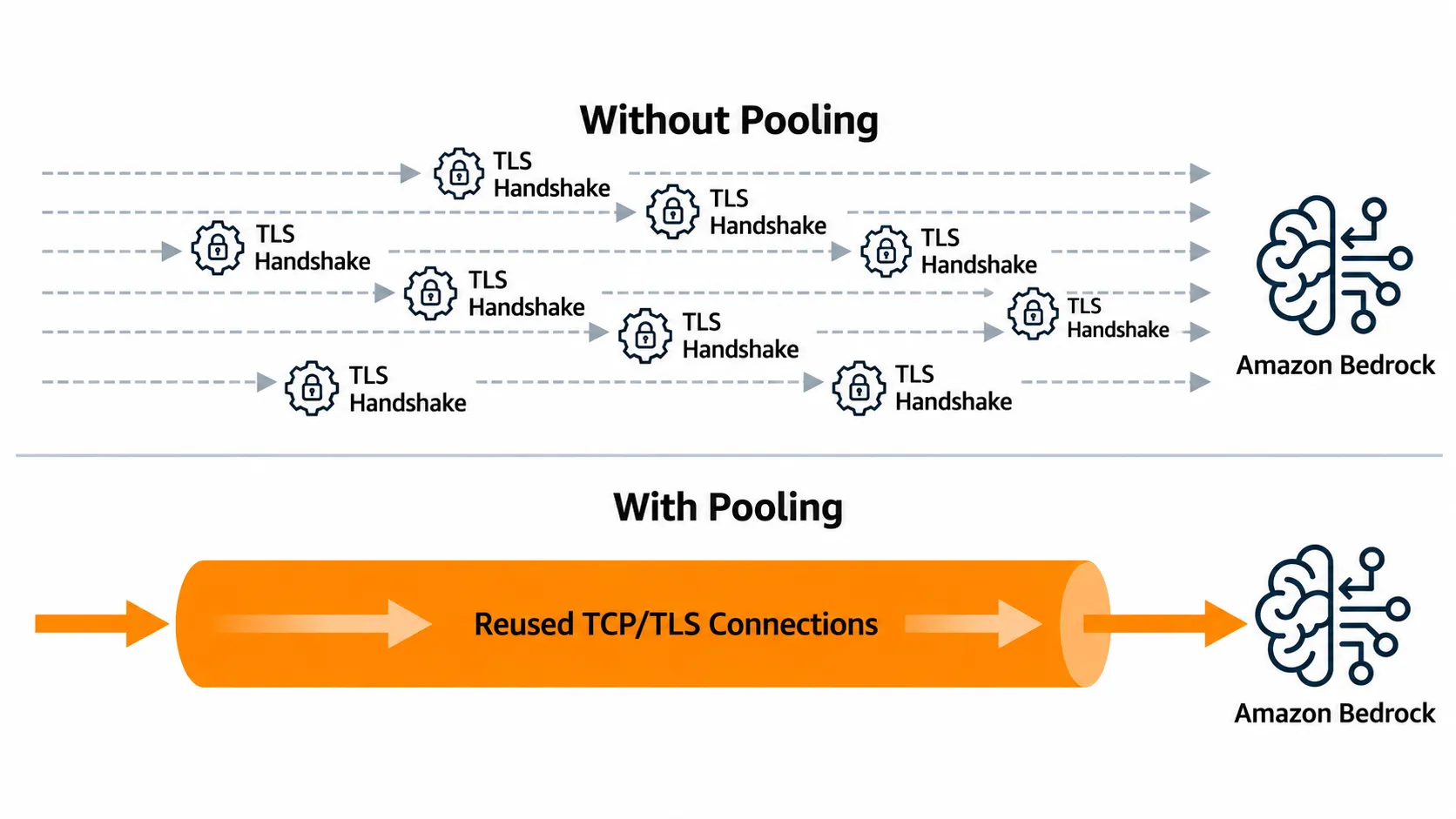
Reusing persistent TCP/TLS sockets across Lambda warm executions using SDK connection pooling.
Minimizing Network Overhead with Connection Pooling
Every isolated HTTPS connection to Amazon Bedrock endpoints incurs network overhead from TCP three-way handshakes and TLS cryptographic negotiations. In concurrent serverless or containerized environments (such as sustained AWS Lambda workloads or Amazon ECS tasks), establishing fresh TLS sessions for every single invocation introduces hundreds of milliseconds of unnecessary transport latency.
AWS recommends configuring persistent Connection Pooling within the underlying SDK HTTP client. In Python (Boto3), instantiate the client outside the Lambda function handler within the global execution scope, customizing the pool using
botocore.config.Config:1
2
3
4
5
6
7
8
9
10
11
12
13
14
15
16
17
18
19
20
21
22
import boto3
from botocore.config import Config
# Configure persistent HTTP connection pooling and standardized retries
client_config = Config(
max_pool_connections=50,
retries={
'max_attempts': 5,
'mode': 'standard' # Applies native Exponential Backoff with Jitter
}
)
# Global initialization: persistent sockets are shared across warm Lambda executions
bedrock_runtime = boto3.client(
service_name='bedrock-runtime',
region_name='us-east-1',
config=client_config
)
def lambda_handler(event, context):
# The handler reuses the open TCP/TLS connection pool
pass
This pattern cuts connection negotiation latency and prevents local ephemeral socket exhaustion during concurrency bursts.
Monitoring, Error Handling, and Operational Resilience
Production architectures must clearly distinguish deterministic client-side exceptions from transient, capacity-related server errors.

Fault-handling logic isolating deterministic failures from transient rate-limit errors.
Handling Bedrock API Exceptions
- ValidationException (HTTP 400):
- Root Cause: The request payload violates structural or semantic requirements (e.g., missing parameters, invalid inference arguments, or an inaccessible model ID).
- Remediation Strategy: Do not retry. Because this is a deterministic error, resubmitting the identical payload will repeatedly fail. The application must trap the error, log the payload to Amazon CloudWatch Logs for debugging, and return an actionable client error.
- ThrottlingException (HTTP 429):
- Root Cause: Invocation traffic has exceeded regional RPM or TPM limits for the selected model.
- Remediation Strategy: Retry using Exponential Backoff with Jitter. Jitter introduces randomized delays that prevent synchronized client retries (the thundering herd problem). If throttling persists, incorporate SQS buffers, cross-region inference endpoints, or Provisioned Throughput.
- SerializationException:
- Root Cause: Data conversion errors between application object models and the JSON format expected by the foundation model.
- Remediation Strategy: Validate payloads against strict local schemas prior to SDK dispatch, backed by integration tests.
💡 Exam Tip #3: Exam questions on resilience test your ability to differentiate recoverable from non-recoverable errors. Watch out for distractor options suggesting automated retry loops (such as while loops) around
ValidationException (HTTP 400). Deterministic errors should never be retried. Automatic retries with exponential backoff and jitter are strictly reserved for transient capacity errors like ThrottlingException (HTTP 429) or internal service issues (HTTP 5xx).Complete Architecture Blueprint: Flexible Interaction Systems
Combining these patterns yields an enterprise-grade architectural blueprint for resilient, flexible Amazon Bedrock integrations:

End-to-end reference architecture uniting edge validation, SQS buffering, Claim Check storage, and EventBridge fan-out.
Figure 12: Architectural dataflow diagram detailing end-to-end component decoupling and execution flow.
Summary: Foundation Model Communication Patterns
| Pattern / Strategy | Primary AWS Services | Operational Benefits | Trade-offs and Constraints |
|---|---|---|---|
| Synchronous (Request/Response) | • Amazon API Gateway• AWS Lambda• Amazon Bedrock | Direct, real-time responses suited for interactive chat and live dashboards. | Bound by the rigid 29-second API Gateway timeout; susceptible to concurrency exhaustion under sudden traffic spikes. |
| Synchronous via Streaming | • Amazon API Gateway (WebSocket / SSE)• AWS Lambda• Amazon Bedrock (InvokeModelWithResponseStream / ConverseStream) | Drastically lowers perceived Time to First Token (TTFT); maintains active connections to avoid timeout disconnects. | Requires client-side support for chunked transfer encoding or persistent WebSocket sessions. |
| Asynchronous Decoupled | • Amazon SQS• AWS Lambda• Amazon EventBridge• Amazon Bedrock | Absorbs unexpected bursts of traffic; enforces concurrency boundaries to prevent HTTP 429 throttling. | Introduces eventual consistency; unsuitable for low-latency conversational interfaces. |
| Edge Validation (Fail-Fast) | • Amazon API Gateway (JSON Schema Request Validation) | Safeguards upstream RPM/TPM quotas and prevents compute spend from malformed or malicious inputs. | Requires upfront definition, versioning, and continuous schema maintenance at the gateway layer. |
| Large Payload Offloading | • Amazon S3 (Claim Check Pattern)• Amazon SQS• AWS Lambda | Overcomes the hard 256 KB message ceiling enforced by Amazon SQS and AWS Step Functions. | Introduces object storage read/write latency prior to payload handoff to the foundation model. |
| Connection Pooling | • AWS SDK (Boto3, Node.js SDK)• AWS Lambda• Amazon ECS | Reduces latency across concurrent calls by eliminating redundant TCP and TLS handshakes. | Demands proper client instantiation within the global execution scope outside the function handler. |
Synchronous (Request/Response)
- Primary AWS Services: Amazon API Gateway, AWS Lambda, Amazon Bedrock
- Operational Benefits: Direct, real-time responses suited for interactive chat and live dashboards.
- Trade-offs and Constraints: Bound by the rigid 29-second API Gateway timeout; susceptible to concurrency exhaustion under sudden traffic spikes.
Synchronous via Streaming
- Primary AWS Services: Amazon API Gateway (WebSocket / SSE), AWS Lambda, Amazon Bedrock (
InvokeModelWithResponseStream/ConverseStream) - Operational Benefits: Drastically lowers perceived Time to First Token (TTFT); maintains active connections to avoid timeout disconnects.
- Trade-offs and Constraints: Requires client-side support for chunked transfer encoding or persistent WebSocket sessions.
Asynchronous Decoupled
- Primary AWS Services: Amazon SQS, AWS Lambda, Amazon EventBridge, Amazon Bedrock
- Operational Benefits: Absorbs unexpected bursts of traffic; enforces concurrency boundaries to prevent
HTTP 429throttling. - Trade-offs and Constraints: Introduces eventual consistency; unsuitable for low-latency conversational interfaces.
Edge Validation (Fail-Fast)
- Primary AWS Services: Amazon API Gateway (JSON Schema Request Validation)
- Operational Benefits: Safeguards upstream RPM/TPM quotas and prevents compute spend from malformed or malicious inputs.
- Trade-offs and Constraints: Requires upfront definition, versioning, and continuous schema maintenance at the gateway layer.
Large Payload Offloading
- Primary AWS Services: Amazon S3 (Claim Check Pattern), Amazon SQS, AWS Lambda
- Operational Benefits: Overcomes the hard 256 KB message ceiling enforced by Amazon SQS and AWS Step Functions.
- Trade-offs and Constraints: Introduces object storage read/write latency prior to payload handoff to the foundation model.
Connection Pooling
- Primary AWS Services: AWS SDK (Boto3, Node.js SDK), AWS Lambda, Amazon ECS
- Operational Benefits: Reduces latency across concurrent calls by eliminating redundant TCP and TLS handshakes.
- Trade-offs and Constraints: Demands proper client instantiation within the global execution scope outside the function handler.
AIP-C01 Practice Questions
Question 1
A legal analytics firm processes complex contracts averaging 3.5 MB per document. The firm uses Amazon Bedrock models to produce automated risk assessments. The existing architecture places an Amazon SQS queue in front of AWS Lambda workers to buffer incoming requests. During staging tests, client applications report that document uploads fail with errors indicating that messages exceed allowed size limitations.
Which solution aligns with AWS architectural best practices while resolving this issue?
- A) Replace the Amazon SQS queue with an Amazon SNS topic configured for direct fan-out delivery to the AWS Lambda function.
- B) Convert the existing standard SQS queue to an SQS FIFO queue and enable automated GZIP payload compression in the console.
- C) Store the source contracts in an Amazon S3 bucket, publish a lightweight message containing the S3 object URI to the Amazon SQS queue, and have the Lambda worker download the object prior to invoking Amazon Bedrock.
- D) Implement an AWS Step Functions workflow to split contracts into synchronous 200 KB chunks dispatched sequentially to the Bedrock API.
Question 2
An AI engineer maintains an AWS Lambda function that queries the Meta Llama 3 foundation model on Amazon Bedrock. During functional tests, specific malformed requests fail with
ValidationException: The input fail to satisfy constraints. During peak business hours, concurrent invocations return ThrottlingException (HTTP 429). The current implementation runs an immediate three-attempt retry loop for any thrown error.How should this error-handling strategy be refactored to optimize reliability and resource consumption?
- A) Halt execution immediately without retries when encountering a
ValidationException, and apply an Exponential Backoff with Jitter retry policy forThrottlingExceptionerrors. - B) Execute five immediate retry attempts for both error types and emit custom CloudWatch metrics for failures.
- C) Catch the
ValidationExceptionand route the payload to a Dead-Letter Queue (DLQ), while disabling retries forThrottlingExceptionerrors. - D) Re-dispatch failed requests to Amazon Bedrock with a higher temperature inference parameter to satisfy model validation constraints.
Question 3
A retail enterprise operates a customer service chatbot backed by Amazon API Gateway, AWS Lambda, and the
InvokeModel API on Amazon Bedrock. Because certain user requests require extensive RAG searches across vector collections, the foundation model takes 34 seconds to return the finalized response. As a result, web clients frequently display an HTTP 504 Gateway Timeout error.Which architecture revision eliminates the gateway timeout while continuing to deliver complete responses to users?
- A) Increase the backend integration timeout setting in the Amazon API Gateway REST API to 60 seconds using the AWS CLI.
- B) Increase the memory allocation of the AWS Lambda function to accelerate token generation within the Bedrock foundation model.
- C) Configure AWS AppConfig to switch dynamically to smaller models without modifying backend integration code.
- D) Migrate from
InvokeModeltoInvokeModelWithResponseStreamand deploy a WebSocket API in API Gateway to stream tokens incrementally to the client.
Question 4
A tech startup exposes a public API endpoint that accepts JSON requests and triggers Amazon Bedrock through AWS Lambda. Monitoring shows that invalid automated bot requests are hitting the endpoint, driving up Lambda compute costs for internal payload parsing and exhausting the account's Bedrock RPM quota.
Which solution eliminates invalid requests with the lowest compute cost and operational overhead?
- A) Configure Request Validation using JSON Schema on Amazon API Gateway to reject invalid requests at the network edge before Lambda is invoked.
- B) Implement an Amazon Bedrock Guardrail to evaluate incoming requests and block malformed payloads before invoking the underlying model.
- C) Insert an Amazon Kinesis Data Firehose delivery stream in front of the application to buffer and filter invalid input traffic.
- D) Deploy an AWS WAF rule that invokes an edge AWS Lambda function within Amazon CloudFront to inspect and validate request bodies.
Question 5
A cloud engineer supporting a high-throughput microservice on Amazon ECS discovers that inference requests dispatched to Amazon Bedrock suffer from elevated response latencies. Profiling indicates that opening new HTTPS connections and executing TLS handshakes for each call accounts for most of the added delay.
Which client-side configuration in the Python Boto3 SDK resolves this bottleneck?
- A) Configure SigV4 credentials to store static IAM access keys in shared task memory.
- B) Refactor all synchronous microservice calls to use the non-blocking
StartAsyncInvokeAPI. - C) Initialize the Boto3 client in the global scope and set
max_pool_connectionsvia abotocore.config.Configobject to enable persistent connection pooling. - D) Disable certificate checks by passing
verify=Falseduring Boto3 client initialization.
Detailed Answer Key and Explanations
Question 1
- Correct Answer: C
- Explanation: Amazon SQS, Amazon SNS, and AWS Step Functions enforce a strict, immutable payload limit of 256 KB. Storing large items (such as a 3.5 MB contract) in Amazon S3 and passing only the object URI through the message queue is the canonical Claim Check architectural pattern. The downstream worker downloads the object securely prior to processing, resolving payload size restrictions without risking data loss.
- Incorrect Options:
- Option A: Amazon SNS shares the same 256 KB payload cap as Amazon SQS, meaning the message would still be rejected.
- Option B: Amazon SQS provides no automated, native GZIP payload compression layer capable of reducing a 3.5 MB document below 256 KB.
- Option D: AWS Step Functions execution states also enforce a 256 KB limit, and splitting text files arbitrarily destroys semantic continuity required by language models.
Question 2
- Correct Answer: A
- Explanation: A
ValidationException (HTTP 400)indicates a deterministic client-side failure (e.g., missing keys, invalid parameters). Retrying a deterministic error produces the exact same failure while wasting execution budget. In contrast,ThrottlingException (HTTP 429)represents a transient capacity limit that should be retried using Exponential Backoff with Jitter to space requests safely and avoid retry spikes. - Incorrect Options:
- Option B: Retrying deterministic schema errors is an anti-pattern that inflates runtime costs.
- Option C: Disabling retries on
ThrottlingExceptionimpairs application reliability, as rate-limiting errors are transient and recoverable. - Option D: Inference parameters like temperature alter token probability distributions; they cannot fix malformed schema errors.
Question 3
- Correct Answer: D
- Explanation: Amazon API Gateway enforces a non-configurable hard limit of 29 seconds on synchronous REST and HTTP backend integrations. The recommended approach to deliver responses that take longer than 29 seconds in an interactive interface is to transition to a streaming pattern using
InvokeModelWithResponseStream(orConverseStream) combined with a streaming transport such as an API Gateway WebSocket API. - Incorrect Options:
- Option A: The 29-second API Gateway integration timeout is a hard ceiling that cannot be increased.
- Option B: Increasing Lambda memory boosts the function's compute profile, but does not accelerate inference latency occurring on Amazon Bedrock.
- Option C: Switching models via AppConfig does not resolve the structural 29-second gateway limit if complex queries continue to exceed that threshold.
Question 4
- Correct Answer: A
- Explanation: Enabling Request Validation with JSON Schema in Amazon API Gateway establishes a fail-fast boundary at the edge. The gateway validates incoming payloads against a predefined schema and returns an
HTTP 400 Bad Requestbefore triggering Lambda. This eliminates compute costs for invalid calls and protects downstream Bedrock quotas without extra operational complexity. - Incorrect Options:
- Option B: Amazon Bedrock Guardrails focuses on content safety and policy enforcement, charging per evaluated character after Lambda compute has already run.
- Option C: Amazon Kinesis Data Firehose is designed for high-throughput streaming ingestion into data lakes, not for synchronous request validation.
- Option D: Using AWS WAF with Lambda@Edge introduces unnecessary costs and operational overhead compared to native API Gateway schema validation.
Question 5
- Correct Answer: C
- Explanation: Re-establishing TCP connections and renegotiating TLS certificates adds latency under high concurrency. Instantiating the Boto3 client globally and configuring
max_pool_connectionsviabotocore.config.Configenables persistent HTTP connection pooling. Reusing open sockets across requests substantially reduces transport overhead. - Incorrect Options:
- Option A: SigV4 signatures are calculated dynamically per request using timestamps and hashes; caching static credentials does not resolve TLS handshakes.
- Option B: Switching to
StartAsyncInvokeshifts the architecture to an asynchronous offline workflow, which does not fit real-time synchronous microservices. - Option D: Setting
verify=Falsedisables TLS certificate verification, violating core security standards without addressing handshake overhead.
AIP-C01 Quick Review Checklist
- Strict Service Timeouts: Keep in mind the non-negotiable serverless timeouts: 29 seconds for Amazon API Gateway and 15 minutes for AWS Lambda. When generative responses exceed 29 seconds in interactive applications, use streaming via
InvokeModelWithResponseStreamor WebSockets. - Rate Leveling for Throttling: For non-interactive, burst-prone workloads encountering
HTTP 429, place an Amazon SQS queue in front of AWS Lambda and regulate throughput using the Maximum Concurrency setting on the Event Source Mapping. - Claim Check for Payloads > 256 KB: Amazon SQS and AWS Step Functions reject messages exceeding 256 KB. Use the Claim Check pattern by storing raw content in Amazon S3 and passing lightweight metadata references through the queue.
- Targeted Exception Handling: Never retry deterministic errors like
ValidationException (HTTP 400). Apply Exponential Backoff with Jitter exclusively to transient capacity errors likeThrottlingException (HTTP 429)and server-sideHTTP 5xxfaults. - Fail-Fast Edge Validation: Protect Amazon Bedrock RPM/TPM quotas and eliminate unnecessary Lambda compute costs from invalid payloads by configuring JSON Schema Request Validation directly on Amazon API Gateway.
- SDK Connection Pooling: Optimize network latency in high-concurrency environments by setting
max_pool_connectionson client configuration objects and declaring SDK clients in the global scope to reuse TCP/TLS sessions across warm executions.
Conclusion
Deploying enterprise-grade Generative AI workloads requires rigorous software engineering and cloud architecture principles. Foundation models do not operate in a vacuum; their real-world success depends on well-engineered ingestion, validation, and decoupling tiers that deliver value reliably while keeping costs under control.
By understanding the differences between blocking and asynchronous patterns, addressing serverless timeout ceilings through progressive streaming, adopting the Claim Check pattern for large payloads, and securing endpoints with edge validation and connection pooling, you can design resilient systems ready for real-world production.
These strategies directly align with Domain 2 (Implementation and Integration for Generative AI Solutions) of the AWS Certified Generative AI Developer Professional (AIP-C01) exam. Apply these patterns to build architectures that are scalable, resilient, and cost-effective.
Series: AIP-C01 | Task 2.4: Implement FM API integrations (2 articles)
- 1Architecting Amazon Bedrock Invocations: From Synchronous to Asynchronous at Enterprise Scale This article
Enjoyed reading this content? Let the author know!
Your likes, comments, shares, and saves help creators reach more builders.

Loading recommendations
Loading article