
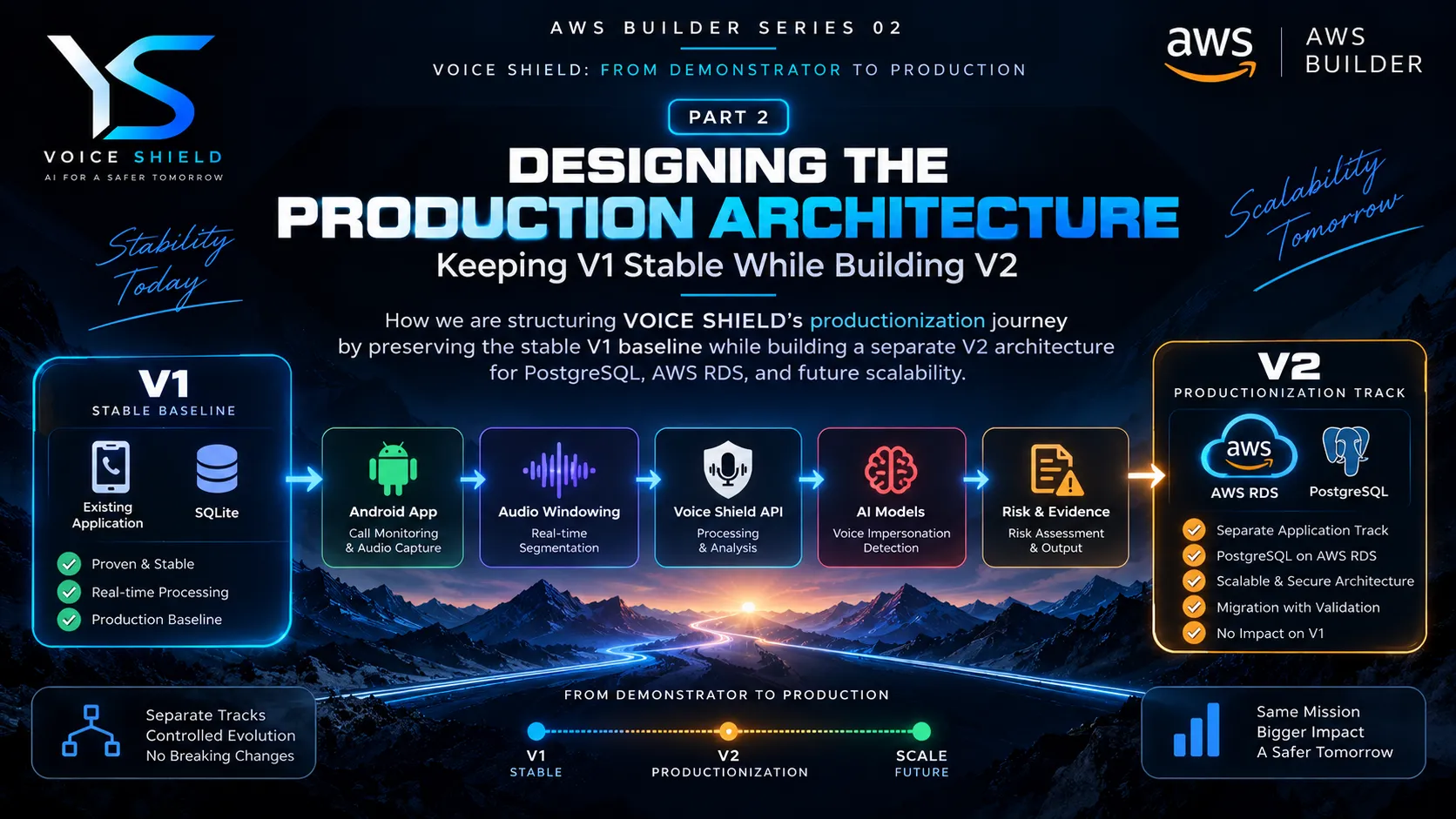
Designing the Production Architecture: Keeping V1 Stable While Building V2
How we are structuring VOICE SHIELD's productionization journey by preserving the stable V1 baseline while building a separate V2 architecture for PostgreSQL, AWS RDS, and future scalability.
Series: VOICE SHIELD: From Demonstrator to Production (5 articles)
- 2Designing the Production Architecture: Keeping V1 Stable While Building V2 This article

The first rule of productionization:
Don't break what already works.
After the demonstrator stage, one of our first architectural decisions for VOICE SHIELD was to separate stability from evolution.
Instead of modifying the existing V1 system directly, we established a controlled V2 track.
V1
→ Existing stable application
→ SQLite
→ Production baseline
→ Existing stable application
→ SQLite
→ Production baseline
V2
→ Separate application track
→ PostgreSQL
→ AWS RDS
→ Productionization & migration
→ Separate application track
→ PostgreSQL
→ AWS RDS
→ Productionization & migration
This separation gives us a controlled path to evolve the platform while keeping the existing system available as a stable reference and fallback.
The architecture is centered around a simple principle:
ANDROID
↓
REAL-TIME AUDIO WINDOWING
↓
VOICE SHIELD API
↓
AI / VOICE ANALYSIS
↓
RISK & EVIDENCE
↓
DATABASE
↓
REAL-TIME AUDIO WINDOWING
↓
VOICE SHIELD API
↓
AI / VOICE ANALYSIS
↓
RISK & EVIDENCE
↓
DATABASE
The database migration therefore isn't treated as an isolated infrastructure change.
It has to preserve the behavior of the complete real-time pipeline.
Our V2 productionization track is being designed around:
• Cloud infrastructure
• PostgreSQL on AWS RDS
• Secure application-to-database connectivity
• Preserved API boundaries
• Real-time session and chunk data
• Migration validation
• Rollback capability
• V1 stability
• PostgreSQL on AWS RDS
• Secure application-to-database connectivity
• Preserved API boundaries
• Real-time session and chunk data
• Migration validation
• Rollback capability
• V1 stability
One particularly important data relationship is:
call_sessions
│
└── 1 → N ── call_chunks
│
└── 1 → N ── call_chunks
This relationship represents the real-time structure of a call session and its processed audio windows.
Productionization is therefore not simply:
"Move SQLite to PostgreSQL."
It is:
"Move the data layer while preserving the behavior, integrity and reliability of the system."
That distinction will guide the next stages of the VOICE SHIELD productionization journey.
Part 2 of:
VOICE SHIELD: From Demonstrator to Production
Next:
Building the AWS foundation and preparing PostgreSQL for the migration.
Building the AWS foundation and preparing PostgreSQL for the migration.
#VoiceShield #AWS #AWSBuilder #CloudArchitecture #PostgreSQL #AWSRDS #SoftwareArchitecture #AI #VoiceAI #CyberSecurity #Productionization #VSPR
Series: VOICE SHIELD: From Demonstrator to Production (5 articles)
- 2Designing the Production Architecture: Keeping V1 Stable While Building V2 This article
Enjoyed reading this content? Let the author know!
Your likes, comments, shares, and saves help creators reach more builders.

Loading recommendations
Loading article