
Hybrid Generative AI Architectures, Edge Deployments, and Jurisdictional Compliance
Explore hybrid generative AI architectures, edge deployments, and jurisdictional data governance for the AWS Certified Generative AI Developer Professional (AIP-C01) exam. Learn how to architect low-latency inference pipelines combining AWS Outposts, AWS Wavelength, and AWS Local Zones while enforcing GDPR, LGPD, and HIPAA compliance through AWS Direct Connect, AWS PrivateLink, local Lambda data sanitization, and Service Control Policies.
Series: AIP-C01 | Task 2.3: Design and implement enterprise integration architectures. (5 articles)
- …
- 4Hybrid Generative AI Architectures, Edge Deployments, and Jurisdictional Compliance This article

AWS Certified Generative AI Developer - Professional - Exam Guide (AIP-C01)
Content Domain 2: Implementation and Integration
Task 2.3: Design and implement enterprise integration architectures.
Skill 2.3.4: Develop cross-environment AI solutions to ensure data compliance across jurisdictions while enabling FM access (for example, by using AWS Outposts for on-premises data integration, AWS Wavelength to perform edge deployments, secure routing between cloud and on-premises resources).
Article Overview
- What You Will Learn: How to architect hybrid generative AI solutions connecting on-premises enterprise environments to the cloud via AWS Outposts; deploy single-digit millisecond latency workloads at the 5G cellular edge using AWS Wavelength and bring metro-area VPC compute closer with AWS Local Zones; enforce strict compliance with territorial data sovereignty and privacy regulations (GDPR, LGPD, HIPAA); establish private, zero-public-internet connectivity using AWS Direct Connect, VPN, and VPC Interface Endpoints (AWS PrivateLink); and isolate sensitive data through local sanitization, tokenization, and pseudonymization with AWS Lambda on Outposts prior to invoking foundation models (FMs).
Introduction: The Challenge of Cross-Environment AI and Data Sovereignty
Foundation models (FMs) hosted on managed services such as Amazon Bedrock have revolutionized intelligent application development by abstracting away the operational overhead of provisioning accelerated compute clusters and dedicated GPU instances. However, as enterprise generative AI initiatives transition from sandbox experiments to regulated production environments, centralized cloud computing encounters two hard constraints: network transit latency and legal mandates governing data custody and territorial sovereignty.

Cross-Environment Architectures, Edge Deployments, and Jurisdictional Compliance
In heavily regulated sectors—such as financial services, the public sector, telecommunications, and healthcare—statutory frameworks often prohibit raw, unredacted corporate records from crossing international borders or leaving physical on-premises boundaries. Concurrently, autonomous mobile platforms, industrial robotics, and smart edge devices require round-trip inference latencies below 10 milliseconds, making continuous round-trips to distant AWS Regions physically impractical.
To succeed in the AIP-C01 exam, architects must know how to strategically distribute AI workloads across on-premises data centers, telecommunications edge locations, and the AWS Cloud.
Data Residency and Jurisdictional Challenges: The Regulatory Trilemma
Routing customer prompts and proprietary knowledge bases to large language models (LLMs) requires rigorous adherence to data protection standards. Three primary legislative frameworks frequently anchor scenario-based exam questions: GDPR in Europe, LGPD in Brazil, and HIPAA in the United States for protected health information (PHI).

The regulatory trilemma governing data residency and sovereign jurisdiction.
These regulations dictate explicit technical requirements for enterprise architectures:
- Physical Sovereignty and Processing Location: Legal frameworks require compute cycles and primary data storage to reside strictly within designated geopolitical boundaries.
- Prohibition of Public Transit: Confidential intellectual property, signed contracts, and electronic health records must never traverse the public, unencrypted internet.
- Personally Identifiable Information (PII) Isolation: Exposing raw customer identifiers directly to external endpoints violates corporate governance and compliance baselines. No raw data containing PII should reach shared managed endpoints without prior sanitization or anonymization.
💡 Exam Tip #1: If an exam scenario explicitly states that local data sovereignty regulations prohibit raw or confidential records from leaving the company's physical premises, eliminate any answer choice that proposes streaming raw text directly to Amazon Bedrock in the cloud. The correct architectural pattern combines AWS Outposts deployed in the customer's on-premises data center with local AWS Lambda functions to sanitize and tokenize PII on-premises before any data traverses the wire.
On-Premises Processing with AWS Outposts
AWS Outposts extends native AWS physical hardware, infrastructure, APIs, and operational tooling directly into the customer's on-premises facility.

On-premises hybrid architecture utilizing AWS Outposts.
By incorporating Outposts into hybrid AI designs, organizations effectively decouple the local data plane from the cloud-managed control plane:
- Amazon S3 on Outposts: Stores proprietary knowledge repositories, confidential training documents, and audit logs inside the physical boundaries of the corporate data center, satisfying data residency mandates.
- Local Compute Execution: Amazon EC2 instances and AWS Lambda functions hosted locally on Outposts perform ingestion pipelines, validate business rules, and sanitize sensitive records close to the data source.
- Control Plane Connectivity: Operational metrics, telemetry, and management APIs maintain continuous, secure synchronization with the parent AWS Region, delivering centralized governance without exposing underlying raw payloads.
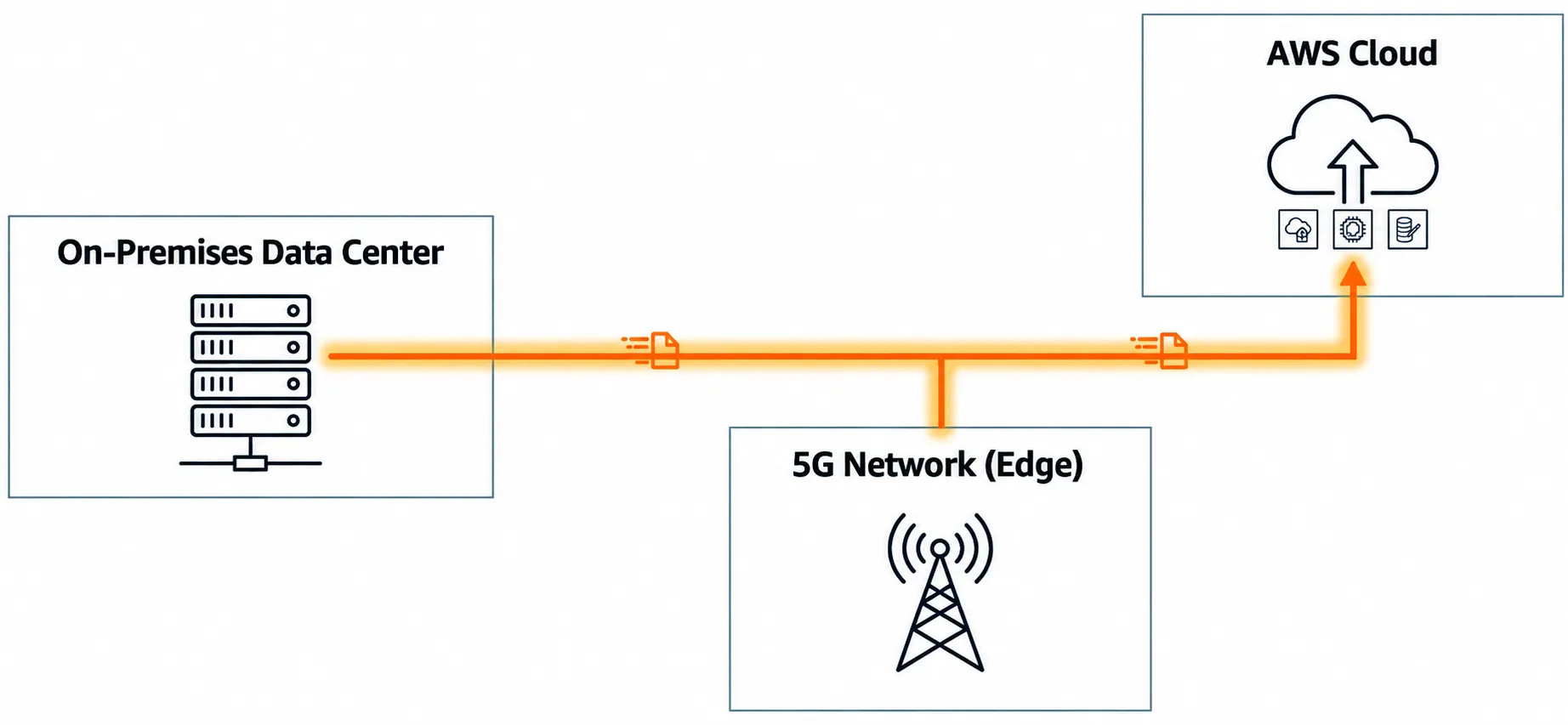
Ultra-Low Latency Edge Deployments: AWS Wavelength and Local Zones
When network round-trip times to an AWS Region degrade user experience or violate mission-critical operational requirements, compute infrastructure must be distributed closer to end devices.

Edge deployment topologies comparing AWS Wavelength and AWS Local Zones.
AWS provides two complementary edge infrastructure solutions to satisfy ultra-low latency demands:
AWS Wavelength
AWS Wavelength embeds AWS compute and storage services inside telecommunications providers' (Telcos) physical data centers, directly at the edge of the 5G cellular network.
Data generated by mobile devices or edge IoT sensors reaches inference endpoints without traversing the commercial internet, bypassing multiple intermediate carrier hops.
- Key Metric: Single-digit millisecond latency (latency < 10 ms).
- Primary Use Cases: Multimodal computer vision at the edge, emergency telemedicine diagnostics, autonomous fleet management, and connected industrial robotics.
AWS Local Zones
AWS Local Zones place AWS compute, storage, database, and select managed services in major metropolitan and industrial centers that do not have a dedicated AWS Region.
Local Zones act as extensions of parent VPC subnets, placing compute power closer to large population hubs and corporate offices.
- Key Metric: Low latency (latency < 15 ms).
- Primary Use Cases: Real-time visual media rendering, low-latency financial trading platforms, and localized analytics workloads requiring low single-to-double-digit latency.
Secure Routing and Hybrid Connectivity
Interconnecting on-premises environments, edge nodes, and the AWS Cloud demands high-throughput, private network paths that eliminate exposure to the public internet.

Resilient and private local-to-cloud network architecture.
Enterprise cross-environment connectivity relies on three core networking components:
- AWS Direct Connect: A dedicated physical fiber-optic link between the enterprise customer gateway and an AWS Direct Connect location. Provides predictable bandwidth, low jitter, and complete isolation from the public internet.
- AWS Site-to-Site VPN: Establishes encrypted IPsec tunnels across connections (often layered directly on top of Direct Connect circuits to enforce end-to-end encryption in transit or maintained as a redundant failover path).
- AWS Transit Gateway: A central network transit hub that simplifies routing topologies across Direct Connect connections, VPN attachments, and multiple VPCs, centralizing routing policy management across hybrid deployments.
Traffic Isolation with AWS PrivateLink
Amazon Bedrock operates as a fully managed regional service that responds to HTTPS API requests. Under rigorous enterprise security policies, inference traffic must remain completely off public IP spaces.

End-to-end private API connectivity using AWS PrivateLink.
Inference calls are kept entirely private using AWS PrivateLink:
- VPC Interface Endpoints: Provisioning an Interface Endpoint places an Elastic Network Interface (ENI) with private IP addresses directly inside the enterprise VPC subnets.
- No Internet Gateways: Client applications route API calls directly over the internal AWS backbone network. Internet Gateways (IGWs) and NAT Gateways are unnecessary for Bedrock invocation, closing outbound public paths.
- Granular Security Group Rules: Security Groups attached directly to the Interface Endpoint strictly limit model invocation permissions to authorized internal sources, such as designated Lambda functions or Amazon ECS tasks.
💡 Exam Tip #1: When an AIP-C01 question demands connectivity to Amazon Bedrock under a strict "Zero Public Internet" constraint, select the architectural design that configures VPC Interface Endpoints powered by AWS PrivateLink, combined with strict Security Group rules and AWS Direct Connect.
Local Data Sanitization and Masking (The PII Funnel)
Even when using isolated private network links, enterprise compliance policies often prohibit transmitting direct customer identifiers to cloud-hosted foundation models. Data must be sanitized within the on-premises security boundary before transmission.

The local PII sanitization and tokenization funnel.
Phases of the Local Sanitization Funnel
- Confined Data Retrieval: Raw records containing sensitive PII are queried strictly within the local perimeter from on-premises databases or Amazon S3 on Outposts.
- Local Lambda Execution: An AWS Lambda function running on local AWS Outposts hardware processes the prompt text, scanning for sensitive entities such as national IDs, account numbers, and personal names.
- Pseudonymization and Tokenization: Identified PII tokens are swapped with synthetic tokens (e.g., John Doe becomes
USER_4920). The lookup table mapping tokens back to true identities stays securely in the on-premises database and never leaves the facility. - Sanitized Prompt Dispatch: Only the de-identified prompt text travels across the private AWS Direct Connect and PrivateLink connection to Amazon Bedrock.
- Local Response Rehydration: When Bedrock returns the generated completion across the private endpoint, the local application replaces the synthetic tokens with the original identifiers before presenting the output to end users.
Jurisdictional Governance and Service Control Policies (SCPs)
In multi-account environments orchestrated by AWS Organizations, enterprises must prevent development teams from inadvertently calling AI services or replicating regulated data into unapproved geographic regions.

Multi-account jurisdictional governance and SCP enforcement.
- Restricting Cross-Border Replication: Automated data replication services, including Amazon S3 Cross-Region Replication (CRR), must be disabled or explicitly blocked on buckets containing regulated data to avoid transferring objects outside legal boundaries.
- Service Control Policies (SCPs): Act as guardrails at the AWS Organizations root, Organizational Unit (OU), or account level. Using the
aws:RequestedRegioncondition key, organizations explicitly deny API operations and resource creation in non-compliant AWS Regions (e.g., restricting operations strictly to EU Regions for GDPR or São Paulo for LGPD). - Localized Compliance Auditing: AWS CloudTrail trails must be configured to store and aggregate audit logs exclusively in buckets located within the sovereign jurisdiction where the events occurred.
Unified Hybrid Infrastructure Management
Operating a distributed environment spanning on-premises hardware, edge nodes, and cloud resources requires unified management tooling to enforce consistent configuration lifecycles.

Unified fleet governance across hybrid environments.
- AWS Systems Manager: Acts as a centralized operational hub providing unified asset inventory, automated OS patching, configuration state enforcement, and maintenance automation across EC2 instances in AWS Regions and Outposts.
- Infrastructure as Code (IaC) with AWS CloudFormation and AWS CDK: Enables engineering teams to define, version, and deploy hybrid infrastructure declaratively. A single template provisions VPC endpoints, IAM policies, and Outposts resources uniformly, minimizing configuration drift.
End-to-End Hybrid Cross-Environment Architecture Synthesis
Combining these architectural building blocks produces an enterprise-ready, compliant, and performant cross-environment inference pipeline.

Complete end-to-end hybrid inference sequence.
Sequence Flow Walkthrough
- The enterprise application queries raw confidential documents from Amazon S3 on Outposts within the physical boundaries of the local data center.
- An AWS Lambda function running locally on the AWS Outposts rack scans the payload, replacing all PII entities with synthetic tokens.
- The sanitized prompt routes through an AWS Direct Connect private connection to an Amazon Bedrock VPC Interface Endpoint (AWS PrivateLink), bypassing the public internet entirely.
- Amazon Bedrock processes the inference request statelessly without retaining prompt or completion data.
- The generated text response returns over the dedicated private connection to the on-premises system. The local application rehydrates the original identifiers from the secure on-premises lookup table and persists the output in compliance with local storage mandates.
💡 Exam Tip #3: If an AIP-C01 question describes a mobile, connected 5G workload requiring inference round-trip times under 10 ms, select AWS Wavelength. If the requirement specifies low-latency access for end users in a major metropolitan center that lacks a full AWS Region, choose AWS Local Zones.
Architectural Comparison: Hybrid Computing and Connectivity Patterns

- AWS Outposts
- Physical Execution Location: Customer on-premises enterprise data center.
- Typical Latency: Local LAN speeds (< 2 ms).
- Network Isolation: Fully isolated within the physical perimeter.
- Primary Exam Focus: Strict territorial data sovereignty, mandatory physical custody of raw data, and local PII redaction.
- AWS Wavelength
- Physical Execution Location: Telecommunications carriers' 5G edge data centers.
- Typical Latency: Ultra-low latency (< 10 ms).
- Network Isolation: Directly integrated into carrier mobile networks without public internet hops.
- Primary Exam Focus: Real-time multimodal inference for autonomous mobile devices, smart robotics, and connected vehicles.
- AWS Local Zones
- Physical Execution Location: Major metropolitan and industrial hubs.
- Typical Latency: Low latency (< 15 ms).
- Network Isolation: Extends regional AWS VPC subnets into metro zones.
- Primary Exam Focus: Low-latency compute proximity for urban user bases without an in-region AWS presence.
- AWS PrivateLink
- Physical Execution Location: Internal AWS global backbone.
- Typical Latency: Governed by WAN / Direct Connect link conditions.
- Network Isolation: Zero transit across the public internet.
- Primary Exam Focus: Private invocations of Amazon Bedrock APIs via VPC Interface Endpoints.
Practice Questions for the AIP-C01 Exam
Question 1
A hospital network wants to build a clinical record summarization application using Amazon Bedrock foundation models. HIPAA regulations and data sovereignty rules dictate that raw patient health records containing personally identifiable information (PII) must never leave the hospital's physical facility in an unredacted state. Furthermore, inference traffic sent to the cloud must never traverse the public internet.
Which combination of architectural steps satisfies these requirements securely and efficiently?
- A) Configure an Amazon S3 Cross-Region Replication rule to distribute the load across continents, and create a public AWS Lambda function in the AWS Region using customer-managed AWS KMS keys to anonymize records upon ingestion.
- B) Provision an AWS Site-to-Site VPN tunnel across the public internet connecting the data center to an enterprise VPC, and invoke the Amazon Bedrock console with end-to-end TLS encryption.
- C) Deploy AWS Outposts in the hospital's local data center, execute local AWS Lambda functions on Outposts to sanitize and tokenize PII records, and route the sanitized prompt to Amazon Bedrock via an AWS Direct Connect dedicated link and an Amazon Bedrock VPC Interface Endpoint powered by AWS PrivateLink.
- D) Deploy Amazon EC2 instances in an AWS Wavelength Zone to collect telemetry from emergency vehicles, and configure Amazon Bedrock Guardrails in the public cloud in passive monitoring mode.
Question 2
An automotive manufacturer operates autonomous mobile robots connected via a private 5G cellular network across a factory floor. The robots capture high-resolution imagery and require multimodal computer vision inference in under 8 milliseconds to prevent mechanical collisions. Sending images to the nearest parent AWS Region incurs an average network latency of 40 milliseconds, exceeding safe operational thresholds.
Which edge computing solution should the architect select to meet the latency requirement?
- A) Deploy inference workloads at the edge of the carrier 5G network using AWS Wavelength to achieve single-digit millisecond response times.
- B) Fasten dedicated physical AWS Direct Connect fiber-optic cables directly to the moving robotic arms on the assembly line.
- C) Launch Amazon EC2 instances in an AWS Local Zone located on another continent and increase the foundation model context window.
- D) Place Amazon CloudFront in front of Amazon Bedrock to cache dynamic image inference requests inside the factory.
Question 3
A multinational financial institution must ensure that development teams across multiple AWS accounts in AWS Organizations are programmatically blocked from provisioning AI services or transferring customer financial records into AWS Regions outside the country's legal jurisdiction.
Which architectural mechanism enforces this compliance requirement centrally and preventatively?
- A) Create regional billing alarms in Amazon CloudWatch to notify incident response personnel after non-compliant resources are created.
- B) Schedule an Amazon EventBridge rule that periodically invokes an AWS Lambda function to scan for and terminate non-compliant S3 buckets and foundation models created in foreign regions.
- C) Implement Service Control Policies (SCPs) at the AWS Organizations root or OU level that deny service access and API actions outside authorized AWS Regions using the
aws:RequestedRegioncondition key. - D) Instruct engineering teams to manually configure word-filtering rules in Amazon Bedrock Guardrails for each individual application.
Question 4
A solutions architect is designing connectivity between an enterprise on-premises data center and Amazon Bedrock managed APIs. Corporate information security policy mandates a "Zero Public Internet" posture for all data packets carrying enterprise prompts.
Which combination of components fulfills this technical specification?
- A) Create a VPC Interface Endpoint powered by AWS PrivateLink with dedicated Security Groups for the Amazon Bedrock API, and direct on-premises traffic over an AWS Direct Connect connection.
- B) Attach an Internet Gateway to the VPC and configure NAT Gateways with restrictive outbound IP filtering rules.
- C) Connect remote engineers using AWS Client VPN terminated on an Application Load Balancer with public TLS certificates.
- D) Configure public DNS routing in Amazon Route 53 with latency-based load balancing and mutual TLS (mTLS) over the commercial internet.
Question 5
An enterprise managing a hybrid infrastructure composed of AWS Outposts racks on-premises and containerized workloads in the cloud needs to standardize operational management, asset inventory tracking, automated security patch application, and declarative Infrastructure as Code (IaC) deployments.
Which native AWS services fulfill these operational governance requirements?
- A) Write custom shell scripts executed via local cron jobs, and configure Amazon S3 Cross-Region Replication to distribute operational binaries.
- B) Develop custom Python automation scripts managed by AWS Glue ETL jobs to push operating system patches to servers.
- C) Utilize AWS CloudFormation or AWS CDK to provision infrastructure declaratively across environments, and leverage AWS Systems Manager to automate configuration, inventory, and patching across both cloud and Outposts instances.
- D) Deploy AWS Storage Gateway to distribute operating system disk images, and use Amazon Macie to manage automated security patches.
Practice Questions: Answers and Detailed Explanations
Question 1 Explanation
- Correct Answer: C
- Why It Is Correct: AWS Outposts ensures raw data storage and compute execution stay physically confined within the hospital's on-premises facility. Executing AWS Lambda on Outposts tokenizes and redacts PII before transmission. Delivering the de-identified prompt over AWS Direct Connect through a VPC Interface Endpoint (AWS PrivateLink) guarantees zero exposure to the public internet.
- Why Other Options Are Incorrect:
- Option A: Cross-region data replication to other continents directly violates GDPR and HIPAA sovereignty mandates, and sanitizing data only after it reaches the cloud leaves raw PII exposed in transit.
- Option B: While standard VPN connections use IPsec encryption, they traverse the shared public internet and do not solve the local PII tokenization requirement prior to transmission.
- Option D: AWS Wavelength targets carrier 5G mobile networks and does not replace on-premises data center custody requirements for hospital records.
Question 2 Explanation
- Correct Answer: A
- Why It Is Correct: AWS Wavelength places accelerated compute instances inside the 5G carrier network, enabling single-digit millisecond latency (< 10 ms) for mobile edge clients and autonomous robotics.
- Why Other Options Are Incorrect:
- Option B: Direct physical cabling is mechanically incompatible with mobile, moving robotics operating across an open factory floor.
- Option C: Utilizing Local Zones situated on foreign continents introduces wide-area network (WAN) latency, increasing transit delays far above the 8 ms requirement.
- Option D: Amazon CloudFront is a content delivery network built for caching static web assets; it cannot perform real-time dynamic multimodal inference for robotics safety controls.
Question 3 Explanation
- Correct Answer: C
- Why It Is Correct: Service Control Policies (SCPs) in AWS Organizations establish preventative, non-bypassable guardrails at the account or OU level. Applying an explicit deny policy using the
aws:RequestedRegioncondition key ensures no IAM user or role can invoke APIs or provision infrastructure outside authorized national borders. - Why Other Options Are Incorrect:
- Option A: CloudWatch billing alarms are reactive and alert teams only after resources have already been deployed and data has been transferred.
- Option B: Reactive event-driven scripts that delete resources do not prevent data from having already left sovereign borders during provisioning.
- Option D: Amazon Bedrock Guardrails filters model content and prompt topics; it cannot enforce account-level regional infrastructure boundaries.
Question 4 Explanation
- Correct Answer: A
- Why It Is Correct: AWS Direct Connect provides private physical connectivity without traversing the public internet. VPC Interface Endpoints powered by AWS PrivateLink allocate private IPs inside the customer VPC, allowing private invocation of Amazon Bedrock APIs.
- Why Other Options Are Incorrect:
- Option B: Internet Gateways and NAT Gateways are designed to route traffic out to the public internet, violating the zero-public-internet constraint.
- Option C: Client VPN terminating at an ALB utilizes public endpoints and public internet routing.
- Option D: Commercial internet routing over Route 53 does not satisfy the private link requirement.
Question 5 Explanation
- Correct Answer: C
- Why It Is Correct: AWS CloudFormation and AWS CDK support consistent, declarative infrastructure definitions across AWS Regions and AWS Outposts. AWS Systems Manager delivers unified fleet governance, automated patch management, and inventory visibility across hybrid instances using the SSM Agent.
- Why Other Options Are Incorrect:
- Option A: Manual cron jobs and S3 replication lack auditability, IaC state management, and enterprise governance.
- Option B: AWS Glue is a managed ETL data integration service, not a systems operations or patch management solution.
- Option D: Amazon Macie discovers and classifies sensitive data stored in S3; it does not install security updates or manage server configuration baselines.
Quick Review Checklist for the AIP-C01 Exam
- Mandatory Physical Data Custody: When regulations prohibit raw records from leaving on-premises facilities, select AWS Outposts + Local AWS Lambda for local PII tokenization and masking.
- Ultra-Low Latency on 5G Networks: When scenarios demand round-trip response times under 10 milliseconds for connected vehicles, mobile devices, or robotics, choose AWS Wavelength.
- Metropolitan Compute Proximity: When workloads require low single-digit millisecond latency near urban hubs without an AWS Region, choose AWS Local Zones.
- Zero Public Internet Routing: For strictly private API invocations to Amazon Bedrock, use AWS Direct Connect combined with VPC Interface Endpoints (AWS PrivateLink) and restrictive Security Groups.
- Enforcing Territorial Boundaries: To prevent teams from launching generative AI workloads in unauthorized geographic areas, implement Service Control Policies (SCPs) using the
aws:RequestedRegioncondition key.
Conclusion
Building enterprise-grade generative AI architectures requires balancing the scalable compute power of cloud foundation models with the physical realities of edge latency and legal boundaries of data sovereignty. Combining AWS Outposts, AWS Wavelength, AWS Direct Connect, and AWS PrivateLink yields a resilient, performant, and compliant operating model for regulated industries. Mastering these cross-environment patterns ensures both technical readiness for mission-critical production workloads and architectural accuracy on the AWS Certified Generative AI Developer Professional (AIP-C01) exam.
Series: AIP-C01 | Task 2.3: Design and implement enterprise integration architectures. (5 articles)
- …
- 4Hybrid Generative AI Architectures, Edge Deployments, and Jurisdictional Compliance This article
Enjoyed reading this content? Let the author know!
Your likes, comments, shares, and saves help creators reach more builders.

Loading recommendations
Loading article