
Enterprise Connectivity and Foundation Model Integration
Learn how to integrate legacy enterprise systems with Amazon Bedrock without tight coupling. Master private hybrid connectivity with AWS Direct Connect and AWS PrivateLink, decouple synchronous workloads using Amazon EventBridge and SQS, mitigate HTTP 429 throttling using exponential backoff with full jitter, adapt legacy SOAP/XML to JSON with AWS Lambda, and trace latency end-to-end with AWS X-Ray for the AWS Certified Generative AI Developer Professional (AIP-C01) exam.
Series: AIP-C01 | Task 2.3: Design and implement enterprise integration architectures. (5 articles)
- 1Enterprise Connectivity and Foundation Model Integration This article

AWS Certified Generative AI Developer - Professional - Exam Guide (AIP-C01)
Content Domain 2: Implementation and Integration
Task 2.3: Design and implement enterprise integration architectures.
Skill 2.3.1: Create enterprise connectivity solutions to seamlessly incorporate FM capabilities into existing enterprise environments (for example, by using API-based integrations with legacy systems, event-driven architectures to implement loose coupling, data synchronization patterns).
Article Overview
- What you will learn: How to integrate legacy enterprise systems with Amazon Bedrock without tight coupling; establish dedicated private connections via AWS Direct Connect, AWS Transit Gateway, and AWS PrivateLink; architect asynchronous protection buffers with Amazon EventBridge and Amazon SQS; handle throttling exceptions (
HTTP 429) with Exponential Backoff and Full Jitter; manage bidirectional RAG data synchronization pipelines (Batch vs. Streaming); adapt monolithic legacy protocols (XML/SOAP) into strict JSON via AWS Lambda; and establish end-to-end distributed observability using AWS X-Ray and Amazon CloudWatch. - Target audience: Solutions Architects, AI/ML Engineers, Cloud Developers, and candidates preparing for the AWS Certified Generative AI Developer Professional (AIP-C01) examination.
Introduction: The Challenge of Enterprise Connectivity with Foundation Models
Integrating cloud-managed Foundation Models (FMs) into established enterprise ecosystems is one of modern architecture's most significant challenges. The vast majority of mission-critical business systems—such as core banking platforms, on-premises ERPs, and legacy billing engines—operate under synchronous communication premises with predictable millisecond-range response times.

Enterprise Connectivity and FM Integration
In contrast, Generative AI foundation models operate under autoregressive inference dynamics, where processing time is variable and heavily dependent on the total volume of generated tokens (Time to First Token plus progressive token decoding).
Attempting to connect these two environments directly without intermediate architectural layers leads to critical operational failure: legacy systems suffer cascading timeouts while waiting for massive model responses, while the AI service encounters sudden traffic spikes that trigger rate-limiting exceptions (
HTTP 429 ThrottlingException).Overcoming this bottleneck requires robust cloud patterns: dedicated private networking, elastic queue buffering for backpressure management, protocol translation adapters, and deep distributed observability.
The Pitfall of Tight Coupling: Synchronous Calls vs. Variable Response Times
The primary design mistake in enterprise FM integrations is maintaining tight coupling. Traditional on-premises environments are optimized for predictable synchronous requests where an execution latency exceeding 500 ms indicates systemic degradation. However, invoking a frontier model can take anywhere from a few hundred milliseconds to several seconds depending on context window depth, reasoning complexity, and output token density.

The Integration Dilemma: Synchronous vs. Variable Response Times
Enterprise integrations must satisfy four core architectural imperatives:
- Eliminate tight coupling: Decouple systems with incompatible operational cadences to prevent slow model inference from exhausting client application connection pools.
- Shield foundation models against bursts: Buffer and smooth batch request surges generated by monoliths before they exceed assigned FM transaction quotas.
- Protect the core business: Ensure that processing latencies and generation bottlenecks never block business-critical transactions across core ERP, CRM, or billing pipelines.
- Deliver end-to-end security: Ensure complete data confidentiality and integrity in transit without routing sensitive enterprise payloads over the public internet.
💡 Exam Tip #1: If an exam scenario describes a legacy ERP system timing out or locking application threads during month-end financial reporting when calling Amazon Bedrock directly, the correct architectural solution will always involve breaking synchronous coupling by adopting an Event-Driven Architecture with Amazon EventBridge and an Amazon SQS buffer queue.
Dedicated Private Network Topology: From Direct Connect to PrivateLink
In regulated industries such as banking, insurance, and healthcare, sensitive corporate data cannot traverse public internet routes. Amazon Bedrock is a multi-tenant managed service accessed via secure HTTPS APIs, but enterprise communication originating from private data centers must travel through dedicated private networking infrastructure.

Private Connection Architecture via Direct Connect, Transit Gateway, and PrivateLink
The private hybrid connectivity path is established across four sequential layers:
- AWS Direct Connect: Establishes a dedicated physical fiber-optic connection between the corporate on-premises data center and AWS, delivering consistent network bandwidth and bypassing public internet routing fluctuations.
- AWS Transit Gateway: Acts as a centralized cloud router, aggregating and orchestrating network traffic between the AWS Direct Connect gateway and multiple enterprise Virtual Private Clouds (VPCs).
- AWS PrivateLink (Interface VPC Endpoints): Keeps calls destined for Amazon Bedrock strictly within the AWS network backbone. VPC workloads access the Bedrock control and data plane APIs via private IPv4 addresses allocated to Elastic Network Interfaces (ENIs) deployed in private subnets.
- Complete network isolation: Corporate inference payloads never traverse public internet routes, satisfying stringent regulatory and security audits by eliminating external endpoint exposure.
Asynchronous Decoupling with EventBridge and SQS
Adopting an event-driven architecture enables client applications to publish events using a fire-and-forget pattern. This frees the enterprise client system from holding open threads while awaiting generation completion.

Full Event-Driven Decoupling with EventBridge and SQS
- Amazon EventBridge: Ingests business events emitted by enterprise systems, evaluates routing metadata through declarative event pattern rules on custom event buses, and fans payloads out to appropriate architectural targets.
- Amazon SQS: Operates as an elastic queue buffer. When a legacy monolith pushes thousands of concurrent requests, messages are queued and durably persisted without dropping requests.
- AWS Lambda: Consumes messages from the SQS queue at a controlled pace governed by Reserved Concurrency limits, processing payloads and dispatching invocations to Amazon Bedrock without exceeding provisioned quotas.
💡 Exam Tip #2: For exam questions requiring content-based intelligent routing combined with model saturation protection, the canonical AWS design pattern is Amazon EventBridge (for rule evaluation and ingestion) coupled to an Amazon SQS queue (for backpressure and load buffering) consumed by an AWS Lambda function with concurrency limits.
Bidirectional Corporate Data Synchronization for RAG
To ensure Large Language Models produce grounded, contextually accurate responses free of hallucinations via Retrieval-Augmented Generation (RAG), vector stores and Amazon Bedrock Knowledge Bases must synchronize continuously with corporate source records.

Batch and Streaming Data Synchronization Patterns
Two structured synchronization patterns are recommended based on operational velocity:
- Batch Path (Scheduled / Overnight): Best suited for high-volume historical, structured, and semi-structured datasets stored in corporate data lakes or data warehouses. AWS Glue ETL jobs extract, transform, and deposit clean data into Amazon S3. Subsequently, Amazon Bedrock Knowledge Bases initiate scheduled ingestion jobs to chunk text, compute vector embeddings, and update the target vector index.
- Streaming Path (Real-Time): Essential for transactional OLTP databases and rapid data modifications. Changes in operational databases are captured via Change Data Capture (CDC) utilizing Amazon DynamoDB Streams or Amazon Kinesis Data Streams. A stream processor (AWS Lambda) computes vector embeddings on the fly and performs sub-second upserts into the vector database.
- Metadata Mapping: Every chunk must be enriched with contextual metadata tags (such as
tenant_id,department, andaccess_level) to enforce metadata filtering and authorization policies during vector search retrieval.
Backpressure Control and Throttling Mitigation (HTTP 429)
Foundation Models in Amazon Bedrock operate under service quotas defined by Tokens per Minute (TPM) and Requests per Minute (RPM). When incoming enterprise volume exceeds assigned limits, Amazon Bedrock rejects incoming requests with a
ThrottlingException (HTTP 429).
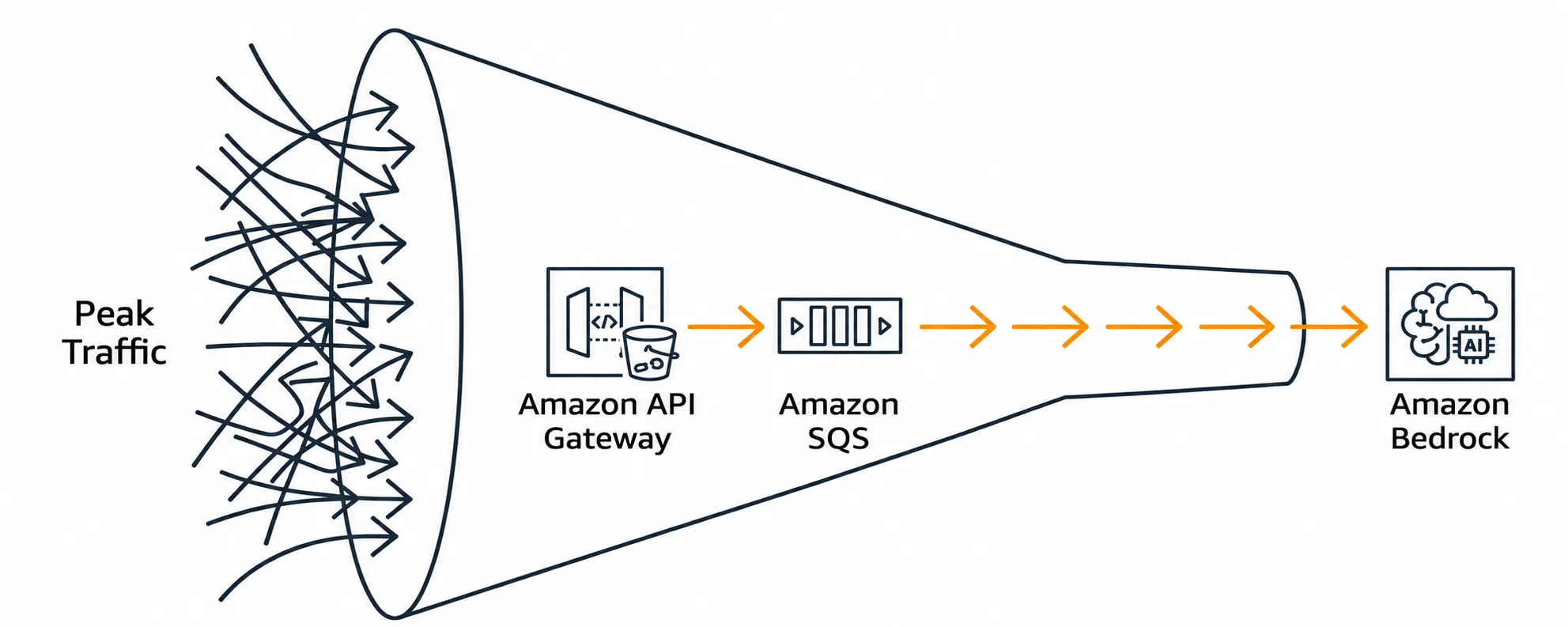
Backpressure Handling and Rate Limiting
Architectures must implement three defensive barriers to mitigate and manage backpressure:
- Amazon API Gateway: Deploys Usage Plans and API keys per enterprise consumer or department, enforcing sustained throttling limits (requests per second) alongside burst limits to reshape incoming traffic at the edge.
- Amazon SQS as a Structural Buffer: Absorbs request spikes during seasonal or end-of-cycle bursts, preventing valid requests from failing due to sudden downstream quota depletion.
- AWS Lambda Reserved Concurrency: Configuring maximum Reserved Concurrency on the consumer Lambda function acts as a physical ceiling on downstream call frequency against the Amazon Bedrock API, guaranteeing throughput remains within provisioned limits.
Resilience Patterns: Exponential Backoff, Jitter, and DLQs
Transient infrastructure errors (
HTTP 500, 503) and temporary rate exhaustion (HTTP 429) are inevitable in distributed systems. Fault-tolerant architectures require robust client-side recovery mechanisms.
Resilience Mechanisms with Exponential Backoff, Jitter, and SQS DLQ
To avoid retry storms—where multiple concurrent clients fail and simultaneously re-issue requests in lockstep, repeatedly overwhelming the downstream service—AWS strongly recommends implementing Exponential Backoff with Full Jitter.
The retry delay formula for attempt i with Full Jitter is:

Where:
- B represents the initial base backoff delay (e.g., 100 ms).
- i represents the consecutive retry attempt count (0, 1, 2, dots).
- M represents the maximum backoff ceiling to prevent unbounded delays.
- random_between injects uniform entropy (Full Jitter), desynchronizing competing clients and flattening connection spikes across time.
When the maximum retry threshold N is exhausted without success, the message is routed to an Amazon SQS Dead-Letter Queue (DLQ) for alerting, audit, and manual or automated reprocessing. For multi-step distributed workflows, AWS Step Functions provides native retry blocks (
Retry) and error handlers (Catch), acting as a managed circuit breaker.Legacy Protocol Adaptation with AWS Lambda
Many legacy enterprise monoliths communicate using heavyweight XML-based SOAP envelopes, RPC, or legacy mainframe formats. Conversely, the Amazon Bedrock runtime API strictly mandates JSON payloads.

Legacy Protocol Adaptation Layer with AWS Lambda
AWS Lambda serves as the Protocol Adaptation Layer (Adapter Pattern):
- Intercepts incoming legacy requests arriving through the private VPC ingress.
- Parses and extracts business data elements from complex XML/SOAP structures.
- Validates and formats the payload into the strict JSON schema expected by the Bedrock API (
InvokeModelorInvokeModelWithResponseStream). - Transforms the model's generated JSON response back into the native XML envelope expected by the legacy monolith before returning the payload.
End-to-End Distributed Observability
Understanding latency distribution across multi-tier Generative AI systems is critical. In enterprise deployments, the primary latency contributor is often not the network transport layer, but the autoregressive inference process of the foundation model itself.

Latency Decomposition with AWS X-Ray
A comprehensive observability stack incorporates two primary tools:
- AWS X-Ray: Injects and propagates trace headers (
X-Amzn-Trace-Id) across all participating nodes. The generated service map highlights the exact time spent in each operational segment:- Enterprise Application Gateway layer (e.g., 100 ms)
- Amazon API Gateway ingress (e.g., 120 ms)
- AWS Lambda serialization and adaptation (e.g., 150 ms)
- Amazon Bedrock autoregressive token inference (e.g., 2000 ms)
- Amazon CloudWatch: Aggregates centralized structured execution logs, captures token metrics, and raises operational alarms when
HTTP 429error rates or p99 latencies breach service level objectives (SLOs).
💡 Exam Tip #3: Whenever an exam scenario asks for a tool to pinpoint whether end-to-end latency originates in hybrid on-premises networking, serverless compute translation layers, or Amazon Bedrock's autoregressive token generation, the correct solution is distributed tracing with AWS X-Ray.
End-to-End Enterprise Reference Architecture
Synthesizing private hybrid networking, event-driven decoupling, resiliency patterns, and protocol transformation yields a production-grade enterprise reference architecture.

End-to-End Horizontal Reference Architecture
Architectural Workflow Walkthrough
- The transaction begins in the on-premises corporate data center, where the legacy application publishes an integration event over AWS Direct Connect without routing traffic across the public internet.
- Amazon EventBridge evaluates incoming event metadata and routes the message to an Amazon SQS buffer queue.
- The AWS Lambda adapter function reads messages from the queue under a strict reserved concurrency limit, parses the legacy SOAP/XML payload, converts it to JSON, and invokes Amazon Bedrock over AWS PrivateLink.
- Transient errors trigger client-side Exponential Backoff with Full Jitter. Messages that repeatedly fail after maximum retries are routed to an Amazon SQS Dead-Letter Queue (DLQ).
- Once inference completes, the Lambda function transforms the output and publishes the response to an asynchronous response event bus for retrieval by the enterprise consumer.
Architectural Integration Patterns Comparison
| Integration Requirement | Recommended Architectural Pattern | AWS Services Involved | Primary Advantage |
|---|---|---|---|
| On-Premises Network Isolation | Dedicated Private Hybrid Connectivity | AWS Direct Connect, AWS Transit Gateway, AWS PrivateLink | Eliminates public internet exposure and delivers predictable network performance. |
| Overload and Quota Protection | Asynchronous Buffering with Rate Limiting | Amazon API Gateway, Amazon SQS, AWS Lambda (Reserved Concurrency) | Prevents HTTP 429 ThrottlingException errors and absorbs batch spikes without dropping requests. |
| Incompatible Processing Cadences | Event-Driven Decoupling (Fire-and-Forget) | Amazon EventBridge, Amazon SQS | Isolates core enterprise workloads from model generation latencies and prevents thread exhaustion. |
| Transient Failure Handling | Retries with Entropy and Isolation | AWS SDK / Lambda (Exponential Backoff with Full Jitter), Amazon SQS DLQ | Mitigates retry storms and guarantees unprocessable messages are preserved for audit and replay. |
| Schema Incompatibility | Protocol Adapter Layer | AWS Lambda (Adapter Pattern) | Seamlessly converts legacy formats (XML/SOAP) into strict JSON required by foundation models. |
| RAG Corporate Data Synchronization | Dual-Path Ingestion (Batch / Streaming) | AWS Glue, Amazon S3, Amazon DynamoDB Streams, Amazon Kinesis, Vector Databases | Keeps knowledge base retrieval contexts up to date without requiring manual pipeline intervention. |
AIP-C01 Practice Exam Questions
Question 1
A multinational financial institution runs an on-premises core banking system on a mainframe. The engineering team must connect this application to Amazon Bedrock to summarize internal compliance audit records automatically. Strict regulatory and security policies dictate that no company data may traverse the public internet.
Which architecture completely fulfills these security and networking requirements?
- A) Create an Internet Gateway (IGW) attached to an AWS VPC and configure Security Group outbound rules restricted strictly to the mainframe's public IP address.
- B) Establish an AWS Direct Connect connection between the on-premises data center and AWS, and access Amazon Bedrock using an Interface VPC Endpoint powered by AWS PrivateLink.
- C) Configure an IPsec Site-to-Site VPN across the public internet with static routes pointing to the regional public endpoint of Amazon Bedrock.
- D) Deploy a public Amazon S3 bucket configured with restricted S3 Bucket Policies and AWS KMS server-side encryption (SSE-KMS) to stage exchange files between the mainframe and Bedrock.
Question 2
An insurance provider processes hundreds of thousands of claims following severe weather events. The corporate monolithic application transmits bursts of semantic analysis requests directly to Amazon Bedrock. During these peak events, the application experiences widespread failures caused by
ThrottlingException (HTTP 429) errors.Which architectural modification absorbs incoming request bursts while preventing legitimate claims from being rejected?
- A) Deploy an Application Load Balancer (ALB) in front of Amazon Bedrock configured with round-robin balancing across multiple AWS Regions.
- B) Vertically scale the monolith's underlying Amazon EC2 instance types to increase the number of simultaneous synchronous outbound threads.
- C) Implement an asynchronous architecture using Amazon EventBridge to ingest claim events, Amazon SQS as an intermediate queue buffer, and AWS Lambda functions configured with reserved concurrency to process messages within Bedrock RPM limits.
- D) Disable Exponential Backoff within the AWS SDK client and set retry intervals to a constant 10 milliseconds.
Question 3
A distributed enterprise application invokes Amazon Bedrock models through AWS Lambda functions. During integration testing, engineers observe that intermittent network errors cause hundreds of concurrent Lambda executions to retry simultaneously, intensifying API throttling bottlenecks on the managed service.
Which client-side mitigation pattern should be implemented to eliminate these retry storms?
- A) Implement Exponential Backoff with Full Jitter in client logic and configure an Amazon SQS Dead-Letter Queue (DLQ) for messages exceeding the maximum retry threshold.
- B) Wrap the invocation within an unthrottled
while(true)loop that executes continuously until anHTTP 200response status is received. - C) Re-instantiate the underlying HTTP connection pool and clear local socket caches upon receiving every non-success HTTP status code.
- D) Increase the AWS Lambda function execution timeout to 15 minutes without implementing intermediate retry backoff intervals.
Question 4
A telecommunications provider identifies that synchronous calls from an on-premises legacy ERP to Amazon Bedrock frequently exceed three seconds, causing critical thread exhaustion in the calling service. Furthermore, the legacy ERP system can only emit messages formatted as SOAP/XML.
Which combination of services and architectural patterns resolves both the client blocking issue and the payload schema incompatibility?
- A) Migrate on-premises endpoints to GraphQL directly on the mainframe and configure Amazon CloudFront to cache dynamic foundation model inferences.
- B) Implement an event-driven architecture using Amazon EventBridge for fire-and-forget decoupling, combined with an AWS Lambda adapter function to transform incoming SOAP/XML messages into JSON before invoking Amazon Bedrock.
- C) Update the IAM policy associated with the Bedrock model to natively accept XML documents via standard system parameters.
- D) Establish a bidirectional gRPC streaming channel directly between the on-premises mainframe and the Amazon Bedrock console.
Question 5
A cloud operations team is investigating elevated end-to-end latency in an enterprise customer assistant integrated with Amazon Bedrock. The distributed flow spans an on-premises client, an Amazon API Gateway endpoint, an AWS Lambda translation function, and the Bedrock runtime. The engineering lead must determine whether the latency stems from hybrid networking and payload transformation or from the model's autoregressive generation phase.
Which observability solution provides detailed, visual segment-by-segment latency breakdowns across this distributed topology?
- A) Query AWS CloudTrail events to aggregate total management-plane API calls across the account.
- B) Implement end-to-end distributed tracing using AWS X-Ray by propagating trace headers across Amazon API Gateway, AWS Lambda, and Amazon Bedrock.
- C) Manually parse unstructured text logs in Amazon CloudWatch Logs to identify warning messages.
- D) Enable Amazon EC2 CPU utilization metrics on the on-premises host instances within the corporate data center.
Detailed Answers and Explanations
Answer to Question 1
Correct Answer: B
- Explanation: AWS Direct Connect provides a private, dedicated physical link between the corporate data center and AWS, entirely bypassing the public internet. AWS PrivateLink (via Interface VPC Endpoints) assigns private IP addresses inside the enterprise VPC to reach Amazon Bedrock. All traffic remains exclusively on the AWS private backbone, satisfying all regulatory requirements.
- Why other options are incorrect:
- Option A: Using an Internet Gateway routes traffic across the public internet, violating the regulatory mandate.
- Option C: A Site-to-Site VPN encrypts data but still traverses the public internet, failing the requirement for a dedicated private link.
- Option D: A public S3 bucket exposes objects to the public internet namespace and does not establish a private connection to the Bedrock runtime API.
Answer to Question 2
Correct Answer: C
- Explanation: Using Amazon EventBridge coupled with an Amazon SQS buffer decouples client ingestion from processing. SQS acts as a shock absorber, enqueuing surges during peak events. AWS Lambda functions configured with controlled Reserved Concurrency drain the queue at a sustainable rate, keeping requests within Amazon Bedrock's provisioned RPM/TPM quotas and preventing
HTTP 429errors. - Why other options are incorrect:
- Option A: Application Load Balancers route HTTP/HTTPS traffic to compute targets (such as EC2, ECS, or Lambda), not directly to managed multi-region Bedrock foundation model endpoints.
- Option B: Scaling on-premises compute instances does not alleviate downstream quota limits enforced by Amazon Bedrock.
- Option D: Disabling backoff and retrying every 10 ms intensifies retry storms and guarantees total API exhaustion.
Answer to Question 3
Correct Answer: A
- Explanation: Implementing Exponential Backoff with Full Jitter adds randomized delay intervals between retry attempts, desynchronizing concurrent clients and flattening request spikes. Forwarding unrecoverable messages to an Amazon SQS Dead-Letter Queue (DLQ) isolates bad payloads and prevents infinite retry loops.
- Why other options are incorrect:
- Option B: An infinite
while(true)loop without delay burns CPU cycles, exacerbates throttling, and exhausts connection limits immediately. - Option C: Resetting socket connections does not introduce delay or desynchronize retrying workers.
- Option D: Extending function execution timeouts keeps Lambda execution environments alive longer, escalating AWS costs without addressing retry synchronization.
- Option B: An infinite
Answer to Question 4
Correct Answer: B
- Explanation: Amazon EventBridge enables an asynchronous fire-and-forget pattern that frees the legacy ERP from waiting for model generation to complete. AWS Lambda implements the Adapter Pattern, parsing the legacy SOAP/XML payload and serializing it into the JSON schema required by Amazon Bedrock.
- Why other options are incorrect:
- Option A: Rewriting mainframe interfaces to GraphQL incurs prohibitive costs, and Amazon CloudFront cannot cache dynamic, non-deterministic generative AI inference calls.
- Option C: IAM policies manage authorization and permissions; they cannot transform or parse payload schemas.
- Option D: The Amazon Bedrock console is an administrative web interface and does not support bidirectional gRPC tunnels from mainframes.
Answer to Question 5
Correct Answer: B
- Explanation: AWS X-Ray provides purpose-built distributed tracing for cloud architectures. By capturing and correlating
X-Amzn-Trace-Idheaders across API Gateway, Lambda, and downstream service calls, X-Ray generates an end-to-end service map showing the exact latency attributed to each architectural segment—including the foundation model's autoregressive token generation. - Why other options are incorrect:
- Option A: AWS CloudTrail audits control-plane governance events (who performed what action and when); it does not record distributed application performance or latency traces.
- Option C: Manual log inspection in CloudWatch is slow, uncoordinated, and cannot provide visual distributed latency waterfall charts.
- Option D: Monitoring on-premises CPU utilization provides no visibility into latency introduced by downstream cloud microservices or Bedrock model inference.
Conclusion and Key Takeaways
Integrating foundation models into enterprise environments requires an intentional, decoupled architectural foundation. Directly coupling synchronous legacy transactional systems to Generative AI inference services leads to cascading timeouts and operational failures.

Robust enterprise Generative AI integrations are built upon five core design principles:
- Network Isolation: Route all hybrid traffic through AWS Direct Connect and AWS PrivateLink to eliminate public internet exposure.
- Asynchronous Decoupling: Adopt fire-and-forget event-driven architectures with Amazon EventBridge and Amazon SQS queue buffers.
- Resilience and Quota Protection: Regulate enterprise request rates to prevent
HTTP 429 ThrottlingExceptionerrors using Exponential Backoff with Full Jitter and SQS Dead-Letter Queues. - Protocol Adaptation: Deploy AWS Lambda functions using the Adapter Pattern to convert legacy envelopes (SOAP/XML) into clean JSON structures for Amazon Bedrock.
- Holistic Observability: Isolate performance bottlenecks across hybrid networks, compute layers, and model token generation using AWS X-Ray and Amazon CloudWatch.
Applying these architectural patterns allows enterprise organizations to safeguard mission-critical transactional stability while unlocking the full transformative potential of Generative AI on AWS.
Series: AIP-C01 | Task 2.3: Design and implement enterprise integration architectures. (5 articles)
- 1Enterprise Connectivity and Foundation Model Integration This article
Enjoyed reading this content? Let the author know!
Your likes, comments, shares, and saves help creators reach more builders.

Loading recommendations
Loading article