
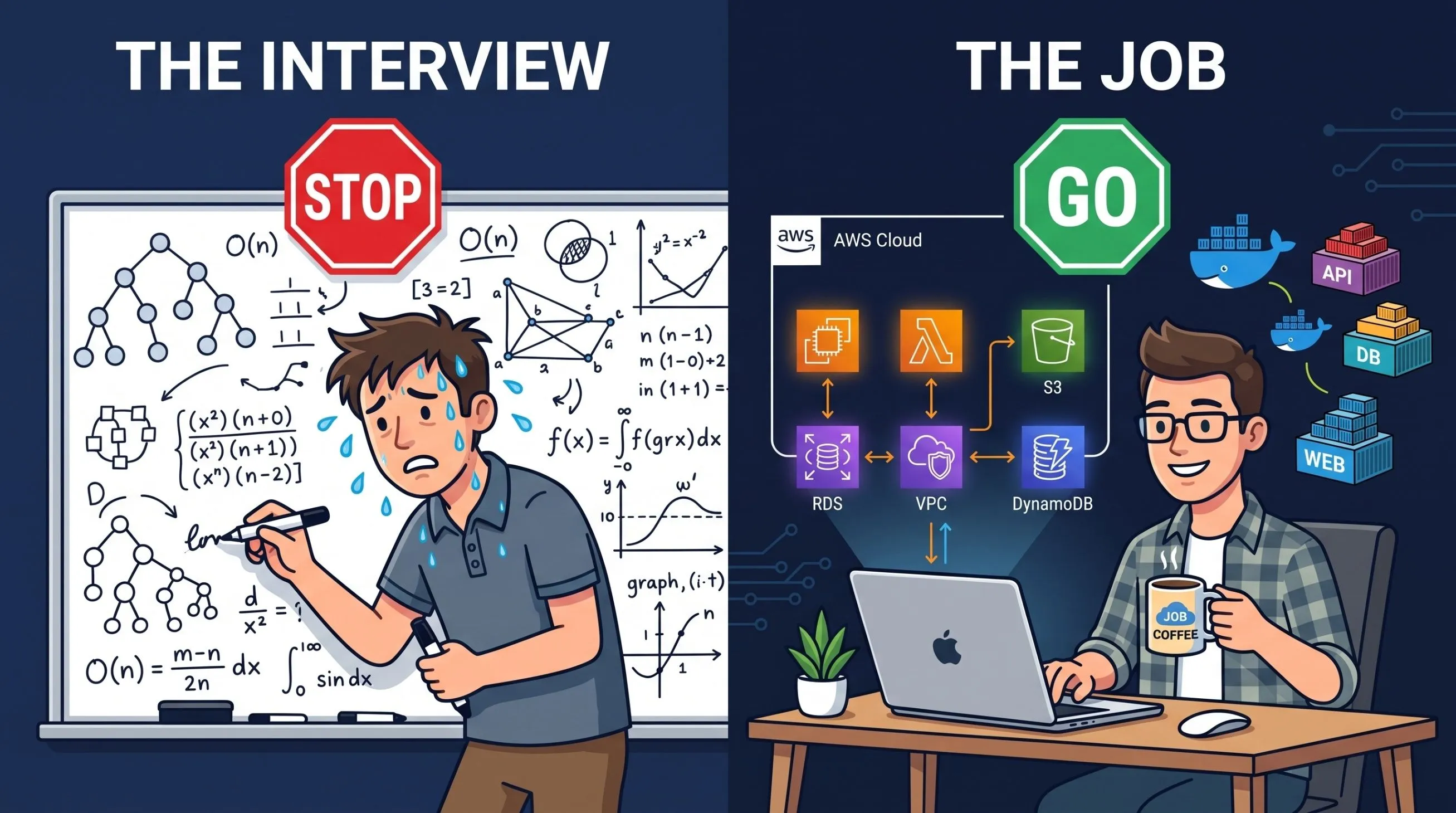
Why Your Ability to Invert a Binary Tree Doesn't Make You a Good Engineer
A brutally honest breakdown of the modern tech interview process: why forcing developers to memorize obscure algorithmic puzzles on a whiteboard filters out pragmatic, real-world problem solvers and heavily rewards professional test-takers who have no idea how to actually ship to production.
Series: Tech Unplugged (7 articles)
- …
- 5Why Your Ability to Invert a Binary Tree Doesn't Make You a Good Engineer This article

The tech industry loves to proudly declare how innovative, fast-paced, and forward-thinking it is. Yet, when it comes to hiring the engineers tasked with building this future, we rely on a hazing ritual that completely ignores how software is actually made in the real world.
I am talking about the algorithmic whiteboard interview. We have collectively accepted a system where the barrier to entry for building web applications and cloud infrastructure is acting like a competitive math Olympian for 45 minutes.
The Professional Test-Taker
Let’s be honest: when was the last time you had to manually implement a Quick-Sort algorithm from scratch in a production environment? When was the last time balancing a binary tree was the bottleneck in your AWS architecture?
The answer is probably never. Modern engineering is built on the shoulders of giants. We use robust, highly optimized standard libraries and frameworks. Yet, we still judge candidates on their ability to rote-memorize time complexities for algorithms they will never write on the job.
We aren't hiring the best engineers; we are hiring the best professional test-takers. We are selecting people who have the free time to grind LeetCode for three months, while filtering out brilliant, pragmatic problem-solvers who actually know how to build a resilient system but forgot the syntax for a depth-first search.
The Disconnect from Reality
Here is what actual senior-level software engineering looks like on a Tuesday: You are trying to figure out why an IAM policy in AWS is silently blocking your Fargate container from writing to an S3 bucket. You are reading terrible documentation left behind by an engineer who quit two years ago. You are negotiating with a product manager about why a feature cannot be delivered in three days.
Whiteboard interviews test exactly zero of these skills. They don't test your ability to read someone else's code. They don't test your debugging tenacity. They don't test how you handle a production outage. They just test if you can solve a synthetic puzzle under artificial pressure without access to a search engine—the exact opposite of how we work every single day.
Stop Hazing, Start Hirin
It is time to drop the algorithmic theater. If you want to know if an engineer can do the job, give them a real piece of your codebase. Ask them to debug a broken Dockerfile. Have a conversation about how they would scale a database when the user base doubles.
Until we change how we hire, we will keep rejecting great builders while filling our teams with people who can traverse a graph but panic the moment a deployment pipeline turns red.
Let me know in the comments: what is the most ridiculous, irrelevant interview question you’ve ever been asked?
Series: Tech Unplugged (7 articles)
- …
- 5Why Your Ability to Invert a Binary Tree Doesn't Make You a Good Engineer This article
Enjoyed reading this content? Let the author know!
Your likes, comments, shares, and saves help creators reach more builders.

Loading recommendations
Loading article