
Stop Clean Code and Design Patterns Will Save Your Startup
An unflinching look at the tech industry's biggest dogma: why obsessive over-engineering, religious adherence to architectural purity, and resume-driven development are quietly murdering more startups and products than actual bugs ever will.
Series: Tech Unplugged (7 articles)
- 1Stop Clean Code and Design Patterns Will Save Your Startup This article

We need to talk about the elephant in the server room. For years, the tech industry has fed developers a comforting lie: if you see just use the right design patterns, implement rigorous hexagonal architecture, and achieve 100% test coverage from day one, your software will effortlessly scale to millions of users and your startup will print money.
It is time to wake up. Obsessive over-engineering and religious adherence to architectural purity are quietly murdering more startups and products than actual bugs ever will.
The illusion of the Future-Proofing
Early-stage software engineering is plagued by a disease called Resume-Driven Development. Developers—especially those fresh out of complex enterprise environments—panic at the thought of writing a monolith. They look at a product with zero users and decide they need a distributed microservices mesh orchestrated by Kubernetes, event-driven Kafka streams, and a dozen asynchronous worker queues, all before validating if anyone actually wants what they are building.
They call this "future-proofing." In reality, it is a massive anchor dragging down your time-to-market. When you spend three weeks abstracting database layers for an entity that might change completely next Tuesday, you aren't being professional; you are procrastinating. You are optimizing for a hypothetical scale that you may never reach, at the direct expense of the only metric that matters right now: learning whether your product solves a real problem.
The Cost of Architectural Dogma
The gospel of "Clean Code" has devolved into a form of dogmatism. We spend hours debating whether a class has too many responsibilities, or whether our dependency injection container is configured correctly, while our competitors ship three new features and capture the market.
Every layer of abstraction you add is a tax on your future velocity. Every microservice introduces network latency, serialization overhead, distributed tracing nightmares, and operational complexity. For a small team, this complexity is lethal. Instead of building features for your users, you spend your weekends debugging why a container crashed or why a gRPC stream dropped packets. You traded business value for architectural vanity.
Pragmatism Over Perfection
This is not an excuse to write sloppy, unmaintainable garbage code. It is an argument for ruthless pragmatism.
Code is a liability, not an asset. The less code you write to solve a problem, the better. A messy monolith that solves a user's problem today is infinitely more valuable than an immaculate, highly scalable distributed system that launches six months late and goes bankrupt.
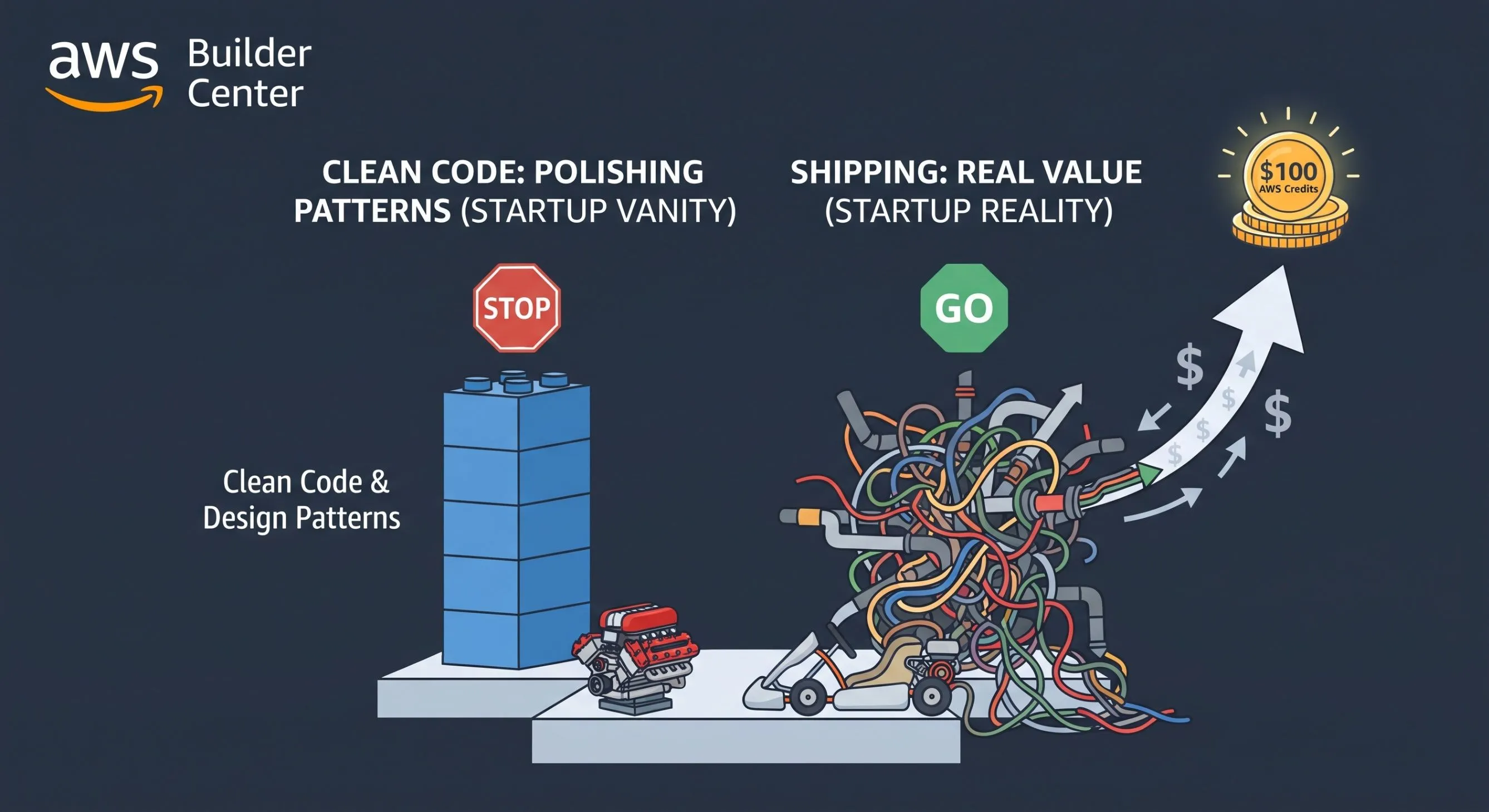
Build simple things first. Use a boring stack. Ship fast, break your own assumptions, and only refactor or scale when the sheer weight of actual, paying users forces your hand. Real engineering isn't about building a Ferrari engine for a go-kart; it's about building the simplest thing that could possibly work, and evolving it only when reality demands it.
Stop polishing patterns. Start shipping.
Series: Tech Unplugged (7 articles)
- 1Stop Clean Code and Design Patterns Will Save Your Startup This article
Enjoyed reading this content? Let the author know!
Your likes, comments, shares, and saves help creators reach more builders.

Loading recommendations
Loading article