
Microservices, Webhooks, and API Gateway Integration for Generative AI
Learn how to decouple enterprise workloads using serverless microservices, implement Amazon API Gateway REST vs. WebSocket streaming architectures, handle asynchronous webhooks with AWS Lambda and Amazon EventBridge, configure edge caching and throttling, and orchestrate resilient Step Functions workflows with Canary deployments.
Series: AIP-C01 | Task 2.3: Design and implement enterprise integration architectures. (5 articles)
- 2Microservices, Webhooks, and API Gateway Integration for Generative AI This article

AWS Certified Generative AI Developer - Professional - Exam Guide (AIP-C01)
Content Domain 2: Implementation and Integration
Task 2.3: Design and implement enterprise integration architectures.
Skill 2.3.2: Develop integrated AI capabilities to enhance existing applications with GenAI functionality (for example, by using API Gateway to implement microservice integrations, Lambda functions for webhook handlers, Amazon EventBridge to implement event-driven integrations)
Article Overview
- What you will learn: How to decouple and modernize legacy applications by integrating Foundation Models (FMs) via serverless microservices; structure synchronous and bidirectional endpoints (REST vs. WebSocket) in Amazon API Gateway for token-by-token streaming; build asynchronous webhook handlers with AWS Lambda and Amazon EventBridge; implement edge governance using caching, JWT authentication, Usage Plans, and Throttling; orchestrate workflows with AWS Step Functions and callbacks; and execute Canary and Blue/Green deployment strategies tailored for Generative AI.
Introduction: The Serverless Integration Layer in the Generative AI Era
The adoption of Amazon Bedrock across enterprise environments has converted access to frontier models into fully managed API calls. However, interfacing these foundation models with established enterprise ecosystems presents substantial engineering challenges. Foundation models exhibit stochastic, variable response latencies, susceptibility to rate-limit exhaustion (
HTTP 429 Too Many Requests), strict network timeout boundaries, and asynchronous streaming patterns that legacy transactional systems cannot natively ingest.Integrating generative AI reliably at enterprise scale demands a resilient Serverless Integration Layer. Instead of coupling end-user clients, CRMs, and ERPs directly to Amazon Bedrock endpoints, builders deploy event-driven microservices, intelligent gateways, and elastic buffering mechanisms. This decoupled architectural pattern separates real-time event ingestion from heavy compute inference, delivering high scalability, granular access governance, and predictable operational cost controls.

End-to-end serverless integration architecture connecting enterprise consumers to Amazon Bedrock.
Application Modernization and Architectural Decoupling
Most organizations cannot justify refactoring established core billing systems, ERPs, or CRMs solely to support modern AI SDKs and real-time streaming interfaces. The standard AWS modernization strategy relies on decoupling via serverless integration microservices.

Extending enterprise legacy systems using an intermediary AWS serverless integration layer.
This architectural modernization rests on three core pillars:
- Extending legacy systems without refactoring: Legacy platforms publish standard event payloads—such as HTTP Webhooks or message queue entries—directly to the AWS perimeter.
- Decoupling workloads with microservices: The intermediary serverless layer absorbs traffic bursts, enforces syntactic validation, and translates legacy payloads into normalized prompt structures required by foundation models.
- Transparent foundation model integration: Prompt templates, Retrieval-Augmented Generation (RAG) lookups, and guardrail validations remain fully encapsulated within AWS microservices, isolating core backend systems from downstream model version upgrades or Amazon Bedrock API changes.
Amazon API Gateway: REST vs. WebSocket and Response Streaming
Amazon API Gateway functions as the managed front door, access controller, and traffic routing layer for downstream foundation models. In the AIP-C01 exam, selecting between REST APIs and WebSocket APIs represents a foundational architectural decision point.

Synchronous request/response REST APIs compared to persistent bidirectional WebSocket APIs.
REST APIs (Synchronous Request-Response)
- Target Workloads: Deterministic workflows, scheduled batch transformations, strict structured JSON generations, or brief textual outputs.
- The Integration Timeout Trap: Amazon API Gateway enforces an immutable, hard integration timeout limit of 29 seconds for REST and HTTP APIs. If FM inference takes 30 seconds to complete, API Gateway terminates the client connection with an
HTTP 504 Gateway Timeout, even if the underlying Amazon Bedrock model finishes generation successfully in the backend.
WebSocket APIs (Persistent, Bidirectional Streaming)
- Target Workloads: Long-running bidirectional interactions, live chat interfaces, interactive coding assistants, and token-by-token streaming.
- Timeout Mitigation and Low Latency: WebSockets maintain long-lived stateful connections, bypassing the 29-second synchronous request-response timeout boundary and natively delivering token-by-token generation straight to browser or mobile clients.
💡 Exam Tip #1: When an exam scenario requires delivering FM-generated responses token-by-token with minimal perceived latency (optimizing Time to First Token - TTFT) for web or mobile clients, the standard recommended pattern is Amazon API Gateway WebSocket APIs integrated with the Amazon Bedrock
InvokeModelWithResponseStream API call. Avoid blocking, synchronous REST APIs for interactive conversational interfaces.Asynchronous Webhook Handlers with AWS Lambda
External notifications from third-party SaaS providers, CRM suites, and Git platforms (such as GitHub or GitLab) communicate via synchronous HTTP webhooks with aggressive response timeout windows (typically 5 to 10 seconds). You must never run foundation model inference inline within the direct execution path handling that synchronous incoming webhook.

Highly responsive webhook ingestion decoupled from asynchronous Bedrock inference.
AWS Lambda acts as an ultra-fast, elastic serverless webhook ingestion handler:
- Instant Ingestion and HTTP 200 Handshake: Lambda receives the webhook, verifies the HMAC cryptographic signature, and returns an immediate
HTTP 200 OKresponse to the sender in under 100 milliseconds. - Protocol Translation and Payload Normalization: The heterogeneous webhook payload is extracted, sanitized, and normalized into a standard JSON event schema.
- Asynchronous Dispatch: The normalized event is dispatched immediately to an event bus such as Amazon EventBridge or an Amazon SQS buffer, preventing upstream timeouts and avoiding duplicate retries from the webhook provider.
Event-Driven Orchestration with Amazon EventBridge
Upon successful ingestion, multiple independent AI pipelines may need to process the event simultaneously. Amazon EventBridge serves as the intelligent, serverless event router for this distributed architecture.

Event-driven routing using dynamic EventBridge Event Patterns.
EventBridge evaluates JSON attributes using dynamic Event Patterns without requiring custom routing code. The following snippet illustrates an Event Pattern configured to trigger priority GenAI workflows:
1
2
3
4
5
6
7
8
{
  "source": ["enterprise.crm.webhook"],
  "detail-type": ["CustomerTicketCreated"],
  "detail": {
    "priority": ["HIGH", "CRITICAL"],
    "requires_sentiment_analysis": [true]
  }
}
Amazon EventBridge inspects incoming events and can simultaneously invoke preliminary screening Lambda functions, publish to message queues, or trigger execution of state machines in AWS Step Functions for multi-step AI tasks.
Inference Optimization and Edge Caching Patterns
Repetitive requests directed to foundation models introduce latency and rapidly consume request and token quotas. Implementing caching across edge and application layers optimizes throughput and controls cloud expenditure.

Layered caching strategies comparing exact-match edge caching with embedding-based semantic caching.
- API Gateway Caching: Configured at the API stage or method level. API Gateway stores exact responses keyed by headers, query string parameters, or request payloads. This provides sub-millisecond retrieval for identical, highly repetitive queries and static FAQ data.
- Amazon ElastiCache (Redis OSS / Valkey): Operates as an advanced semantic cache. It stores vector embeddings of historical prompt queries. Incoming queries with equivalent semantic intent (even when phrased with different wording) are served directly from in-memory cache with sub-10ms response times, preventing unnecessary Amazon Bedrock invocations and guarding against quota exhaustion.
Edge Security and Traffic Governance
Enforcing security and rate constraints before requests reach serverless compute and foundation models protects downstream resources and controls operational spend.

Perimeter security using Amazon Cognito JWT validation and custom Lambda Authorizers.
Endpoint Authentication and Authorization
- Amazon Cognito and JWT Tokens: Validates identity at the API Gateway perimeter using Cognito User Pools and JSON Web Tokens.
- Lambda Authorizers: Enforces custom authorization logic—such as inspecting tenant boundaries, scope-based permissions, and user entitlements—before prompts reach the processing stage.
- Principle of Least Privilege: Fine-grained IAM policies ensure execution roles permit only authorized callers to access downstream resources.

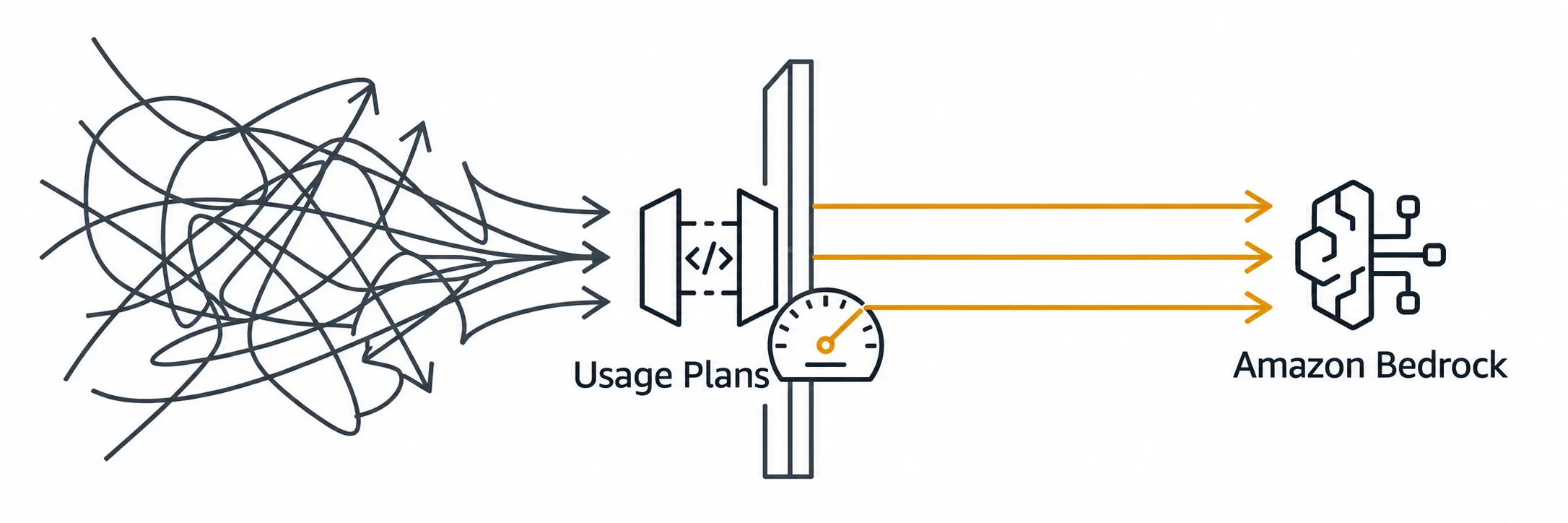
Traffic shaping and quota isolation using API Gateway Usage Plans.
Traffic Governance (Usage Plans and Throttling)
Foundation model capacity can easily saturate under uncontrolled traffic spikes.
- API Gateway Usage Plans and API Keys: Associates specific invocation limits, throttling policies, and monthly quotas with distinct client applications, teams, or tenants.
- Rate and Burst Limiting: Implements the token bucket algorithm to enforce steady-state Request-Per-Second (Rate) and peak capacity (Burst) limits at the edge.
- Downstream HTTP 429 Prevention: Filtering excess requests at the API Gateway perimeter prevents traffic spikes from exhausting Amazon Bedrock account-level Tokens Per Minute (TPM) and Requests Per Minute (RPM) service quotas.
💡 Exam Tip #2: To ingest events from third-party SaaS applications (such as CRMs, Zendesk, or GitHub) without risking message loss during sudden traffic surges, implement an asynchronous webhook pattern using an AWS Lambda handler that immediately publishes to Amazon EventBridge, backed by Amazon SQS queues or Dead-Letter Queues (DLQs) to smooth out downstream inference spikes.
Generative AI Microservice Deployment Strategies
Upgrades to generative AI pipelines involve more than updating application code; they introduce changes across system prompts, hyperparameter configurations (e.g., temperature, top-p), RAG vector index schemas, and foundation model base versions.

Gradual Canary traffic shifting compared to full cutover Blue/Green deployments.
- Canary Deployments: Production traffic shifts incrementally between the current version (v1) and the target release (v2)—for example, initially routing 10% of live traffic to v2 while retaining 90% on v1. Amazon CloudWatch monitors key operational metrics, including
HTTP 429throttling occurrences, Time to First Token (TTFT) latency degradation, and guardrail intervention rates. If anomalies or quality regressions occur, API Gateway automatically rolls back all traffic to v1, minimizing the blast radius. - Blue/Green Deployments: Two identical, independent production stacks coexist simultaneously. Once the target environment (Green) clears all automated verification and synthetic quality benchmarks, 100% of production traffic cuts over at the API Gateway stage or DNS routing layer. The baseline stack (Blue) remains on standby for instant cutback should unforeseen generative issues occur.
Complete Architecture Blueprint: Integrated GenAI Ingestion and Callback Pipeline
Integrating these serverless components produces an enterprise reference blueprint for asynchronous webhook ingestion, dynamic routing, resilient orchestration, and asynchronous client callbacks.

Complete architectural blueprint detailing decoupled webhook ingestion, EventBridge routing, Step Functions orchestration, Bedrock invocation, and client callbacks.
Architectural Flow Lifecycle
- The external SaaS application or client initiates a webhook notification to an Amazon API Gateway endpoint.
- API Gateway validates edge security (JWT/API Keys) and forwards the payload to an AWS Lambda webhook handler. The function records the event, initiates an immediate
HTTP 200 OKresponse to the sender, and decouples the synchronous channel. - Lambda publishes the normalized event to Amazon EventBridge, where configured Event Patterns evaluate the payload and invoke an AWS Step Functions state machine.
- AWS Step Functions orchestrates model execution, managing exponential backoff retry logic, invoking Bedrock Guardrails, and calling Amazon Bedrock.
- Upon inference completion, the Step Functions state machine issues an asynchronous HTTP Callback (or sends a WebSocket push notification) delivering the generated payload to the originating enterprise client without maintaining blocking connections.
💡 Exam Tip #3: When generative AI workflows involve long-running execution times, complex branches, or human-in-the-loop approvals (such as summarizing legal files, validating output policy against Bedrock Guardrails, and awaiting compliance sign-off), AWS Step Functions is the standard orchestration service with built-in error handling. Never chain synchronous, blocking Lambda functions for multi-step AI tasks with unpredictable runtimes.
Integration Patterns Comparison for GenAI Workloads
| Integration Pattern | Execution Pattern | Critical Limit | Optimized Metric | Response Delivery | Target AIP-C01 Scenario |
|---|---|---|---|---|---|
| Traditional Synchronous (REST API) | Blocking request-response model. | Hard 29-second maximum integration timeout in Amazon API Gateway. | Batch transaction throughput; consistent operational cost for deterministic endpoints. | Consolidated, monolithic payload returned upon complete generation. | Structured JSON generation, classification tasks, or short, deterministic text extraction. |
| Interactive Streaming (WebSocket API) | Persistent, stateful bidirectional TCP socket connection. | Requires socket connection state tracking and client connection lifecycle management. | Minimized perceived latency; optimized Time to First Token (TTFT). | Incremental text chunks streamed token-by-token in real time. | Conversational AI chatbots, code completion engines, and interactive customer support interfaces. |
| Asynchronous Event-Driven (Webhooks + EventBridge + Step Functions) | Fire-and-forget ingestion with decoupled asynchronous callback notification. | No immediate, inline payload response delivered within the incoming client HTTP thread. | High resilience against downstream model throttling; complete architectural decoupling. | Out-of-band notification delivered via reverse webhook or messaging queue callback. | SaaS event ingestion, batch document summarization, and multi-step agentic workflows. |
AIP-C01 Practice Questions
Question 1
An engineering team implemented an enterprise support assistant powered by Amazon Bedrock and exposed via an Amazon API Gateway REST API. During peak business hours, users report that complex customer questions result in web client errors displaying
HTTP 504 Gateway Timeout. Application logs confirm that the backend calls are successfully processing inside Amazon Bedrock, but comprehensive generation requires approximately 35 seconds.Which architectural modification resolves the root cause of this error while optimizing user experience?
A) Increase the route integration timeout of the REST API in Amazon API Gateway to 60 seconds using the AWS Management Console.
B) Transition the integration from a REST API to an Amazon API Gateway WebSocket API and invoke the model via
InvokeModelWithResponseStream to stream generated tokens progressively.C) Deploy an Amazon CloudFront distribution with caching enabled directly in front of the API Gateway REST API to handle responses asynchronously.
D) Provision a managed fleet of Amazon EC2 instances inside an Auto Scaling group to process requests to Amazon Bedrock using dedicated compute instances.
Question 2
A software development organization needs to integrate GitHub Actions webhook notifications with Amazon Bedrock to automate security reviews on pull requests. GitHub requires the webhook receiver endpoint to return an
HTTP 200 OK status within 3 seconds, or it marks the delivery as failed and initiates repetitive retries. Deep code analysis with the selected foundation model typically requires 20 seconds.How should a Solutions Architect design a serverless, decoupled integration architecture on AWS to satisfy these requirements?
A) Deploy an Amazon API Gateway REST API configured to invoke Amazon Bedrock directly using synchronous service integration.
B) Configure the incoming webhook to trigger an AWS Step Functions Synchronous Express State Machine that invokes Bedrock and awaits output before returning a response.
C) Receive the webhook request via Amazon API Gateway backed by an AWS Lambda function that publishes the event to an Amazon EventBridge event bus, returns an immediate
HTTP 200 OK, and triggers Bedrock asynchronously.D) Increase the execution memory of the AWS Lambda webhook handler to 10 GB to accelerate the downstream Amazon Bedrock inference duration to under 3 seconds.
Question 3
A Solutions Architect is reviewing a multi-tenant enterprise GenAI platform built on Amazon Bedrock. Recently, an automated load-testing script executed by one department consumed the total Bedrock service quota for the AWS account, triggering
ThrottlingException (HTTP 429) errors that degraded mission-critical generative workloads across all other business units.Which mechanism should the architect implement in Amazon API Gateway to isolate tenant capacity and enforce independent traffic limits across departments?
A) Configure AWS WAF global rate-based rules associated with the API Gateway endpoint to block requests originating from the internal corporate network CIDR.
B) Configure Usage Plans paired with dedicated API Keys, applying distinct Rate and Burst limits for each individual department.
C) Enable Amazon API Gateway stage-level caching with a Time-to-Live (TTL) of 3,600 seconds across all API methods.
D) Provision dedicated AWS PrivateLink VPC endpoints for Amazon Bedrock for each individual department.
Question 4
A financial institution is deploying a revised system prompt and adjusted inference hyperparameters (temperature and top-p) for a regulatory compliance reporting microservice powered by Amazon Bedrock. To reduce operational risk, governance policies mandate that the updated prompt receive only 10% of live production traffic initially, while the remaining 90% stays on the proven baseline version. The deployment must continuously monitor Amazon CloudWatch metrics and automatically revert if anomalies occur.
Which deployment strategy fulfills these requirements?
A) A Blue/Green Deployment executing an instantaneous 100% DNS weighted cutover in Amazon Route 53.
B) An In-Place Deployment applied directly to the active production AWS Lambda function code and configuration.
C) A Canary Deployment configured on the Amazon API Gateway deployment stage with a gradual percentage-based traffic shift.
D) A Rolling Deployment distributing the update sequentially across multiple Availability Zones (AZs).
Detailed Explanations and Answer Key
Answer to Question 1
- Correct Answer: B
- Explanation: Amazon API Gateway enforces an unalterable hard limit of 29 seconds on integration timeouts for REST and HTTP APIs. Migrating the client connection to an API Gateway WebSocket API establishes a persistent, stateful, bidirectional channel. When combined with the Amazon Bedrock streaming API (
InvokeModelWithResponseStream), tokens stream to the client in discrete chunks as they are generated. This architectural change bypasses the 29-second synchronous integration limit and lowers the Time to First Token (TTFT). - Incorrect Explanations:
- A: The 29-second integration timeout for REST/HTTP APIs in API Gateway cannot be increased via the AWS Console or service quota adjustments.
- C: Amazon CloudFront caches static or existing completed responses; it does not transform a blocking synchronous backend call into an asynchronous inference pipeline.
- D: Introducing Amazon EC2 instances introduces unnecessary management overhead and does not resolve the 29-second timeout enforced at the API Gateway ingress layer.
Answer to Question 2
- Correct Answer: C
- Explanation: Ingesting webhooks from external SaaS platforms requires immediate acknowledgment to avoid transmission failure and automated retry loops. The standard AWS pattern uses an AWS Lambda function behind API Gateway as an elastic ingestion handler. Lambda validates the payload, publishes the event to an Amazon EventBridge bus, and immediately returns an
HTTP 200 OKresponse to GitHub within milliseconds. EventBridge then routes the event asynchronously to downstream compute or orchestration layers to invoke Amazon Bedrock. - Incorrect Explanations:
- A: The synchronous inference latency of 20 seconds violates GitHub's 3-second webhook timeout requirement, causing persistent delivery retries.
- B: Synchronous Express Step Functions keep the client connection open until the entire execution completes, exceeding the 3-second limit.
- D: Amazon Bedrock runs foundation model inference on its own managed service infrastructure; modifying the memory configuration of the ingestion Lambda function has no impact on Bedrock inference latency.
Answer to Question 3
- Correct Answer: B
- Explanation: Amazon API Gateway Usage Plans combined with API Keys allow administrators to define granular, tenant-level traffic policies. By configuring distinct sustained request rates (Rate) and maximum peak capacities (Burst) for each department, the gateway throttles rogue or unoptimized scripts at the perimeter. This isolates tenants, resolves noisy neighbor conflicts, and protects upstream Amazon Bedrock TPM/RPM quotas.
- Incorrect Explanations:
- A: Implementing IP-based blocking with AWS WAF would block legitimate corporate network users sharing the egress IP address.
- C: Caching reduces load for repeated, identical requests, but does not constrain arbitrary, distinct queries generated by unconstrained scripts.
- D: AWS PrivateLink VPC endpoints provide private network connectivity to Amazon Bedrock; they do not enforce tenant invocation limits or request rate throttling.
Answer to Question 4
- Correct Answer: C
- Explanation: A Canary Deployment on Amazon API Gateway allows architects to route a controlled fraction of live production traffic (such as 10%) to a newly deployed canary stage, while keeping the majority (90%) on the stable deployment stage. Amazon CloudWatch tracks integration errors, latency, and guardrail trip rates. If regressions occur, traffic rolls back instantly to the base stage with minimal operational impact.
- Incorrect Explanations:
- A: Blue/Green deployments switch 100% of production traffic at the cutover moment, violating the requirement to route an initial 10% slice.
- B: In-Place deployments overwrite active application artifacts in place, exposing all users immediately to potential prompt defects or runtime errors without traffic splitting.
- D: Rolling deployments across Availability Zones apply to containerized or host-based deployments (such as Amazon ECS or Amazon EKS), not to serverless API Gateway deployment stages.
Summary and Key Takeaways
Architecting enterprise-grade Generative AI applications on AWS requires treating Amazon Bedrock as a managed compute engine orchestrated within a serverless ecosystem. Amazon API Gateway provides perimeter defense, applying JWT validation, tenant isolation via Usage Plans, and timeout management, while enabling WebSocket APIs with response streaming for responsive user experiences.

Architectural Patterns Overview: API Gateway, EventBridge, Lambda, and Bedrock
In enterprise integration environments, decoupled webhook handling via AWS Lambda, intelligent event pattern routing via Amazon EventBridge, and resilient orchestration through AWS Step Functions ensure that upstream systems remain responsive despite unpredictable model latencies. By applying these integration patterns alongside automated Canary deployments, builders deliver resilient, cost-effective Generative AI architectures aligned with the requirements of the AWS Certified Generative AI Developer Professional (AIP-C01) exam.
Series: AIP-C01 | Task 2.3: Design and implement enterprise integration architectures. (5 articles)
- 2Microservices, Webhooks, and API Gateway Integration for Generative AI This article
Enjoyed reading this content? Let the author know!
Your likes, comments, shares, and saves help creators reach more builders.

Loading recommendations
Loading article