
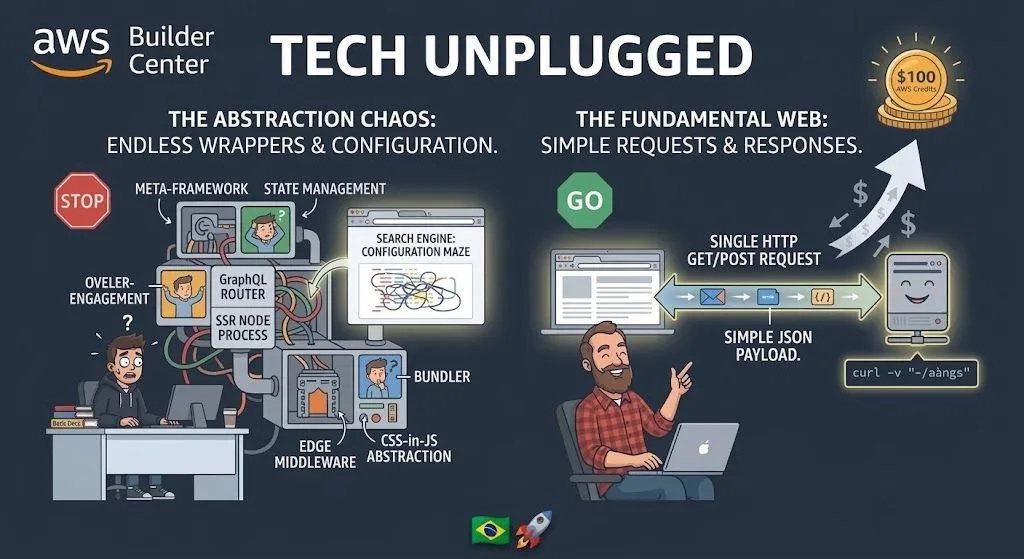
Why Your Favorite Framework Is Just a Giant Wrapper Around HTTP Requests
A brutally honest breakdown of modern web development frameworks: why we spend months learning complex abstractions, state machines, and proprietary magic, only to realize that 90% of what we do is just passing JSON back and forth over basic HTTP sockets.
Series: Tech Unplugged (7 articles)
- …
- 3Why Your Favorite Framework Is Just a Giant Wrapper Around HTTP Requests This article

Every few months, a new JavaScript framework or backend architecture drops, promising to "revolutionize developer experience," solve state management forever, and introduce a brand-new paradigm that will make everything you wrote last year look like prehistoric cave paintings. We jump on Twitter, watch three-hour migration tutorials, and start rewriting our side projects because, God forbid, we aren't using the absolute bleeding edge of technology.
Let’s take a collective deep breath and state the obvious: your favorite, hyper-optimized, opinionated framework is mostly just a giant, beautifully styled wrapper around an HTTP request and a response object.
The Abstraction Rabbit Hole
We have built an incredible house of cards on top of the web. To render a simple button on a screen, modern applications often require a client-side bundler, a server-side rendering node process, an edge middleware function, a GraphQL query router, a state hydration layer, and twelve different CSS-in-JS abstraction libraries.
If you trace the execution flow of a user clicking that button, you realize that 99% of this stack exists solely to manage the sheer friction created by previous layers of abstraction. We invented complex problems just so we could use complex tools to solve them, while the browser is just sitting there waiting for a simple JSON payload over a TCP connection.
Resume-Driven Stack Chasing
Why do we do this to ourselves? Because "I built a blazing-fast CRUD app using raw sockets and basic routing" doesn't look as impressive on a resume as "Architected a distributed, event-driven micro-frontend matrix using cutting-edge meta-frameworks."
We chase complexity because the tech industry rewards shiny things. We spend weeks configuring build pipelines and arguing over which state management library is morally superior, losing sight of the actual product we are supposed to be delivering.
Back to basics
Next time you find yourself knee-deep in configuration files trying to force a bloated framework to do something simple, remember how the web actually works. Underneath the marketing hype, the compiler magic, and the 500 megabytes of node_modules, it’s still just a client asking for data, and a server sending it back.
Stop letting complex abstractions intimidate you. Master the fundamentals, build what works, and remember that you don't need a spaceship framework to launch a simple website.
Series: Tech Unplugged (7 articles)
- …
- 3Why Your Favorite Framework Is Just a Giant Wrapper Around HTTP Requests This article
Enjoyed reading this content? Let the author know!
Your likes, comments, shares, and saves help creators reach more builders.

Loading recommendations
Loading article