
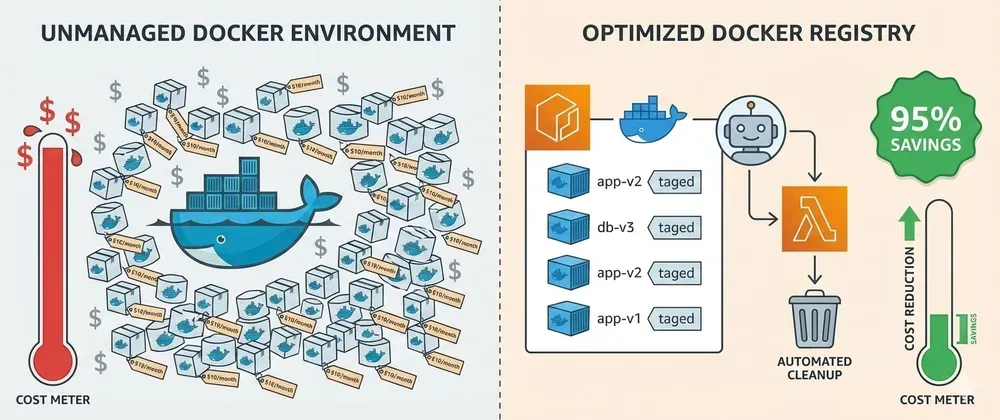
Your Docker Registry Has 500 Unused Images Costing You Every Month 🐳
ECR charges per GB for every Docker image ever pushed. Here's how to auto-delete old images with Terraform lifecycle policies and reclaim 80% of that storage.
Series: Save on AWS with Terraform (21 articles)
- …
- 10Your Docker Registry Has 500 Unused Images Costing You Every Month 🐳 This article

ECR charges per GB for every Docker image ever pushed. Here's how to auto-delete old images with Terraform lifecycle policies and reclaim 80% of that storage.
tags: aws, terraform, docker, devops
Quick question: How many Docker images are in your ECR registry right now?
If you've been pushing images from CI/CD for the past year, the answer is probably hundreds or thousands.
Here's the problem:
ECR storage: $0.10/GB-monthYour images: 500 images × 500MB avg = 250GBMonthly cost: $25Annual cost: $300
And it grows every single day.
You're literally paying for every failed build, every test branch, every "quick-fix" from 6 months ago.
Most teams only use the last 5-10 images. The rest? Dead weight costing you money.
Let me show you how to automatically clean up old images with Terraform and recover 70-90% of that storage cost.
💸 The ECR Storage Problem
ECR pricing is simple: $0.10/GB per month
But Docker images add up fast:
Typical Node.js app:
- Base image: ~200MB
- With dependencies: ~500MB
- Builds per day: 10 (main + PR branches)
- Days per year: 365
- Total images/year: 3,650 images
- Storage/year: 1,825GB
- Annual cost: $2,190 💰
And that's just one application.
What you actually need:
- Latest 10 production images: 5GB
- Latest 5 staging images: 2.5GB
- Total needed: 7.5GB
- Should cost: $0.75/month
You're paying 30x more than necessary.
🎯 The Solution: ECR Lifecycle Policies
ECR has built-in lifecycle policies that auto-delete images based on:
- Image age - Delete images older than X days
- Image count - Keep only last N images
- Tag status - Different rules for tagged vs untagged
One Terraform resource. Set it once. Forget it forever.
🛠️ Terraform Implementation
Basic Lifecycle Policy (Keep Last 10 Images)
# ecr-lifecycle.tf
resource "aws_ecr_repository" "app" {  name                 = "my-app"  image_tag_mutability = "MUTABLE"
  image_scanning_configuration {    scan_on_push = true  }
  tags = {    Name = "my-app"  }}
resource "aws_ecr_lifecycle_policy" "app" {  repository = aws_ecr_repository.app.name
  policy = jsonencode({    rules = [      {        rulePriority = 1        description  = "Keep last 10 images"        selection = {          tagStatus   = "any"          countType   = "imageCountMoreThan"          countNumber = 10        }        action = {          type = "expire"        }      }    ]  })}
Deploy it:
terraform apply
# ECR will automatically delete images beyond the 10 most recent# Runs daily, no manual intervention needed
Savings from this alone: 70-90% of storage costs! 🎉
Advanced: Multi-Environment Lifecycle Policy
# ecr-lifecycle-advanced.tf
resource "aws_ecr_lifecycle_policy" "multi_env" {  repository = aws_ecr_repository.app.name
  policy = jsonencode({    rules = [      # Rule 1: Keep last 20 production images (tagged)      {        rulePriority = 1        description  = "Keep last 20 production images"        selection = {          tagStatus     = "tagged"          tagPrefixList = ["prod-", "v"]          countType     = "imageCountMoreThan"          countNumber   = 20        }        action = {          type = "expire"        }      },      # Rule 2: Keep last 10 staging images      {        rulePriority = 2        description  = "Keep last 10 staging images"        selection = {          tagStatus     = "tagged"          tagPrefixList = ["staging-"]          countType     = "imageCountMoreThan"          countNumber   = 10        }        action = {          type = "expire"        }      },      # Rule 3: Delete untagged images older than 7 days      {        rulePriority = 3        description  = "Delete untagged images after 7 days"        selection = {          tagStatus   = "untagged"          countType   = "sinceImagePushed"          countUnit   = "days"          countNumber = 7        }        action = {          type = "expire"        }      },      # Rule 4: Keep only last 5 dev/feature branch images      {        rulePriority = 4        description  = "Keep last 5 dev images"        selection = {          tagStatus     = "tagged"          tagPrefixList = ["dev-", "feature-"]          countType     = "imageCountMoreThan"          countNumber   = 5        }        action = {          type = "expire"        }      },      # Rule 5: Catch-all - delete any images older than 30 days      {        rulePriority = 5        description  = "Delete any remaining images older than 30 days"        selection = {          tagStatus   = "any"          countType   = "sinceImagePushed"          countUnit   = "days"          countNumber = 30        }        action = {          type = "expire"        }      }    ]  })}
Production-Ready Module
# modules/ecr-with-lifecycle/main.tf
variable "repository_name" {  description = "ECR repository name"  type        = string}
variable "prod_image_count" {  description = "Number of production images to keep"  type        = number  default     = 20}
variable "staging_image_count" {  description = "Number of staging images to keep"  type        = number  default     = 10}
variable "dev_image_count" {  description = "Number of dev/feature images to keep"  type        = number  default     = 5}
variable "untagged_days" {  description = "Days to keep untagged images"  type        = number  default     = 7}
resource "aws_ecr_repository" "this" {  name                 = var.repository_name  image_tag_mutability = "MUTABLE"
  encryption_configuration {    encryption_type = "AES256"  }
  image_scanning_configuration {    scan_on_push = true  }
  tags = {    Name       = var.repository_name    ManagedBy  = "terraform"  }}
resource "aws_ecr_lifecycle_policy" "this" {  repository = aws_ecr_repository.this.name
  policy = jsonencode({    rules = [      {        rulePriority = 1        description  = "Keep last ${var.prod_image_count} production images"        selection = {          tagStatus     = "tagged"          tagPrefixList = ["prod-", "release-", "v"]          countType     = "imageCountMoreThan"          countNumber   = var.prod_image_count        }        action = { type = "expire" }      },      {        rulePriority = 2        description  = "Keep last ${var.staging_image_count} staging images"        selection = {          tagStatus     = "tagged"          tagPrefixList = ["staging-", "stage-"]          countType     = "imageCountMoreThan"          countNumber   = var.staging_image_count        }        action = { type = "expire" }      },      {        rulePriority = 3        description  = "Delete untagged images after ${var.untagged_days} days"        selection = {          tagStatus   = "untagged"          countType   = "sinceImagePushed"          countUnit   = "days"          countNumber = var.untagged_days        }        action = { type = "expire" }      },      {        rulePriority = 4        description  = "Keep last ${var.dev_image_count} dev/feature images"        selection = {          tagStatus     = "tagged"          tagPrefixList = ["dev-", "feature-"]          countType     = "imageCountMoreThan"          countNumber   = var.dev_image_count        }        action = { type = "expire" }      }    ]  })}
output "repository_url" {  value = aws_ecr_repository.this.repository_url}
output "repository_arn" {  value = aws_ecr_repository.this.arn}
Usage
# main.tf
module "api_ecr" {  source = "./modules/ecr-with-lifecycle"
  repository_name     = "api-service"  prod_image_count    = 30  staging_image_count = 15  dev_image_count     = 5  untagged_days       = 7}
module "web_ecr" {  source = "./modules/ecr-with-lifecycle"
  repository_name     = "web-frontend"  prod_image_count    = 20  staging_image_count = 10  dev_image_count     = 3  untagged_days       = 3}
output "api_url" {  value = module.api_ecr.repository_url}
📊 Before/After Comparison
Before Lifecycle Policies
Repository: api-serviceImages: 847 total  - prod-* : 234 images  - staging-*: 198 images  - feature-*: 312 images  - untagged: 103 images
Total size: 423GBMonthly cost: $42.30Annual cost: $507.60
After Lifecycle Policies
Repository: api-serviceImages: 45 total  - prod-* : 20 images (kept last 20)  - staging-*: 10 images (kept last 10)  - feature-*: 15 images (kept last 5 per branch)  - untagged: 0 images (deleted after 7 days)
Total size: 22.5GBMonthly cost: $2.25Annual cost: $27
Savings: $480.60/year (95% reduction!) 🎉
💡 Pro Tips
1. Test Lifecycle Policies First
ECR has a preview feature:
# See what WOULD be deleted without actually deletingaws ecr get-lifecycle-policy-preview \ --repository-name api-serviceUnfortunately, Terraform doesn't support this directly. Start with generous retention:
prod_image_count = 50  # Start highdev_image_count  = 20  # Start high
# Gradually decrease over time
2. Tag Your Images Properly
Lifecycle policies work best with consistent tagging:
# In your CI/CD pipelinedocker tag myapp:latest $ECR_URL:prod-${GIT_SHA}docker tag myapp:latest $ECR_URL:staging-${GIT_SHA}docker tag myapp:latest $ECR_URL:feature-${BRANCH_NAME}-${GIT_SHA}3. Monitor Deletions
Set up CloudWatch alerts:
resource "aws_cloudwatch_metric_alarm" "ecr_deletions" {  alarm_name          = "ecr-high-deletions"  comparison_operator = "GreaterThanThreshold"  evaluation_periods  = 1  metric_name         = "RepositoryPullCount"  namespace           = "AWS/ECR"  period              = 86400  statistic           = "Sum"  threshold           = 100
  dimensions = {    RepositoryName = "api-service"  }}
4. Exclude Critical Images
If you need to keep specific images forever:
# Option 1: Use a special tag prefix not in lifecycle rulesdocker tag myapp:latest $ECR_URL:keep-forever-v1.0.0
# Option 2: Create separate repository for long-term imagesmodule "releases_ecr" {  source = "./modules/ecr-with-lifecycle"    repository_name  = "api-service-releases"  prod_image_count = 100  # Keep many more}
🎓 Common Tagging Strategies
Strategy 1: Environment-Based
prod-abc123staging-abc123dev-feature-xyzWorks well with lifecycle rules based on tag prefix.
Strategy 2: Semantic Versioning
v1.2.3v1.2.4-rc1latestGood for release management, harder for lifecycle automation.
Strategy 3: Combined
prod-v1.2.3-abc123staging-v1.2.3-abc123Best of both worlds - clear environment + version.
⚠️ Gotchas to Watch Out For
1. Rule Priority Matters
Rules are evaluated in order. More specific rules should have lower priority numbers:
rulePriority = 1 # Most specific (prod images)rulePriority = 2 # Less specific (staging)rulePriority = 5 # Catch-all (everything else)2. Untagged Images Pile Up Fast
Failed builds leave untagged images. Always have a cleanup rule:
{ rulePriority = 99 description = "Cleanup untagged" selection = { tagStatus = "untagged" countType = "sinceImagePushed" countUnit = "days" countNumber = 1 # Delete after 1 day } action = { type = "expire" }}3. Images In Use Won't Delete
ECR won't delete images currently in use by ECS/EKS. This is good! But your count might be higher than expected.
🚀 Quick Start
# 1. Check current storage usageaws ecr describe-repositories \  --query 'repositories[*].[repositoryName]' \  --output table
# For each repository, get image countaws ecr list-images \  --repository-name api-service \  --query 'length(imageIds)'
# 2. Deploy lifecycle policyterraform apply
# 3. Wait 24 hours (ECR runs cleanup daily)
# 4. Verify reductionaws ecr list-images \  --repository-name api-service \  --query 'length(imageIds)'
# 5. Check cost savings next month 💰
📈 Real-World Impact
Startup with 5 microservices:
Before:
- 5 repositories
- Average 600 images each = 3,000 total
- Average 500MB per image = 1,500GB
- Monthly cost: $150
- Annual cost: $1,800
After (lifecycle policies):
- 5 repositories
- Average 30 images each = 150 total
- Total: 75GB
- Monthly cost: $7.50
- Annual cost: $90
Savings: $1,710/year (95% reduction!)
Implementation time: 30 minutes
Ongoing maintenance: Zero
🎯 Summary
The Problem:
- ECR charges $0.10/GB per month
- CI/CD pushes hundreds/thousands of images
- Old images never get deleted
- Storage costs grow indefinitely
The Solution:
- ECR lifecycle policies (built-in feature)
- Auto-delete based on age or count
- Different rules per environment
- Set once, runs forever
The Result:
- Typical savings: 70-95% of ECR costs
- Keep only what you need (last 5-20 images)
- Zero ongoing maintenance
- One Terraform resource
Stop paying for every Docker image you've ever built. Set lifecycle policies today and reclaim your storage. 🚀
Implemented ECR lifecycle policies? How many images did you delete? Share in the comments! 💬
Follow for more AWS cost optimization with Terraform! ⚡
Series: Save on AWS with Terraform (21 articles)
- …
- 10Your Docker Registry Has 500 Unused Images Costing You Every Month 🐳 This article
Enjoyed reading this content? Let the author know!
Your likes, comments, shares, and saves help creators reach more builders.

Loading recommendations
Loading article