
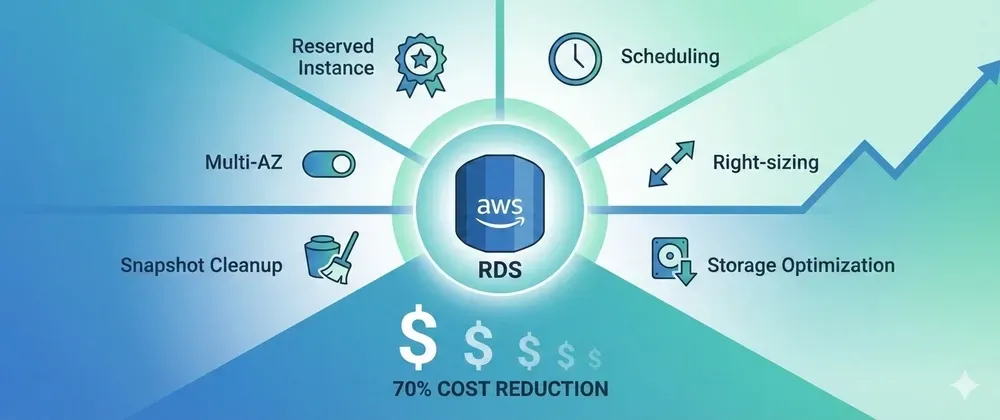
Cut Your AWS RDS Bill by 70%: The Complete Cost Optimization Playbook 💰
Reduce Your AWS RDS Bill and Cost Optimization Playbook using Terraform
Series: Save on AWS with Terraform (21 articles)
- …
- 5Cut Your AWS RDS Bill by 70%: The Complete Cost Optimization Playbook 💰 This article

From automated dev/test auto-resize to right-sizing and storage optimization—here's how to slash RDS costs with Terraform without sacrificing performance.
Your RDS database is probably your second-highest AWS cost after EC2. And if you're like most teams, you're overpaying by 50-70%.
Here's why:
- Dev/test databases running at full capacity 24/7 (you only need full power during business hours)
- Production instances sized for peak load that happens 1% of the time
- Multi-AZ enabled everywhere "just in case"
- gp2 storage when gp3 is 20% cheaper
- Snapshots piling up from instances deleted 2 years ago
Sound familiar? Let's fix all of this with Terraform automation.
💸 The RDS Cost Breakdown
A typical $5,000/month RDS bill looks like:
Instance hours: $3,200 (64%) ← Biggest targetStorage: $1,000 (20%) ← Easy winsBackups/snapshots: $400 (8%) ← Often wastedData transfer: $300 (6%) ← Sneaky costsMulti-AZ premium: $100 (2%) ← Necessary evil?Our strategy: Attack each of these systematically with Terraform.
🎯 Strategy #1: Dev/Test Auto-Resize (45% Savings)
Automatically downsize instances during nights and weekends. Keeps databases available 24/7 but at significantly lower cost.
The Math:
- Dev database at db.t3.large 24/7: $200/month
- Auto-resize: db.t3.large (50 hrs/wk) + db.t3.small (118 hrs/wk): $110/month
- Savings: 45% 🎉
Implementation
# modules/rds-auto-resize/main.tf
variable "rds_instances" {  type = map(object({    identifier           = string    business_hours_class = string  # e.g., "db.t3.large"    off_hours_class     = string  # e.g., "db.t3.small"    scale_up_cron       = string    scale_down_cron     = string  }))}
resource "aws_lambda_function" "rds_resizer" {  filename         = data.archive_file.lambda.output_path  function_name    = "rds-auto-resizer"  role            = aws_iam_role.lambda.arn  handler         = "index.handler"  runtime         = "python3.11"  timeout         = 600  source_code_hash = data.archive_file.lambda.output_base64sha256}
data "archive_file" "lambda" {  type        = "zip"  output_path = "${path.module}/lambda.zip"  source {    content  = <<-EOFimport boto3import json
rds = boto3.client('rds')
def handler(event, context):    db_identifier = event['db_identifier']    target_class = event['target_instance_class']        try:        response = rds.describe_db_instances(DBInstanceIdentifier=db_identifier)        current_class = response['DBInstances'][0]['DBInstanceClass']                if current_class == target_class:            return {'statusCode': 200, 'body': 'Already at target size'}                rds.modify_db_instance(            DBInstanceIdentifier=db_identifier,            DBInstanceClass=target_class,            ApplyImmediately=True        )                return {'statusCode': 200, 'body': f'Resized to {target_class}'}    except Exception as e:        return {'statusCode': 500, 'body': str(e)}EOF    filename = "index.py"  }}
resource "aws_iam_role" "lambda" {  name = "rds-resizer-lambda"  assume_role_policy = jsonencode({    Version = "2012-10-17"    Statement = [{      Action = "sts:AssumeRole"      Effect = "Allow"      Principal = { Service = "lambda.amazonaws.com" }    }]  })}
resource "aws_iam_role_policy" "lambda_rds" {  role = aws_iam_role.lambda.id  policy = jsonencode({    Version = "2012-10-17"    Statement = [{      Effect = "Allow"      Action = ["rds:ModifyDBInstance", "rds:DescribeDBInstances", "logs:CreateLogGroup", "logs:CreateLogStream", "logs:PutLogEvents"]      Resource = "*"    }]  })}
resource "aws_cloudwatch_event_rule" "scale_down" {  for_each            = var.rds_instances  name                = "rds-scale-down-${each.key}"  schedule_expression = "cron(${each.value.scale_down_cron})"}
resource "aws_cloudwatch_event_rule" "scale_up" {  for_each            = var.rds_instances  name                = "rds-scale-up-${each.key}"  schedule_expression = "cron(${each.value.scale_up_cron})"}
resource "aws_cloudwatch_event_target" "scale_down" {  for_each = var.rds_instances  rule     = aws_cloudwatch_event_rule.scale_down[each.key].name  arn      = aws_lambda_function.rds_resizer.arn  input = jsonencode({    db_identifier         = each.value.identifier    target_instance_class = each.value.off_hours_class  })}
resource "aws_cloudwatch_event_target" "scale_up" {  for_each = var.rds_instances  rule     = aws_cloudwatch_event_rule.scale_up[each.key].name  arn      = aws_lambda_function.rds_resizer.arn  input = jsonencode({    db_identifier         = each.value.identifier    target_instance_class = each.value.business_hours_class  })}
resource "aws_lambda_permission" "allow_eventbridge" {  for_each      = merge(    { for k, v in var.rds_instances : "down-${k}" => aws_cloudwatch_event_rule.scale_down[k].arn },    { for k, v in var.rds_instances : "up-${k}" => aws_cloudwatch_event_rule.scale_up[k].arn }  )  statement_id  = "AllowEventBridge-${each.key}"  action        = "lambda:InvokeFunction"  function_name = aws_lambda_function.rds_resizer.function_name  principal     = "events.amazonaws.com"  source_arn    = each.value}
Usage
module "rds_auto_resize" { source = "./modules/rds-auto-resize" rds_instances = { dev = { identifier = "myapp-dev" business_hours_class = "db.t3.large" off_hours_class = "db.t3.small" scale_up_cron = "0 8 ? * MON-FRI *" # 8 AM weekdays scale_down_cron = "0 18 ? * MON-FRI *" # 6 PM weekdays } staging = { identifier = "myapp-staging" business_hours_class = "db.t3.xlarge" off_hours_class = "db.t3.medium" scale_up_cron = "0 7 ? * MON-FRI *" scale_down_cron = "0 20 ? * MON-FRI *" } }}Note: Resizing causes a brief 1-2 minute connection interruption. Most apps with connection pooling handle this automatically.
🎯 Strategy #2: Right-Sizing Instances (30-40% Savings)
Most RDS instances are sized for peak load. Downsize to match actual usage.
Find Oversized Instances
data "aws_cloudwatch_metric_statistics" "cpu" {  for_each    = toset(["myapp-prod", "myapp-staging"])  namespace   = "AWS/RDS"  metric_name = "CPUUtilization"  period      = 86400  stat        = "Average"  start_time  = timeadd(timestamp(), "-30d")  end_time    = timestamp()  dimensions  = { DBInstanceIdentifier = each.key }}
output "rightsizing_candidates" {  value = {    for id, stats in data.aws_cloudwatch_metric_statistics.cpu :    id => "Avg CPU: ${mean(stats.datapoints[*].average)}%"    if mean(stats.datapoints[*].average) < 40  }}
Rule of thumb: If average CPU < 40%, downsize one tier (e.g., db.r6g.xlarge → db.r6g.large).
Use Burstable Instances for Dev/Test
resource "aws_db_instance" "dev" { identifier = "myapp-dev" instance_class = "db.t3.medium" # Burstable, much cheaper engine = "postgres" allocated_storage = 100 storage_type = "gp3" multi_az = false backup_retention_period = 7 skip_final_snapshot = true}
🎯 Strategy #3: Storage Optimization (20% Savings)
Migrate gp2 → gp3
resource "aws_db_instance" "optimized" { identifier = "myapp-prod" storage_type = "gp3" # 20% cheaper than gp2 iops = 3000 # Baseline included (free) throughput = 125 # MB/s baseline included (free) allocated_storage = 500}Instant savings: 20% on storage costs with better performance. gp3 baseline (3,000 IOPS, 125 MB/s) is included at no extra cost.
🎯 Strategy #4: Snapshot Cleanup (30-50% Savings)
Old snapshots cost $0.095/GB-month and pile up quickly.
Automated Retention
resource "aws_db_instance" "prod" { identifier = "myapp-prod" backup_retention_period = 30 # Keep 30 days only backup_window = "03:00-04:00" skip_final_snapshot = var.environment != "production"}Manual Cleanup Script
# Delete snapshots older than 35 daysaws rds describe-db-snapshots --snapshot-type manual \ --query "DBSnapshots[?SnapshotCreateTime<='$(date -d '35 days ago' -Iso)'].DBSnapshotIdentifier" \ --output text | xargs -n1 aws rds delete-db-snapshot --db-snapshot-identifier
🎯 Strategy #5: Multi-AZ Optimization (50% Savings)
Multi-AZ doubles your instance cost. Only use for critical production databases.
locals {  multi_az_config = {    production = true   # Critical, customer-facing    staging    = false  # Can tolerate brief downtime    dev        = false  # Definitely not needed  }}
resource "aws_db_instance" "db" {  for_each = local.multi_az_config    identifier     = "myapp-${each.key}"  instance_class = each.key == "production" ? "db.r6g.large" : "db.t3.medium"  multi_az       = each.value    backup_retention_period = each.value ? 30 : 7}
Savings: $200/month per non-production database by removing unnecessary Multi-AZ.
🎯 Strategy #6: Reserved Instances (40-60% Savings)
For stable production workloads, purchase RIs:
# Find your stable instancesaws rds describe-db-instances \  --query 'DBInstances[?DBInstanceStatus==`available`].[DBInstanceIdentifier,DBInstanceClass]' \  --output table
# Purchase via AWS Console: RDS → Reserved Instances → Purchase# - 1-year RI: 40% savings# - 3-year RI: 60% savings (all-upfront for max discount)
Pro tip: Start with 1-year RIs, upgrade to 3-year once workload is proven stable.
📊 Real-World Example: Complete Optimization
Before (Typical startup with 10 RDS instances):
3 Production (Multi-AZ, r6g.xlarge, gp2): $2,400/month3 Staging (Multi-AZ, r6g.large, gp2): $1,200/month4 Dev (t3.large, gp2, 24/7 full size): $800/monthSnapshots (500 GB): $48/monthTotal: $4,448/monthAfter (Optimized with Terraform):
3 Production (Multi-AZ, r6g.large, gp3, RI): $960/month (RI discount + right-sized + gp3)3 Staging (Single-AZ, t3.large, gp3): $450/month (removed Multi-AZ + gp3)4 Dev (auto-resize t3.medium/small, gp3): $280/month (auto-resize + gp3)Snapshots (200 GB with lifecycle): $19/month (automated cleanup)Total: $1,709/monthAnnual savings: $32,868 💰
⚡ Quick Implementation Checklist
Week 1: Quick wins (Low effort, high impact)
- ✅ Enable dev/test auto-resize module (45% savings immediately)
- ✅ Migrate gp2 → gp3 storage (20% storage savings, zero downtime)
- ✅ Run snapshot cleanup script (30-50% backup savings)
Week 2: Right-sizing (Requires analysis)
- ✅ Query CloudWatch metrics for CPU utilization
- ✅ Identify oversized instances (avg CPU < 40%)
- ✅ Downsize dev/test to burstable instances
- ✅ Test smaller instance classes in staging
Week 3: Architectural changes
- ✅ Remove unnecessary Multi-AZ from non-production
- ✅ Set up automated snapshot lifecycle policies
- ✅ Verify backups are working correctly
Week 4: Long-term commitments
- ✅ Analyze stable production workloads
- ✅ Purchase 1-year Reserved Instances
- ✅ Document RI strategy for future purchases
- ✅ Set up monthly cost review process
🎯 Summary: Savings by Strategy
Strategy | Effort | Savings | Risk | Priority |
|---|---|---|---|---|
Dev/test auto-resize | Low | 45% | Low | 🔥 Do first |
gp2 → gp3 migration | Low | 20% | None | 🔥 Do first |
Snapshot cleanup | Low | 30-50% | Low | High |
Right-sizing | Medium | 30-40% | Medium | High |
Remove unnecessary Multi-AZ | Low | 50% | Medium | Medium |
Reserved Instances | Low | 40-60% | Low | Medium |
Expected total: 50-70% of RDS costs
For a $5,000/month RDS bill, that's $2,500-$3,500/month saved = $30,000-$42,000/year 🚀
💡 Pro Tips
- Start with dev/test auto-resize - Easiest win, 45% savings, minimal risk
- Use Cost Explorer tags - Tag instances with
Environment,Team,CostCenterfor tracking
- Test resizing manually first - Verify your app handles brief connection interruptions
- Don't over-optimize production - Saving $100/month isn't worth a 3 AM outage
- Review quarterly - Workloads change, revisit right-sizing every 3 months
What's your biggest RDS cost pain point? Share in the comments! 💬
Follow for more AWS cost optimization strategies! ⚡
Series: Save on AWS with Terraform (21 articles)
- …
- 5Cut Your AWS RDS Bill by 70%: The Complete Cost Optimization Playbook 💰 This article
Enjoyed reading this content? Let the author know!
Your likes, comments, shares, and saves help creators reach more builders.

Loading recommendations
Loading article