
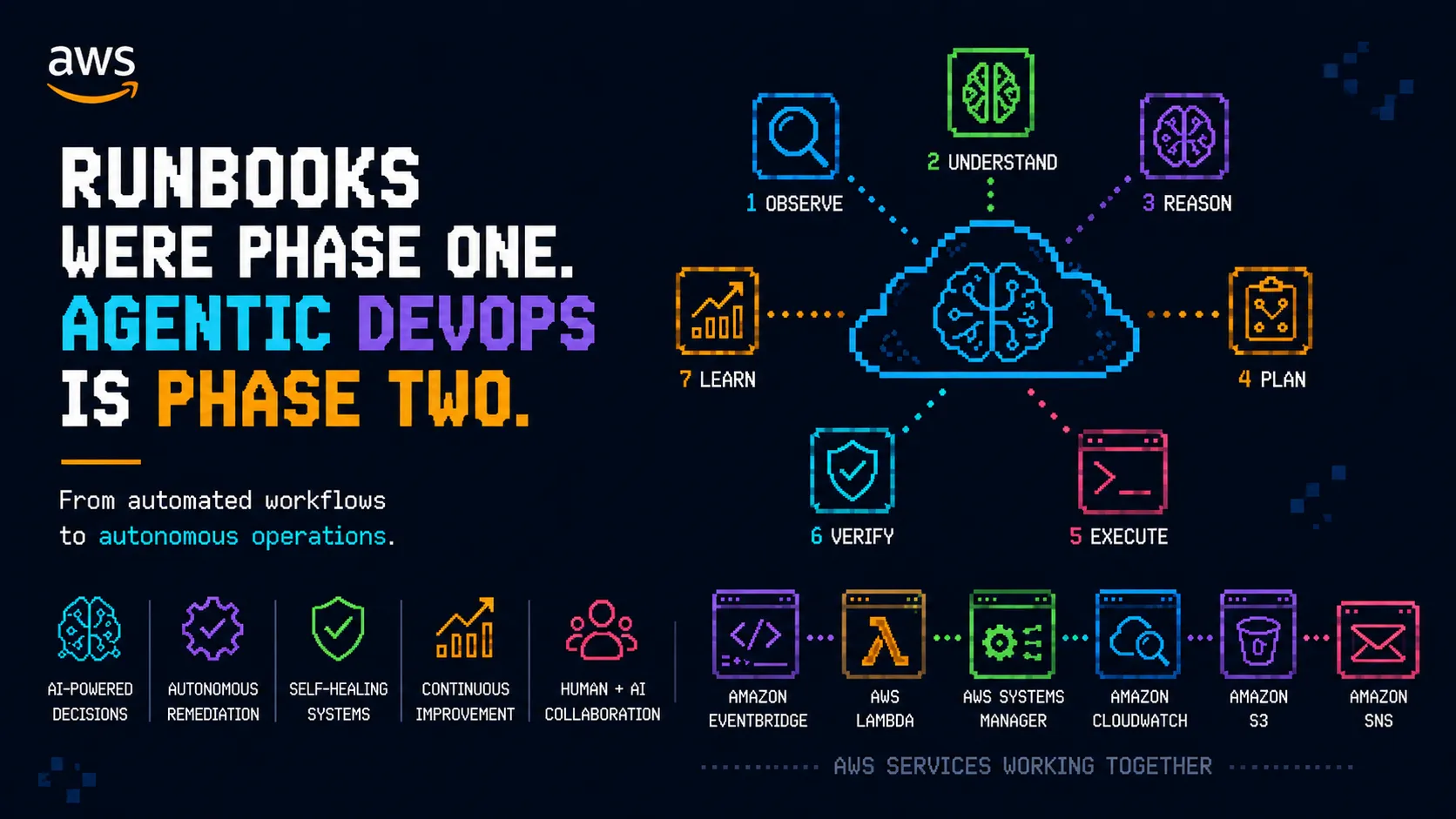
Runbooks Were Phase One. Agentic DevOps Is Phase Two.
How AI Agents are transforming DevOps from automated pipelines into autonomous engineering systems.
Series: The Future of Cloud Engineering (2 articles)
- 2Runbooks Were Phase One. Agentic DevOps Is Phase Two. This article

For years, DevOps has been about automation.
We automated infrastructure.
We automated deployments.
We automated testing.
We automated monitoring.
We automated scaling.
Yet, every production incident still follows a familiar pattern:
- An alert is triggered.
- The on-call engineer gets paged.
- Logs are searched.
- Dashboards are opened.
- A root cause is identified.
- A fix is applied.
- A postmortem is written.
Automation accelerated our workflows, but humans still remained at the center of every operational decision.
What if systems could investigate, reason, and remediate incidents on their own?
Welcome to the era of Agentic DevOps.
Looking Back: The Evolution of Operations
The journey of modern operations has evolved through distinct phases.
| Era | Characteristics |
|---|---|
| Traditional IT | Manual operations, documentation-heavy |
| DevOps | Automation, CI/CD, Infrastructure as Code |
| Platform Engineering | Self-service developer platforms |
| Self-Healing Systems | Automated recovery workflows |
| Agentic DevOps | Autonomous reasoning and decision-making |
Instead of merely executing predefined workflows, AI Agents understand objectives and dynamically determine the best course of action.
Why Traditional Automation Isn't Enough
Traditional automation works well for predictable scenarios.
For example:
1
2
If CPU > 80%
    Scale EC2 Auto Scaling Group
Or
1
2
If Deployment Fails
Rollback Release
These are deterministic workflows.
Someone had to predict the failure beforehand.
Modern cloud infrastructure has become far more complex.
A production environment today may contain:
- Hundreds of microservices
- Kubernetes clusters
- Event-driven architectures
- APIs
- Databases
- Multiple cloud services
- Third-party integrations
No runbook can anticipate every possible production failure.
Automation executes instructions.
Agentic AI pursues objectives.
That distinction changes everything.

The Rise of Agentic DevOps
An AI Agent behaves less like a script and more like an experienced Site Reliability Engineer.
Instead of simply following instructions, it continuously:
- Observes
- Understands
- Reasons
- Plans
- Executes
- Learns
Unlike traditional automation, AI Agents can combine telemetry, historical knowledge, operational policies, and real-time system state before making decisions.
How Agentic DevOps Works
(Insert Flow Diagram 1 here)
The operational lifecycle becomes:
1
2
3
4
5
6
7
8
9
10
11
12
13
14
Observe
     ↓
Understand Context
     ↓
Reason
     ↓
Plan
     ↓
Execute
     ↓
Verify
     ↓
Learn
     ↺
Instead of waiting for engineers to investigate incidents, AI Agents continuously improve after every execution.
Imagine This Production Incident
Your e-commerce application suddenly experiences increased latency.
Instead of sending a PagerDuty notification immediately, an AI Agent begins investigating.
It notices:
- A deployment happened 12 minutes ago.
- Error rates increased only in one region.
- Database latency is stable.
- Cache hit ratio dropped significantly.
- CloudWatch logs indicate serialization failures.
The AI Agent concludes that a recent deployment introduced an incompatible cache serialization format.
Without human intervention it can:
- Create an incident timeline
- Validate previous deployment metrics
- Recommend rollback
- Execute rollback (after approval)
- Verify application health
- Generate a postmortem
- Open a GitHub Pull Request for permanent remediation
The engineer wakes up to a resolved incident instead of a critical page.
Traditional DevOps vs Agentic DevOps
(Insert Comparison Diagram here)
| Traditional DevOps | Agentic DevOps |
|---|---|
| Reactive | Proactive |
| Rule-based | Goal-driven |
| Static Automation | Dynamic Reasoning |
| Human Investigation | AI Investigation |
| Manual Root Cause Analysis | Autonomous Correlation |
| Execute Scripts | Execute Decisions |
| Documentation First | Continuous Learning |
Building an Agentic DevOps Platform on AWS
AWS already provides many of the building blocks required for Agentic Operations.
| AWS Service | Purpose |
|---|---|
| Amazon CloudWatch | Metrics, Logs, Alarms |
| AWS X-Ray | Distributed Tracing |
| Amazon EventBridge | Event Routing |
| AWS Lambda | Automated Actions |
| AWS Systems Manager | Operational Automation |
| Amazon Bedrock | Foundation Models |
| Amazon Q Developer | AI-assisted Engineering |
| Amazon ECS / EKS | Workload Management |
An AI Agent can combine these services into a reasoning engine capable of understanding production systems instead of merely monitoring them.
A Possible Architecture
(Insert AWS Architecture Diagram here)
1
2
3
4
5
6
7
8
9
10
11
12
13
14
15
16
17
18
19
Applications
      │
      ▼
CloudWatch + X-Ray + Logs
      │
      ▼
Amazon EventBridge
      │
      ▼
AI Agent
(Amazon Bedrock)
      │
 ┌────┼────┐
 │    │    │
 ▼    ▼    ▼
Lambda Systems Manager GitHub
 │
 ▼
Infrastructure Remediation
Human Engineers Are Still Essential
One common misconception is that AI Agents will replace DevOps Engineers.
They won't.
Instead, our responsibilities evolve.
Tomorrow's engineers will focus on:
- Designing intelligent systems
- Building operational guardrails
- Creating governance policies
- Evaluating AI decisions
- Improving platform reliability
- Architecting resilient cloud systems
The engineer transitions from operator to orchestrator.
Challenges Ahead
Like every technological shift, Agentic DevOps introduces new challenges.
Some important questions include:
- How much autonomy should AI Agents have?
- Who approves production changes?
- How do we audit AI decisions?
- How do we prevent hallucinations?
- How should AI Agents collaborate with humans?
These questions are just as important as the technology itself.
The Future of DevOps
Over the next few years, I believe we'll witness a major transformation.
Instead of writing:
- Runbooks
- Shell scripts
- Incident checklists
We'll increasingly design:
- AI workflows
- Multi-Agent systems
- Operational memory
- Intelligent automation
- Autonomous remediation pipelines
Infrastructure as Code transformed cloud engineering.
Operations as Intelligence may define the next decade.
Final Thoughts
In my previous Builder Center article, I argued that we should stop writing endless runbooks and start building self-healing systems.
Today, I'd extend that idea even further.
Self-healing systems recover from failures.
Agentic systems understand failures.
They investigate.
They reason.
They make informed decisions.
They continuously improve.
The future of DevOps isn't just about automating tasks.
It's about building systems that become active participants in operating themselves.
And I believe that future has already begun.
References
Series: The Future of Cloud Engineering (2 articles)
- 2Runbooks Were Phase One. Agentic DevOps Is Phase Two. This article
Enjoyed reading this content? Let the author know!
Your likes, comments, shares, and saves help creators reach more builders.

Loading recommendations
Loading article