
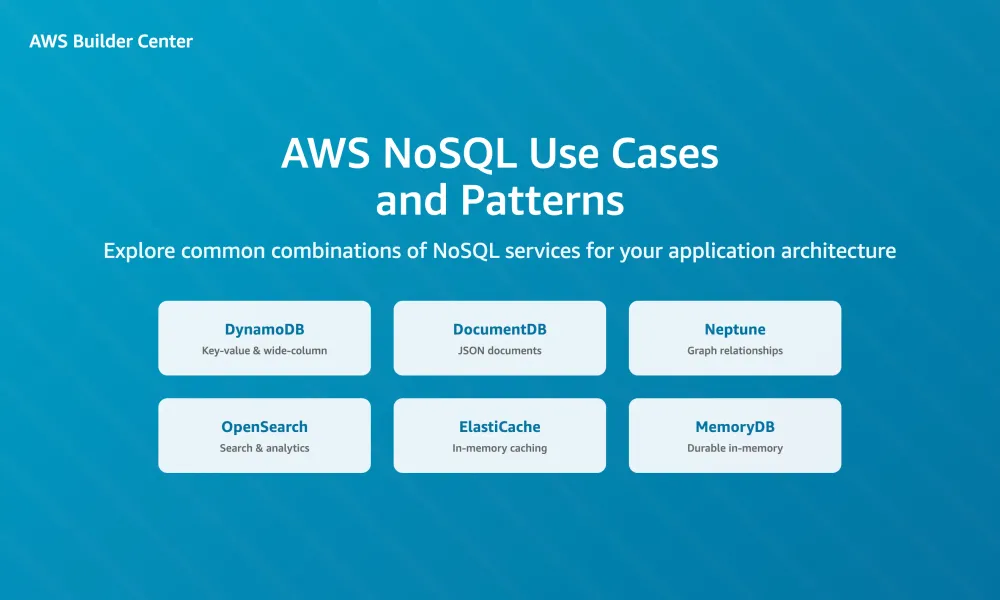
AWS NoSQL Use Cases and Patterns
Explore common combinations of NoSQL services for your application architecture

AWS NoSQL Use Cases and Patterns
Explore common combinations of NoSQL services for your application architecture
Article • 4 min read • Service Selection
Key Takeaways
- Each AWS NoSQL service excels at specific use cases and access patterns
- Modern applications benefit from combining multiple databases (polyglot persistence)
- Serverless options provide automatic scaling with pay-per-use pricing
- Architecture patterns guide optimal service combinations
Primary Services by Use Case
E-commerce Platform
Recommended Architecture: DynamoDB + OpenSearch + ElastiCache
- Product catalog → DynamoDB (fast lookups)
- Search & filtering → OpenSearch (complex queries)
- Shopping cart → ElastiCache (session data)
- User profiles → DynamoDB (consistent access)
Content Management System
Recommended Architecture: DocumentDB + OpenSearch + DynamoDB
- Articles & content → DocumentDB (flexible schema)
- Full-text search → OpenSearch (relevance scoring)
- User sessions → DynamoDB (fast access)
- Media metadata → DocumentDB (nested structures)
Social Network Platform
Recommended Architecture: Neptune + DynamoDB + ElastiCache
- Social graph → Neptune (relationship traversal)
- User profiles → DynamoDB (fast lookups)
- Activity feeds → ElastiCache (real-time updates)
- Recommendations → Neptune (graph algorithms)
IoT Analytics Platform
Recommended Architecture: DynamoDB + OpenSearch + ElastiCache
- Device data → DynamoDB (high-throughput writes)
- Analytics queries → OpenSearch (aggregations)
- Real-time dashboards → ElastiCache (fast reads)
- Device metadata → DynamoDB (consistent access)
Real-time Gaming
Recommended Architecture: MemoryDB + DynamoDB + ElastiCache
- Game state → MemoryDB (sub-ms latency)
- Player profiles → DynamoDB (persistent data)
- Leaderboards → ElastiCache (fast rankings)
- Match history → DynamoDB (structured data)
Financial Services
Recommended Architecture: DynamoDB + Neptune + ElastiCache
- Transactions → DynamoDB (ACID properties)
- Fraud detection → Neptune (pattern analysis)
- Risk calculations → ElastiCache (fast computation)
- Audit logs → DynamoDB (immutable records)
Multi-Database Architecture Patterns
Modern applications rarely use a single database. Instead, they combine multiple databases to optimize for different access patterns. Here are proven architectural patterns with specific service combinations:
🏗️ The CQRS (Command Query Responsibility Segregation) Pattern
Architecture: DynamoDB (writes) + OpenSearch (complex queries)
- Commands: DynamoDB for fast, consistent writes
- Queries: OpenSearch for complex searches and analytics
Best for: E-commerce platforms, content management systems with search requirements
Resources:
🌐 The Polyglot Persistence Pattern
Architecture: DynamoDB (core data) + DocumentDB (content) + Neptune (relationships)
- User Data: DynamoDB for profiles, sessions
- Content: DocumentDB for articles, media
- Social Graph: Neptune for relationships
Best for: Social platforms, content networks with complex user relationships
Resources:
⚡ The High-Performance Gaming Pattern
Architecture: MemoryDB (game state) + DynamoDB (persistent data) + ElastiCache (leaderboards)
- Real-time: MemoryDB for game state
- Persistence: DynamoDB for player data
- Leaderboards: ElastiCache for fast rankings
Best for: Real-time multiplayer games, live applications requiring sub-millisecond response
Resources:
Real-World Architecture Examples
E-commerce Platform
Architecture: DynamoDB + OpenSearch + ElastiCache
Data Flow:
- Product catalog → DynamoDB (fast lookups)
- Search & filtering → OpenSearch (complex queries)
- Shopping cart → DynamoDB (durable session data)
- Product metadata → ElastiCache (fast access)
Benefits: Sub-10ms product lookups, rich search experience, scalable to millions of users
Resources:
Content Management System
Architecture: DocumentDB + OpenSearch + DynamoDB
Data Flow:
- Articles & content → DocumentDB (flexible schema)
- Full-text search → OpenSearch (relevance scoring)
- User sessions → DynamoDB (fast access)
- Media metadata → DocumentDB (nested structures)
Benefits: Flexible content modeling, powerful search, consistent user experience
Resources:
Social Network Platform
Architecture: Neptune + DynamoDB + ElastiCache
Data Flow:
- Social graph → Neptune (relationship traversal)
- User profiles → DynamoDB (fast lookups)
- Activity feeds → ElastiCache (real-time updates)
- Recommendations → Neptune (graph algorithms)
Benefits: Efficient relationship queries, personalized recommendations, real-time interactions
Resources:
IoT Analytics Platform
Architecture: DynamoDB + OpenSearch + ElastiCache
Data Flow:
- Device data → DynamoDB (high-throughput writes)
- Analytics queries → OpenSearch (aggregations)
- Real-time dashboards → ElastiCache (fast reads)
- Device metadata → DynamoDB (consistent access)
Benefits: Handle millions of IoT events, real-time analytics, cost-effective storage
Resources:
Next Steps
- Map your access patterns using the framework linked below
- Create a proof of concept with your recommended architecture
- Set up monitoring to validate performance assumptions
- Plan your migration strategy if moving from existing systems
Enjoyed reading this content? Let the author know!
Your likes, comments, shares, and saves help creators reach more builders.

Loading recommendations
Loading article