
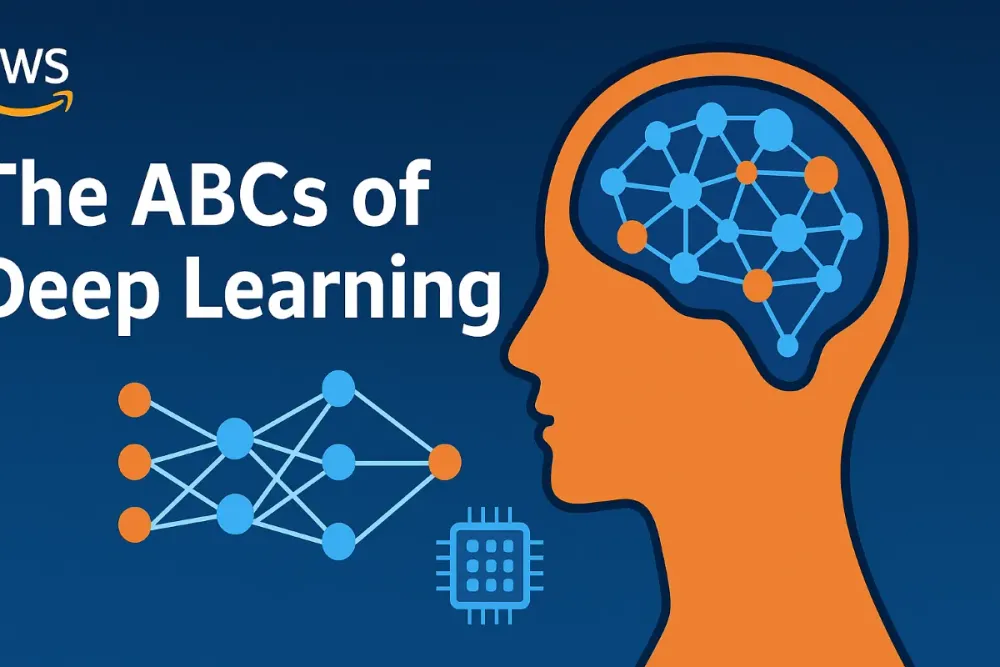
The ABCs of Deep Learning - AWS
This article breaks down the fundamentals of Deep Learning in a simple way, explaining how it works, where it’s used, and why it’s booming today. It also connects the concepts to AWS AI/ML services like SageMaker, Rekognition, and Comprehend, showing how you can put deep learning into action on the cloud.

Welcome back to the AI for Dummies series!
If you've been hanging with me since the start, you know we kicked things off with Layers of Artificial Intelligence (Part 1), where we broke down what AI really means in simple terms. Then, in The ABCs of Machine Learning (Part 2), we learned how machines "learn" patterns from data, much like how we humans improve by practicing.
If you've been hanging with me since the start, you know we kicked things off with Layers of Artificial Intelligence (Part 1), where we broke down what AI really means in simple terms. Then, in The ABCs of Machine Learning (Part 2), we learned how machines "learn" patterns from data, much like how we humans improve by practicing.
Let’s buckle in; it’s time to go a step deeper (pun intended) into one of the most fascinating branches of AI: Deep Learning.
Inspired by the Brain
Here’s the deal: Deep Learning is straight-up inspired by our own brains.

Your brain? It’s got billions of neurons firing signals back and forth. That’s how you recognize your best friend’s face, remember your Netflix password (sometimes), or decide pizza > salad.
Deep Learning? Same idea, but with artificial neurons called nodes. These little guys are linked up in layers:
- Input layer (data walks in)
- Hidden layers (the real hustle happens here)
- Output layer (boom, final answer pops out)
On AWS, you can build these brain-inspired networks using Amazon SageMaker, which gives you everything from pre-built deep learning frameworks (like TensorFlow and PyTorch) to tools for labeling and preparing your data.
Why’s It Called “Deep”?
"Deep" just means there are a bunch of layers stacked up.
- Basic machine learning = maybe 1–2 layers.
- Deep learning = dozens, sometimes hundreds.
Take self-driving cars, for example.

The car’s “brain” works in layers:
- First layers: pick up raw details from cameras—edges, colors, signs.
- Middle layers: combine shapes into concepts (“that’s a pedestrian”).
- Deeper layers: predict what might happen next (“that pedestrian might cross”).
- Final layers: make a decision (“slow down, stop, or change lanes”).
On AWS, these types of workloads are often trained using Amazon EC2 instances with GPUs (like P4d or Trn1 for training) and then deployed for real-time inference on Amazon SageMaker Endpoints
Where’s Deep Learning Being Used?
Honestly? Everywhere. Chances are you’re already using it daily:
- Voice Assistants – Alexa runs on deep learning for speech recognition.
- Face Unlock – Powered by computer vision, similar to Amazon Rekognition.
- Self-Driving Cars – Detecting stop signs, people crossing, and more.
- Healthcare – Detecting diseases in X-rays (medical imaging is often powered on AWS by SageMaker pipelines).
- Recommendations – Netflix’s “just one more episode” is like Amazon Personalize, which builds recommendation models using deep learning.
The Heavy-Hitter Applications
1. Computer Vision
This is where machines learn to actually “see.”
Tasks include:
Tasks include:
- Image classification (cat vs. dog vs. blurry selfie)
- Object detection (spotting pedestrians on the road)
- Image segmentation (figuring out which part of an image is what)
On AWS, you can use Amazon Rekognition for plug-and-play image and video analysis, or build custom vision models with Amazon SageMaker.
2. Natural Language Processing (NLP)
This one’s about teaching computers to understand human language.
Deep learning has pushed NLP to wild new levels:
Deep learning has pushed NLP to wild new levels:
- Sorting spam from legit emails
- Reading reviews and catching the vibe (positive/negative)
- Translating languages like a pro
- Generating text
On AWS, you can explore Amazon Comprehend (for text analysis), Amazon Translate (for translation), and Amazon Lex (for building conversational chatbots, like Alexa).
Deep Learning vs. Machine Learning
Quick refresher:
- Machine Learning = works fine with small data and simple patterns.
- Deep Learning = thrives on massive data, crazy patterns, and huge compute power.
On AWS, ML can often be handled by services like Amazon SageMaker Autopilot, while deep learning projects lean more on GPU/ML-optimized compute instances, distributed training in SageMaker, and specialized AI services.
Why’s Deep Learning Blowing Up Now?
Three reasons it’s everywhere lately:
- Big Data – and with Amazon S3, we’ve got a home for it all.
- Powerful GPUs – available on-demand with Amazon EC2.
- Smarter Algorithms – AWS offers managed deep learning frameworks (PyTorch, TensorFlow, MXNet) pre-configured in SageMaker.
Final 2 Cents
If you’ve messed around with ChatGPT, MidJourney, or DALL·E, you’ve already had a taste. But trust me, we’re just scratching the surface.
On AWS, deep learning is accessible whether you’re a hobbyist or building production-scale AI. Services like SageMaker, Rekognition, Comprehend, and Lex mean you don’t have to start from scratch — the building blocks are ready.
Explore AI in depth with my mini-series:
- Part 1: Layers of Artificial Intelligence
- Part 2: ABCs of Machine Learning
- Part 3: ABCs of Deep Learning (this one!)
Enjoyed reading this content? Let the author know!
Your likes, comments, shares, and saves help creators reach more builders.

Loading recommendations
Loading article