
Layers of Artificial Intelligence
AI is already woven into daily experiences, from voice assistants, content recommendations, to automated tagging of photos. On AWS, you have a deep and broad set of tools covering all layers: machine learning, deep learning, and generative AI. Understanding these layers, and knowing which AWS service fits into which layer, helps you design better architecture, make better trade-offs, and build more reliable, scalable AI systems.

AI… it’s one of those things that sounds super techy and, honestly, a bit confusing. Welcome to AI for Dummies, where I’ll walk you through the world of Artificial Intelligence without all the jargon and over-complicated stuff.
This is part 1: Layers of AI
AI is an umbrella term that brings together multiple branches, including machine learning, deep learning, and generative AI.
Artificial intelligence (AI) is one of the most exciting and impactful technologies of our time. At its core, AI is about creating systems that can perform tasks that normally require human intelligence, things like problem solving, decision making, recognizing faces, understanding speech, or even creating new content.

Machine Learning (ML)
Machine learning allows computers to learn from data and improve their performance without being programmed.

Instead of following a strict set of rules, ML models recognize patterns and make predictions or decisions based on the information they are trained on.
Example: Netflix recommending your next show based on your watch history.
- AWS Example: Amazon SageMaker, a fully managed service to build, train, tune, and deploy ML models at scale.
- Other AWS related tools: SageMaker Data Wrangler, SageMaker Feature Store, SageMaker Pipelines, SageMaker JumpStart.
- What it does: handling data preprocessing, feature engineering, model training (on CPU/GPU), hyperparameter tuning, model deployment, and monitoring.
Remember: machine learning models are only as good as the data you feed them.
If you train a model on movie reviews but only from people who love horror films, don’t be shocked when it calls Finding Nemo ‘not scary enough.’
We'll cover ML in great detail in next article..
Deep Learning (DL)
We already understand how machines work and how the human brain works, then some brilliant minds thought, what if we combine the two? And that’s how Deep Learning was born.
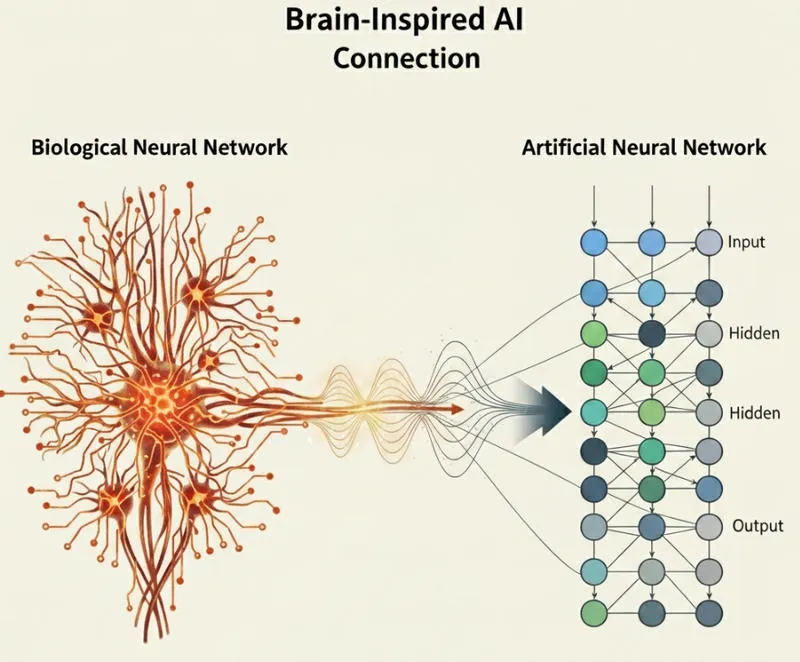
Deep learning is a subfield of ML inspired by how the human brain works. It uses artificial neural networks to recognize patterns in complex data like images, sound, or video.
In fact, we're using DL every day to unlock your phone; yes, face recognition is an application of DL.
Instead of learning simple patterns, deep learning models have many layers (hence deep) that automatically extract features from raw data. This makes them extremely powerful for images, audio, natural language, and complex tasks where traditional ML struggles.
- AWS Example: Amazon Rekognition, image & video analysis: detect objects, people, activities, facial recognition, etc.
- Other AWS services/tools:
- AWS Deep Learning AMIs / Deep Learning Containers — preconfigured environments for training DL models.
- Amazon Translate, Amazon Comprehend, Amazon Transcribe — for natural language/audio processing.
ML vs. DL
- Machine Learning: Works well with smaller datasets, requires feature engineering, simpler algorithms like decision trees, SVM, logistic regression.
- Deep Learning: Needs huge amounts of data and computing power, uses neural networks with many layers, and learns features automatically.
Generative AI
Fast forward to today… We stand at the dawn of a new era, the age of Generative AI.
Generative AI takes deep learning a step further; instead of just analyzing data, it can create new data (like text, images, or audio) by learning patterns from existing examples.

What we've seen so far,
- LLMs: Generate text, chat, summarize, write code. Your GPTs and Claude.
- Image AI: Create art, designs, and edit photos. DALL·E, MidJourney, Stable Diffusion.
- Video AI: Turn text into movies or animations. Runway Gen-2, Pika Labs
- Audio AI: Make music, clone voices, or narrate. AIVA, Suno, Jukebox
- 3D AI: Build models for games, design, and AR/VR. NVIDIA GET3D, OpenAI’s Point·E.
AWS Example: Amazon Bedrock, lets developers build and scale generative AI applications using foundation models from AWS as well as third-party model providers.
Related AWS services:
- Amazon SageMaker support for fine-tuning foundation models.
- AWS Lambda, AWS Fargate for serving generative models in production.
- Amazon Polly for text-to-speech, Amazon Lex for conversational agents.
- AWS CodeWhisperer for AI-assisted coding.
Putting It All Together
Stage | AWS Services / Tools |
|---|---|
Data collection & storage | Amazon S3, AWS Glue, AWS Data Pipeline, Amazon Kinesis |
Data preparation & labeling | SageMaker Ground Truth, AWS Glue, AWS Data Wrangler |
Model building & training | SageMaker, DL AMIs/Containers, AWS EC2 / GPU instances |
Model deployment & serving | SageMaker Endpoint, Amazon API Gateway, Lambda, AWS Fargate |
Monitoring & governance | SageMaker Model Monitor, AWS CloudWatch, AWS IAM, AWS Audit Manager |
Generative outputs / applications | Bedrock, Polly, Lex, CodeWhisperer, custom fine-tuned models |
Enjoyed reading this content? Let the author know!
Your likes, comments, shares, and saves help creators reach more builders.

Loading recommendations
Loading article