

From a Curious Student to Building a Community: My Journey with AWS
How AWS became more than a technology for me - a community, a responsibility, and eventually a part of who I am.
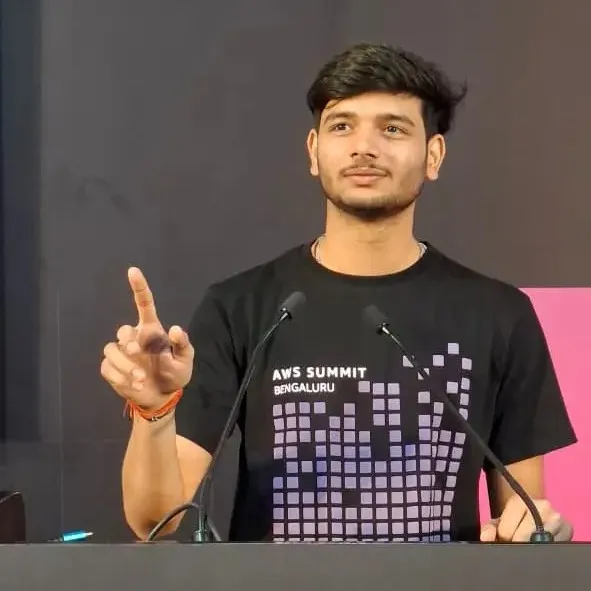
Backend-focused Full Stack Developer | AWS Serverless & Cloud | Technical Writer
Some journeys begin with a clear destination. Mine didn't.
When I look back at my university journey, I realize that AWS has been one of the most significant parts of my growth, both technically and personally. What started as an interest in cloud computing gradually turned into something much bigger: building communities, organizing learning experiences, helping other students discover technology, sharing what I know, and finding my own voice along the way.
Today, I am part of the AWS Student Builder Group at Lovely Professional University, have had opportunities to speak in front of large student audiences, contribute to the broader developer community, and recently became part of the AWS New Voices journey.
But to explain how I got here, I need to go back to the beginning.
1. The Beginning: A Student Trying to Find His Direction
My journey in technology didn't begin with AWS.
Like many computer science students, I entered university with curiosity about software development, programming, and the possibilities technology could create.
During my early university years, I spent time exploring different areas of computer science. I was interested in building things, understanding how systems worked behind the scenes, and experimenting with technologies beyond what was covered in classrooms.
Eventually, I started exploring backend development, cloud computing, infrastructure, and deployment.
I was particularly fascinated by the idea that an application could serve users across the world without being restricted to a single machine.
That curiosity led me towards cloud computing. And that's where AWS entered my journey.
Initially, AWS was simply a technology ecosystem I wanted to understand. I started exploring its services, learning cloud fundamentals, and understanding how organizations use cloud infrastructure to build scalable applications.
I completed AWS Cloud Practitioner Essentials in December 2024, which helped me establish a foundation in cloud computing.
It wasn't just about learning what EC2, S3, IAM, or other AWS services did. I wanted to understand why these services existed, how they connected, and how developers could use them to solve real problems.
I didn't know it at the time, but this curiosity would eventually take me somewhere I hadn't imagined.
2. Discovering the AWS Community: More Than Just Learning Technology
One of the things I gradually realized was that learning technology doesn't have to be an isolated experience.
There are people around the world who are learning, building, experimenting, sharing knowledge, and helping others grow.
The AWS community introduced me to a different perspective on technology.
It wasn't just about certifications or knowing more services than someone else. It was about collaboration, knowledge sharing, experimentation, and making technology accessible to others.
I started seeing the value of developer communities and the opportunities they created for students.
For me, community participation became just as important as technical learning.
I wanted to contribute, not simply attend. I wanted to create opportunities where students could learn about cloud computing, explore AWS services, interact with other builders, and understand how the technology they were learning could be applied in the real world.
That mindset eventually brought me closer to the AWS Cloud Club at Lovely Professional University (now AWS Student Builder Group at Lovely Professional University)
And things started changing.
3. Taking Responsibility: AWS Cloud Club LPU
Becoming involved with AWS Cloud Club LPU was an important turning point.
I eventually took responsibility as an AWS Cloud Club Captain at Lovely Professional University (now AWS Student Builder Group Leader).
The role introduced me to a completely different side of technology.
Until then, much of my focus had been on learning and building software. Now, I also had to think about people, collaboration, event planning, community engagement, and creating meaningful learning experiences.
Being part of a student community comes with responsibilities that aren't always visible from the outside.
You have to think about:
- How do we introduce students to cloud computing?
- How do we make technical learning interesting and accessible?
- How do we encourage students to build instead of only consuming content?
- How do we bring industry perspectives closer to university students?
- How do we create an environment where beginners feel comfortable asking questions?
- How do we keep a community active beyond individual events?
These questions gradually became part of my everyday thinking.
I started understanding that a community isn't defined by how many people are in its WhatsApp group or how many registrations an event receives.
A community is defined by the opportunities it creates and the people it helps grow.
That became the philosophy behind my contributions.
4. Building Experiences, Not Just Organizing Events
As my involvement grew, so did the scale of our activities.
We worked towards creating learning opportunities around AWS fundamentals, cloud computing, certifications, hands-on learning, and broader developer experiences.
Some of the initiatives and experiences that became significant milestones included:
AWS Student Community Day 2025
Being involved in the AWS student community ecosystem helped strengthen my understanding of how student-led communities can create meaningful technical experiences.
AWS Fundamentals - Season 2
On March 27, 2026, we continued our efforts to introduce students to AWS fundamentals and make cloud computing more approachable.
Horizon 2026
Another chapter in our efforts to create larger community-driven technical experiences at LPU.
AWS Certification and Career Awareness
We also focused on helping students understand the certification ecosystem, learning pathways, and career opportunities associated with AWS.
Over time, our community grew beyond individual sessions.
Our WhatsApp community reached approximately 2,000 members, our community platform crossed 2,000 users, and our Meetup presence grew to around 900 members.
Our events regularly attracted hundreds of participants, with attendance often ranging between 200 and 450 students.
But the numbers were never the entire story.
Behind every registration was someone exploring cloud computing for the first time, someone preparing for a certification, someone looking for their next learning opportunity, or someone simply trying to figure out where to begin.
That is what made the work meaningful.
5. Evolution: From AWS Cloud Club to AWS Student Builder Group
Communities evolve, and ours did too.
On April 30, 2026, AWS Cloud Club LPU evolved into the AWS Student Builder Group (AWS SBG) at Lovely Professional University.
For me, this was more than a change in naming.
It represented the direction in which we wanted to take the community.
We wanted to create an environment that went beyond introductory sessions and traditional event formats.
We wanted students to become builders.
A place where students could explore cloud technologies, work on projects, participate in hackathons, learn about certifications, collaborate with other developers, and develop skills that matter beyond university examinations.
This evolution also pushed me to think differently about the infrastructure supporting our community.
I started working on our digital ecosystem, including the AWS SBG website, authentication systems, dashboards, and community platforms.
One particularly interesting project was integrating AWS LPU Identity Services using OAuth 2.0 and OpenID Connect.
I wanted our community infrastructure to reflect the same engineering mindset we encouraged students to develop.
It wasn't enough to tell students to build things. I wanted to build things myself.
That is something I continue to believe in:
The best way to encourage people to build is to build alongside them.
6. The Other Side of Community Building: Learning to Lead
Community building also taught me lessons that I couldn't have learned entirely through programming.
I learned that organizing a technical event involves much more than finding a venue and announcing registrations.
It involves coordination, communication, planning, partnerships, logistics, and handling unexpected situations.
Sometimes registrations exceed expectations. Sometimes plans change. Sometimes you have to solve problems at the last minute.
You learn to work with different people, understand different perspectives, and make decisions while managing multiple responsibilities.
I also learned that community leadership isn't about being the most technically knowledgeable person in the room.
It's about making sure that the room becomes a place where everyone can learn something.
Over time, I became increasingly interested in creating opportunities for students to participate in larger developer initiatives.
One such experience was being selected as a Hacktoberfest Meetup Host for Phagwara.
On October 23, 2026, we hosted a Hacktoberfest Meetup at LPU, bringing together students interested in open-source development.
It was another opportunity to create a space where students could connect with the wider developer ecosystem.
These experiences reinforced something important for me:
Community building is not a one-time achievement. It is continuous work.
7. Moving From Behind the Scenes to the Stage
For a long time, a significant part of my contribution happened behind the scenes.
I was involved in planning, organizing, coordinating, developing platforms, and ensuring that community initiatives moved forward.
But I also wanted to become better at sharing knowledge.
I realized that knowing something and explaining it effectively are two very different skills.
Being technically confident doesn't automatically make someone a good speaker.
You need to understand your audience, structure your thoughts, communicate complex ideas simply, and make people interested in what you're saying.
I started taking more opportunities to speak and share my knowledge.
One particularly meaningful experience came on November 4, 2026.
I had the opportunity to deliver a session titled:
AWS Certification Roadmap & CLF-C02 Mock Examination
Organized by AWS Student Builder Group at Lovely Professional University, the session was designed to help students understand the AWS certification ecosystem and prepare for the AWS Certified Cloud Practitioner (CLF-C02) examination.
We covered:
- AWS certification pathways and career opportunities.
- Understanding the CLF-C02 examination.
- Exam patterns and preparation strategies.
- Recommended learning resources.
- A 65-question mock examination.
Standing in front of a packed auditorium and talking about something I had spent time learning and exploring was a special experience.
Looking at the audience, I could see students taking notes, listening, interacting, and trying to understand how they could begin their own cloud journeys.
It felt different from organizing an event.
This time, I wasn't only creating the opportunity for someone else to learn.
I was directly sharing what I had learned.
And that experience made me realize how much I wanted to improve as a speaker.
I wanted to communicate better, tell better stories, make my presentations more engaging, and become someone who could confidently represent technical ideas on stage.
That realization led me to another opportunity.
8. AWS New Voices: Learning to Find My Voice
One of the most exciting developments in this journey has been becoming part of the AWS New Voices program.
I have always been comfortable with technology.
I can spend hours building backend systems, working with APIs, exploring infrastructure, debugging applications, and figuring out how different components fit together.
But public speaking is a different challenge.
It requires a different kind of preparation.
I wanted to work on that side of myself.
Through the AWS New Voices initiative and its Ready Room™ program, I got the opportunity to focus on something that often receives less attention in technical communities: communication.
The Ready Room experience helped me understand several important aspects of delivering a presentation:
Finding the right audience
A presentation should be designed around the people listening to it. Understanding their background, expectations, and interests changes how a message should be delivered.
Creating a powerful hook
The opening moments matter. Instead of immediately jumping into technical details, a speaker needs to give the audience a reason to pay attention.
Structuring the journey
A good presentation isn't simply a collection of slides. It should take the audience through a clear journey, with every section contributing to the larger message.
Designing uncluttered visuals
Slides should support the speaker, not compete with them. Communicating an idea visually is often more effective than putting paragraphs of information on a screen.
Building stage confidence
Confidence comes from preparation, clarity, and understanding the message you want to communicate.
Completing the Ready Room program was an important step for me.
It made me think differently about presentations.
I began realizing that being a good technical speaker isn't about showing how much you know.
It's about making someone else understand something they didn't understand before.
And that's a skill I genuinely want to develop.
I am still learning, still experimenting, and still working on becoming a better communicator.
But now I have a much clearer understanding of what I need to improve.
For me, AWS New Voices isn't simply another program to add to my profile.
It's an opportunity to grow beyond the technical side of my identity.
9. What AWS Has Taught Me Beyond Cloud Computing
If someone asks me what AWS has given me, I could talk about cloud services, certifications, infrastructure, and technical knowledge.
But that wouldn't tell the complete story.
AWS has introduced me to people, communities, opportunities, and experiences that have shaped how I approach technology. It has taught me:
To contribute before expecting recognition.
Some of the most meaningful community work happens behind the scenes. Not everything needs to become an achievement post.
To build opportunities for others.
Creating a learning opportunity for hundreds of students can be just as rewarding as completing a technical project yourself.
To keep learning publicly.
You don't need to know everything before sharing what you know. Learning and contributing can happen simultaneously.
To become comfortable with being uncomfortable.
Speaking in front of a large audience, taking responsibility, and leading initiatives have all pushed me outside my comfort zone.
To value people as much as technology.
Technology brings builders together, but communities grow because of the people who contribute to them.
Most importantly, I have learned that growth doesn't always happen in a straight line.
Sometimes you grow technically. Sometimes you grow as a leader. Sometimes you discover that you need to work on something completely different, like communication.
All of these experiences are connected.
10. Looking Ahead: Still Building, Still Learning
As I write this, my journey with AWS is far from over.
There are still so many things I want to explore, build, and contribute to.
With AWS Student Builder Group at LPU, I want to continue creating meaningful learning opportunities, helping students discover cloud computing, encouraging hands-on development, and connecting our university community with the broader builder ecosystem.
One of our upcoming initiatives is AWS Re Fest, planned for November 30 to December 4, 2026.
With an expected participation of approximately 2,000–2,500 students, it represents another ambitious step in creating large-scale technical experiences at LPU.
Beyond community building, I want to continue improving my technical depth, contributing to the AWS ecosystem, writing more technical content, and becoming a better speaker.
AWS New Voices is an important part of that next chapter.
I want to become someone who can not only build reliable systems but also explain the ideas behind them, share experiences meaningfully, and inspire other students to start building.
I don't consider myself someone who has figured everything out.
I'm still a student. I'm still learning. I still make mistakes. There are still technologies I haven't explored and skills I need to improve.
And honestly, I think that's the best part of this journey.
There is always something new to learn.
A Note to Anyone Starting Their Own Journey
If there's one thing I would tell a student who is just beginning to explore AWS or the broader technology ecosystem, it would be this:
Don't limit yourself to learning technologies.
Build something with them. Find people who share your interests. Join communities. Ask questions. Help someone who is just starting. Share what you learn. Volunteer for opportunities, even when they seem intimidating.
You don't need to wait until you become an expert to contribute.
Some of the most valuable experiences come from taking responsibility before you feel completely ready.
I started with curiosity about technology.
That curiosity introduced me to AWS.
AWS introduced me to a community.
The community gave me opportunities to contribute.
Those opportunities pushed me to become a builder, organizer, and speaker.
And now, through AWS New Voices, I'm learning how to communicate those experiences and ideas more effectively.
I don't know exactly where this journey will take me next.
But I know what I want to keep doing:
Keep building. Keep sharing. Keep contributing. And help more people become builders along the way.
Because somewhere along the way, AWS stopped being just another technology I was learning.
It became a community I wanted to be part of, an ecosystem I wanted to contribute to, and a journey that continues to shape who I am.
And this is only the beginning.
About the Author
I'm Shashank Pandey, a computer science student, full-stack developer, cloud enthusiast, and community builder at Lovely Professional University.
I contribute to the AWS ecosystem through community building, technical initiatives, learning experiences, and knowledge sharing as part of the AWS Student Builder Group at LPU.
I'm passionate about backend engineering, cloud infrastructure, developer communities, and creating opportunities that help students become better builders.
Currently, I'm also exploring how to become a better technical communicator and speaker through AWS New Voices.
Connect with me and let's build something meaningful together!
Enjoyed reading this content? Let the author know!
Your likes, comments, shares, and saves help creators reach more builders.

Loading recommendations
Loading article