

Rewiring Global Value Chains for 2026 and Beyond
The global economy is entering a friction-free era as 2026 becomes the year AI transcends chatbot prompts to become the invisible engine of cross-industry value chains. Explore how multi-agent architectures, hybrid sovereign networks, and physical automation are reshaping industrial, financial, and digital landscapes.

The 2026 Great Rebuild: Integrating AI directly into the Value Chain
We are living through a massive technological shift: treating AI as an experiment is over. In 2026, the technology landscape is being reshaped by a stark financial reality. While raw AI token and computational costs have plummeted over the last two years, enterprise investments have skyrocketed into the tens of millions of dollars. Usage has heavily outpaced cost declines, forcing a massive reckoning in how we design, deploy, and scale intelligent systems.
For developers, architects, and C-suite leaders, the challenge has shifted from simply building AI to sustainably orchestrating it. We are officially in the era of the "Great Rebuild," where lean, modular, and collaborative agentic pipelines are replacing brute-force compute. Here are the cross-industry, data-driven trends that define this new era.
Part I: The Rise of Multi-Agent Orchestration
AI is transitioning from isolated "copilots" into coordinated, multi-agent systems-specialized AI agents that work together across complex workflows to take autonomous, goal-oriented actions.
Instead of waiting for a human to trigger every task, these networks talk to each other, manage errors, and hand off workflows across complex enterprise setups. However, this shift comes with a significant warning. Gartner reports that over 40% of agentic projects risk cancellation by the end of 2027 if they do not address rising maintenance costs, security risks, or the mistake of automating fundamentally broken processes.
True transformation requires completely redesigning operational workflows from the ground up, allowing autonomous agents to securely interact with internal APIs, ERPs, and database systems while maintaining visibility across the organization.
The businesses succeeding in this shift are seeing remarkable results. According to recent McKinsey data, 40% of organizations with over $1 billion in revenue are actively scaling AI agents-up from 27% a year ago. These modern pipelines are delivering an average enterprise ROI of 190%+, outperforming traditional automation by up to three times.
Meanwhile, the AI supply chain market-driven by automated logistics, predictive sourcing, and IoT analytics-has grown into a massive $13.8 billion industry in 2026, proving that agentic systems are quickly becoming the standard for modern business operations.

Part II: Modern Infrastructure and the Sovereignty Era
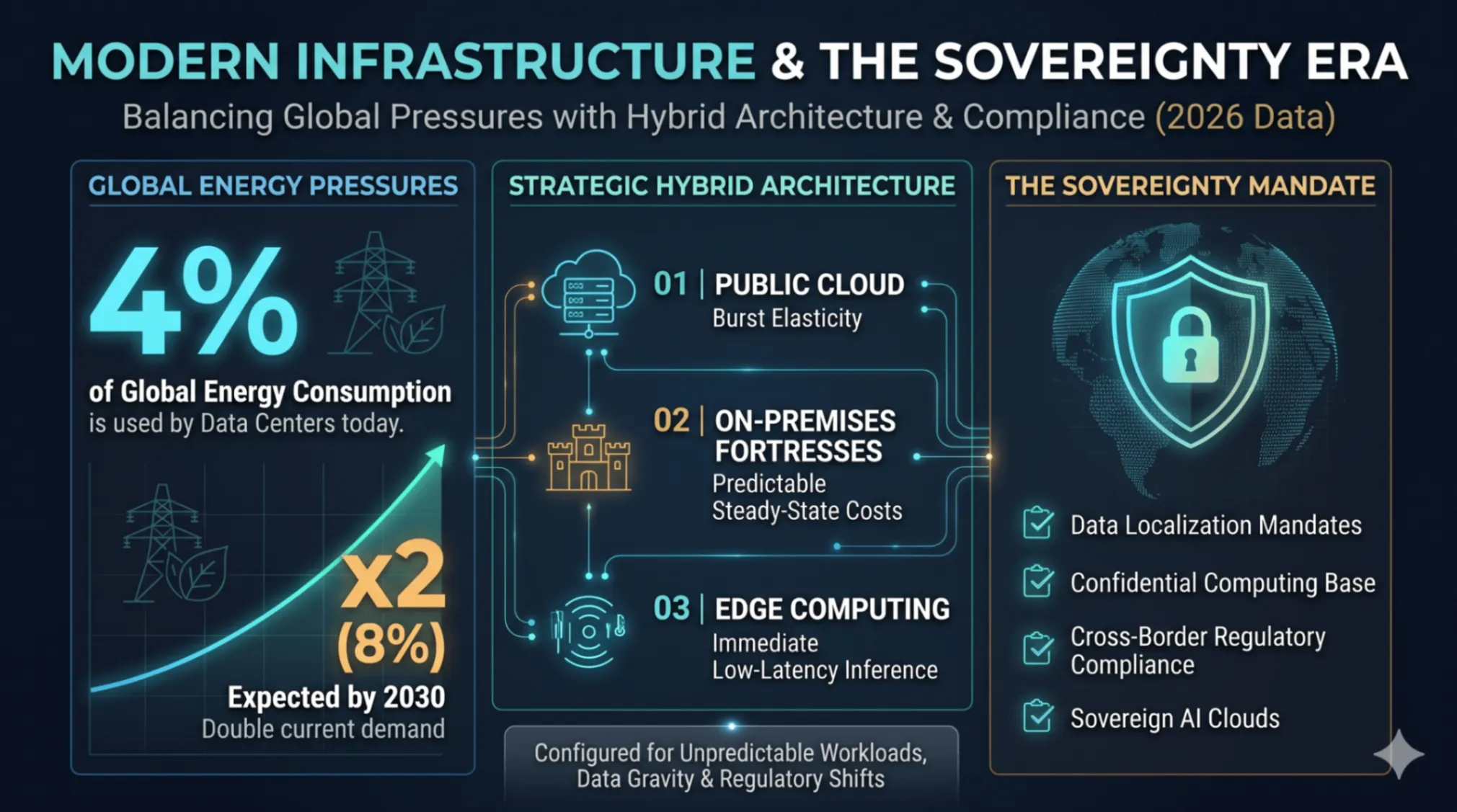
This software evolution requires a major rethink of the hardware and environments that run it. The old debate of "cloud vs. on-premises" is outdated. In 2026, cloud strategy is no longer about where a workload lives, but how quickly it can adapt to AI demand, data sovereignty, and heavy processing needs.
With data centers now consuming 4% of global energy-a figure expected to double to 8% by 2030-efficiency is no longer just an IT concern; it is a core business priority.
This has driven a major shift toward strategic hybrid architectures:
- Public Cloud: Used for rapid scale and burst elasticity.
- On-Premises Fortresses: Used to ensure predictable costs for steady workloads.
- Edge Computing: Used to run low-latency, real-time AI right where data is created.
At the same time, confidential computing and sovereign clouds have become essential, allowing companies to protect sensitive workloads while complying with strict data localization and privacy regulations.
Part III: Physical AI and Embodied Intelligence
Perhaps the most visible change in 2026 is AI breaking out of the screen and into the physical world. Intelligence is now embodied and autonomous, bridging digital smarts with heavy machinery.
Take Amazon, which has deployed over 1 million industrial robots coordinated by its DeepFleet AI system, improving warehouse travel efficiency by 10%. Across manufacturing, energy, and transportation, agentic AI is analyzing real-time IoT sensor data, predicting equipment failures before they happen, and managing complex physical tasks without human intervention.
Building for this "physical AI" requires a new infrastructure paradigm-one that bridges the gap between massive cloud training clusters and local, domain-specific edge setups.

The mandate for today’s industry leaders is clear: stop automating the processes of the past. Focus on building systems that are flexible, highly secure, and economically sustainable to lead the multi-agent economy.
Enjoyed reading this content? Let the author know!
Your likes, comments, shares, and saves help creators reach more builders.

Loading recommendations
Loading article