Building an AI-Powered Document Chat Assistant Using RAG 🚀
What if you could upload a PDF document and ask questions about its content just like having a conversation with a person?
That was the idea behind my RAG-Based Document Chat Assistant project.
While exploring Generative AI, I became interested in building applications that go beyond traditional chatbots. I wanted to create a system that could understand uploaded documents and provide relevant answers based on their content.
💡 Project Overview
The Document Chat Assistant is an AI-powered application that uses Retrieval-Augmented Generation (RAG) to answer questions from uploaded documents.
Instead of depending entirely on an LLM's existing knowledge, the system retrieves relevant information from the uploaded documents and uses it as context to generate responses.
⚙️ Technologies Used
Some of the technologies explored in this project include:
- Python: Core programming and backend logic.
- LangChain: Connecting different components of the RAG pipeline.
- FastAPI: Building backend APIs.
- React.js: Developing the user interface.
- ChromaDB: Storing and retrieving vector embeddings.
- LLM API: Generating contextual responses.
🧠 How the System Works
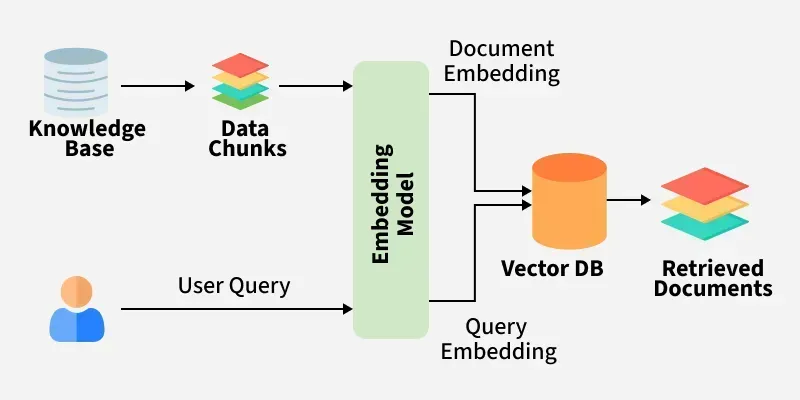
The application follows a simple workflow:
- Users upload their PDF documents.
- The system extracts text from the documents.
- The extracted text is divided into smaller chunks.
- Embeddings are generated for those chunks.
- The embeddings are stored in a vector database.
- When users ask questions, relevant chunks are retrieved.
- The retrieved context is passed to an LLM to generate an answer.
🎯 What Makes This Project Interesting?
This project helped me explore how multiple technologies work together to create an intelligent application.
Some interesting areas include:
- Context-aware question answering.
- Semantic search using embeddings.
- Vector database integration.
- Connecting frontend and backend services.
- Integrating Large Language Models into applications.
I am also interested in exploring multilingual capabilities so that users can interact with the assistant in English, Hindi, and Marathi.
☁️ Future Scope with AWS
One area I want to explore further is integrating AWS services into this architecture.
For example:
- Amazon S3 for document storage.
- Amazon Bedrock for foundation models and embeddings.
- AWS Lambda for serverless processing.
- Amazon OpenSearch Service for vector search.
These integrations could help evolve the application toward a more scalable cloud-based solution.
🚀 Key Takeaway
Building this project gave me a practical understanding of how Generative AI, backend development, databases, and frontend technologies can work together.
I believe hands-on projects are one of the best ways to understand emerging technologies.
I am excited to continue exploring Generative AI and AWS to build more useful real-world applications.
Question for the AWS community:
If you were building a production-ready document chat assistant, which AWS services and architecture would you recommend?
I would love to hear your suggestions and experiences!
#AWS #GenerativeAI #AmazonBedrock #RAG #Python #LangChain #ArtificialIntelligence #CloudComputing



Loading article