
The Legend of AWS Warrior (Part 3 - Gen Question): Autonomous AWS Question Bank Generation with Loop Engineering, Strands Multi-Agent Graphs, Harness Plugins and Live OpenTelemetry Tracing
Explore how Dual-Level Loop Engineering with @strands-agents/harness (GoalLoop, ContextOffloader) and cyclic @strands-agents/sdk multi-agent graphs autonomously mines, fact-checks, localizes, and calibrates trilingual AWS interview questions across 302 services. Grounded by Amazon Nova Web Grounding and the live AWS Knowledge MCP Server, every candidate rubric is verified against a 3-way live grader with full OpenTelemetry trace visibility in Jaeger.
Series: THE LEGEND OF AWS Warrior (4 articles)
- …
- 3The Legend of AWS Warrior (Part 3 - Gen Question): Autonomous AWS Question Bank Generation with Loop Engineering, Strands Multi-Agent Graphs, Harness Plugins and Live OpenTelemetry Tracing This article

3-Part Technical Blog Series: Part 1 covers the Game and Pedagogy , Part 2 covers the AWS Serverless and AgentCore Design , and Part 3 covers Autonomous Question Generation with Loop Engineering and Strands Multi-Agent Graphs.
1. Introduction: Why Single-Pass Prompting Fails for Production Question Banks
In Part 1 - The Game and Part 2 - The AWS Design , we established why Architectural Q&A in The Legend of AWS Warrior V2 never improvises questions at runtime:
- Every Q&A session is backed by an approved question in DynamoDB (
PK = QUESTION_BANK) with trilingual prompts (en-US,zh-HK,zh-CN), 2-3 atomic concepts whose weights sum to100, misconceptions, acceptable answers, and a reference answer.
- Scaling and refreshing questions across 302 AWS service landmarks faces three major hurdles:
- Community Questions Go Stale: Online AWS interview questions often repeat outdated claims (e.g., S3 eventual consistency or unencrypted defaults, when AWS enabled strong read-after-write consistency and default SSE-S3 / Block Public Access years ago).
- Ungrounded Rubrics Fail Live Grading: A rubric that looks reasonable on paper might be phrased too narrowly for our Two-Phase
NFKCsubstring verifier (gradeAnswer), causing a good spoken English or Cantonese code-switched answer to score< 80%, or letting a misconception pass (>= 60%).
- Multi-Slot Topic Duplication: Asking an LLM for multiple questions on S3 or RDS naturally gravitates toward the same headline topic unless a deterministic semantic deduplicator forces an orthogonal scenario.
To solve all three autonomously, we built a self-calibrating 4-Agent Question Generator and Refresher ( src/VoiceAgent/question-generator.mjs and src/VoicePractice/question-generator.mjs ) powered by Loop Engineering,
@strands-agents/harness ( ^0.3.3 ), @strands-agents/sdk ( ^1.23.0 ), Amazon Nova Web Grounding ( nova_grounding ), the AWS Knowledge MCP Server ( https://knowledge-mcp.global.api.aws ), and Native Strands OpenTelemetry ( @strands-agents/sdk/telemetry ).
2. The Loop Engineering Idea: Moving Beyond Imperative Retry Loops
A common misconception is that Loop Engineering simply means wrapping an LLM call inside an imperative
for or while retry loop:JavaScript
// ANTI-PATTERN: Blind imperative retry loop (NOT Loop Engineering)for (let attempt = 0; attempt < 3; attempt++) {const raw = await callModel(giantMonolithicPrompt);if (isValid(raw)) return raw; // Wipes memory on failure; re-runs Web Search & MCP from scratch!}
Why does this anti-pattern fail in production?
- Stateless Amnesia: When an attempt fails on localization or rubric weights, a blind
forloop discards conversation state and re-runs expensive web searches and AWS documentation reads from scratch.
- No Fault Isolation: One monolithic prompt cannot cleanly separate live web discovery, official documentation fact-checking, trilingual localization, and adversarial rubric calibration.
- Self-Grading by "Vibes": Asking the same LLM that wrote a question "Is your question good?" produces rubber-stamp approvals rather than deterministic verification against the production grading engine.
The Three Layers of Modern AI Systems Engineering
Engineering Layer | Core Question | Primary Focus | Strands Implementation in Our Pipeline |
|---|---|---|---|
1. Prompt Engineering | "What should we say to the model?" | Role definitions, rules, and JSON schemas for a single turn. | Specialist systemPrompt per node ( interview_miner , aws_docs_fact_checker , trilingual_localizer , calibration_critic ). |
2. Context Engineering | "What does the model need to know and access?" | Workspace state, tools, prior questions, and context limits. | invocationState ( targetMeta , avoidQuestions ), McpClient , ContextOffloader ( maxResultTokens: 2500 ), and preserveContext: true . |
3. Loop Engineering | "How does the system perceive, act, verify, route feedback, and terminate?" | Closed-loop control (Perceive -> Reason -> Act -> Observe -> Verify -> Targeted Self-Correction) with deterministic verifiers and turn caps. | Inner agent ReAct + GoalLoop ( @strands-agents/sdk/vended-plugins/goal ) nested inside an outer cyclic Strands Graph with conditional back-edges. |
How Loop Engineering Maps to @strands-agents/harness and @strands-agents/sdk
- Autonomous Tool-Calling Loops (
tool()+McpClient): Specialist agents autonomously querynova_web_searchandaws___search_documentation/aws___read_documentation, inspect live citations, and synthesize grounded outputs.
- Intra-Node Self-Correction (
GoalLoop+ContextOffloader): Every specialist agent runs insidecreateHarness()with a vendedGoalLoopplugin (AfterInvocationEvent). If an agent outputs invalid JSON,GoalLoopfeeds the parse error back into the preserved node context and resumes immediately without triggering an outer graph cycle.
- Deterministic Closed-Loop Verifiers (
verifyAndCalibrate): Candidates must pass 5 deterministic verifiers, including Jaccard semantic anti-duplication (findDuplicateOrOverlappingQuestion) and 3x parallel live grading (Promise.allovergoodEn,goodZhHk, andwrongOutdated) using our production Strands grader (createGraderAgent+gradeAnswer).
- Fault-Isolated Graph Routing (
GraphConditional Back-Edges +preserveContext: true): When verification fails,classifyFailureStageclassifies the defect as"localization","rubric", or"topic", routing a structuredTextBlockcritique back to the exact responsible node, which repairs its output in-place.
- Defense-in-Depth Turn Governance: Hard turn caps at four layers (
limits: { turns: 1 }on the grader,maxAttempts: 2onGoalLoop,maxTurnsPerNode = 4viaBeforeModelCallEvent, andmaxAttempts = 3/maxSteps = 12onGraph) guarantee termination.
3. Dual-Level Loop Architecture and Complete Strands Implementation
Our question generator ( src/VoiceAgent/question-generator.mjs ) implements two nested levels of native Strands loops:
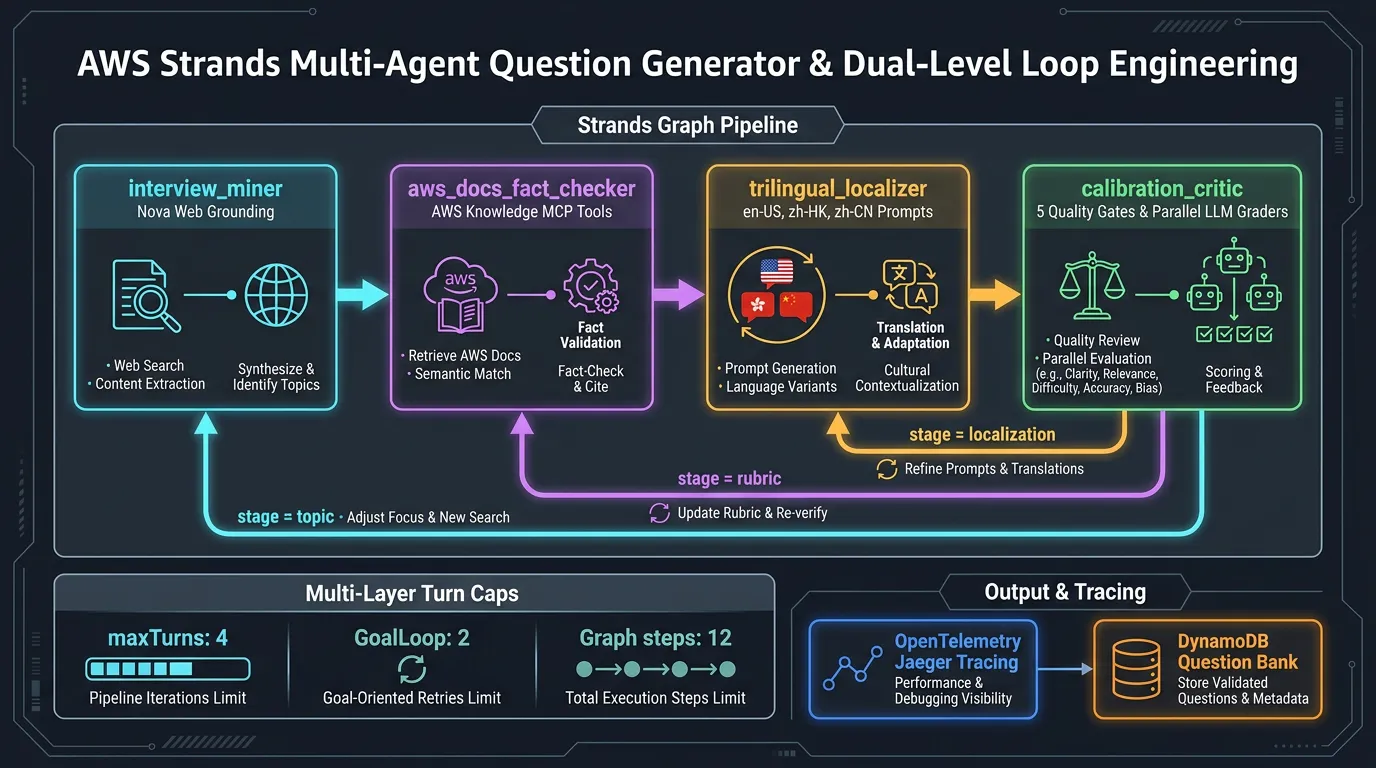
3.1 Grounding Tools: Amazon Nova Web Grounding ( tool() ) and AWS Knowledge MCP ( McpClient )
We wire two live grounding mechanisms into Strands:
-
createNovaWebSearchTool: Wraps Amazon Bedrock'sConverseCommand(systemTool: { name: "nova_grounding" }) inside a Strandstool(), extracting search queries and citations fromcitationsContent.
-
loadAwsKnowledgeMcpTools: UsesMcpClient.loadServers()to connect to the AWS Knowledge MCP Server (https://knowledge-mcp.global.api.aws) and filter foraws___search_documentationandaws___read_documentation.
JavaScript
// src/VoiceAgent/question-generator.mjsimport { BedrockRuntimeClient, ConverseCommand } from "@aws-sdk/client-bedrock-runtime";import { McpClient, tool } from "@strands-agents/sdk";const defaultClient = new BedrockRuntimeClient({ maxAttempts: 3, retryMode: "adaptive" });export function createNovaWebSearchTool({send = command => defaultClient.send(command),modelId = process.env.VOICE_MODEL_ID ?? "us.amazon.nova-2-lite-v1:0",} = {}) {return tool({name: "nova_web_search",description: "Search the live web using Amazon Nova Web Grounding (nova_grounding) for common AWS interview questions and recent service changes.",inputSchema: {type: "object",properties: { query: { type: "string" } },required: ["query"],},callback: async input => {const query = String(input?.query ?? "").trim();const response = await send(new ConverseCommand({modelId,messages: [{ role: "user", content: [{ text: query }] }],toolConfig: { tools: [{ systemTool: { name: "nova_grounding" } }] },inferenceConfig: { maxTokens: 1000, temperature: 0 },}));return extractNovaGroundingResult(response);},});}export async function loadAwsKnowledgeMcpTools({url = "https://knowledge-mcp.global.api.aws",allowed = ["aws___search_documentation", "aws___read_documentation"],} = {}) {const [mcpClient] = await McpClient.loadServers({awsKnowledge: { url, toolFilters: { allowed } },});return { tools: await mcpClient.listTools(), disconnect: () => mcpClient.disconnect() };}
3.2 Level 1 (Inner Loop): Building Each Specialist Node with createHarness , GoalLoop , and ContextOffloader
Every specialist node is created by
createStrandsNodeAgent() . Three Loop Engineering mechanisms work together inside each node:- Intra-Node
GoalLoop(@strands-agents/sdk/vended-plugins/goal): EvaluatesparseJsonFromText(text)on the node's final response. If a model outputs malformed JSON,GoalLoopreturns{ passed: false, feedback: ... }and resumes the agent in-place (preserveContext: true) up tomaxAttempts: 2.
-
ContextOffloader(@strands-agents/sdk/vended-plugins/context-offloader): Offloads MCP documentation reads larger than2500tokens intoInMemoryStoragewhile keeping a1000-token preview in active context.
- Resumption-Aware Turn Cap (
BeforeInvocationEvent+BeforeModelCallEvent): WhenGoalLoopresumes an agent after a JSON failure,event.resumedistrue, soturnsInCurrentInvocationis not reset—ensuring tool calls andGoalLoopretries share a single hard ceiling (boundedMaxTurns = 4).
JavaScript
// src/VoiceAgent/question-generator.mjsimport { createHarness } from "@strands-agents/harness";import { BedrockModel, BeforeInvocationEvent, BeforeModelCallEvent } from "@strands-agents/sdk";import { ContextOffloader, InMemoryStorage } from "@strands-agents/sdk/vended-plugins/context-offloader";import { GoalLoop } from "@strands-agents/sdk/vended-plugins/goal";async function createStrandsNodeAgent({id, description, systemPrompt, tools = [], send, modelId, maxTokens = 2200, maxTurns = 4, traceAttributes,}) {const boundedMaxTurns = Math.min(10, Math.max(1, Math.trunc(Number(maxTurns) || 4)));const model = new BedrockModel({modelId, maxTokens, temperature: 0, stream: false,clientConfig: { maxAttempts: 3, retryMode: "adaptive" },});// 1. Intra-Node GoalLoop Plugin: Self-corrects malformed non-JSON output before graph handoffconst jsonGoalLoop = new GoalLoop({name: `${id}:json-goal-loop`,maxAttempts: Math.min(2, boundedMaxTurns),preserveContext: true,goal: response => {const text = (response?.content ?? []).map(b => b?.text ?? "").join("\n").trim();try {parseJsonFromText(text);return { passed: true };} catch (error) {return {passed: false,feedback: `Output from ${id} was not valid JSON (${error.message}). Return ONLY valid JSON matching your node schema.`,};}},});// 2. ContextOffloader Plugin: Offloads large MCP documentation reads (>2500 tokens) to InMemoryStorageconst plugins = [jsonGoalLoop];if (tools.length > 0) {plugins.unshift(new ContextOffloader({storage: new InMemoryStorage(), maxResultTokens: 2500, previewTokens: 1000, includeRetrievalTool: false,}));}// 3. Strands Harness with Large-Tool Offloading and Overflow Protectionconst agent = await createHarness({id, name: id, description, model, effort: "auto", caching: false,systemPrompt, tools, plugins, builtinTools: [], builtinPlugins: [],contextManager: { strategies: ["largeToolOffloading", "overflowProtection"], stash: false },session: false, memory: false, skills: false, backgroundTasks: false, printer: false, retryStrategy: null,...(traceAttributes ? { traceAttributes } : {}),});// 4. Hard Inner Turn Cap (Default 4 turns, shared across tool calls and GoalLoop resumes)let turnsInCurrentInvocation = 0;agent.addHook(BeforeInvocationEvent, event => {if (!event?.resumed) turnsInCurrentInvocation = 0;});agent.addHook(BeforeModelCallEvent, () => {if (++turnsInCurrentInvocation > boundedMaxTurns) {throw new Error(`Agent "${id}" exceeded maximum inner loop turns (${boundedMaxTurns})`);}});return agent;}
3.3 The 4 Specialist Agents and Their Prompt Contracts
Each node in the Strands
Graph has a single responsibility and strict JSON output schema:
3.4 Deterministic Verifiers, Semantic Deduplication, and toolContext.invocationState
The heart of Loop Engineering is replacing subjective LLM self-review with deterministic verification. When
calibration_critic calls verify_and_calibrate_question , Strands passes toolContext.invocationState into the tool callback, running five deterministic gates in verifyAndCalibrate() :- Gate 1 (
validateQuestion): Enforces trilingual prompts, 2-3 concepts summing to100,misconceptions,acceptableAnswers, andreferenceAnswer.
- Gate 2 (
findDuplicateOrOverlappingQuestion): Computes stopword-filtered Jaccard token similarity againstavoidQuestions, rejectingoverlapping_prompt(>= 0.55) andoverlapping_concepts(>= 0.60).
- Gate 3 (
cantoneseOnlyChars): Rejectszh-CNprompts containing Cantonese-only characters (/[嘅喺唔畀佢哋乜啲揀嚟]/u).
- Gate 4 (
forbiddenVoiceClaim): Ensures no field mentions pronunciation, voice tone, or accent.
- Gate 5 (3x Parallel Live Grader Calibration): Invokes the production Strands grader (
graderfromsrc/VoiceAgent/agent.mjs,limits: { turns: 1 }) and our Two-PhaseNFKCsubstring verifier (gradeAnswer) in parallel viaPromise.all:goodEn(>= 80),goodZhHk(>= 80), andwrongOutdated(< 60).
JavaScript
// src/VoiceAgent/question-generator.mjsexport function findDuplicateOrOverlappingQuestion(question, avoidQuestions = [], avoidIds = []) {const blockedIds = new Set(avoidIds.map(id => String(id).trim()).filter(Boolean));if (blockedIds.has(question.id)) return { reason: "duplicate_id", matchId: question.id };const promptTokens = tokenizeTopicText(`${question.title ?? ""} ${question.prompts?.["en-US"] ?? ""}`, question.serviceId);const conceptTokens = tokenizeTopicText((question.concepts ?? []).map(c => `${c.id} ${c.description}`).join(" "), question.serviceId);for (const rawExisting of avoidQuestions) {const existing = summarizeExistingQuestion(rawExisting);if (!existing) continue;if (existing.id === question.id) return { reason: "duplicate_id", matchId: existing.id, matchTitle: existing.title };const promptSim = jaccardSimilarity(promptTokens, tokenizeTopicText(`${existing.title} ${existing.enPrompt}`, question.serviceId));if (promptSim >= 0.55) return { reason: "overlapping_prompt", similarity: promptSim, matchId: existing.id };const conceptSim = jaccardSimilarity(conceptTokens, tokenizeTopicText(existing.concepts.join(" "), question.serviceId));if (conceptSim >= 0.6) return { reason: "overlapping_concepts", similarity: conceptSim, matchId: existing.id };}return null;}export function classifyFailureStage(errorOrMessage) {const msg = String(errorOrMessage?.message ?? errorOrMessage ?? "");if (/already used|overlaps too closely|duplicate_|overlapping_|Question id is required/i.test(msg)) return "topic";if (/Mandarin prompt \(zh-CN\) contains Cantonese-only characters|Synthetic goodZhHk failed/i.test(msg)) return "localization";return "rubric";}// Inside verifyAndCalibrate(candidate, targetMeta): 3x Parallel Live Grader Calibrationconst [enRaw, hkRaw, wrongRaw] = await Promise.all([grader({ operation: "grade_answer", language: "en-US", feedbackLanguage: "English", question: rubricFor("en-US"), transcript: transcripts.goodEn }),grader({ operation: "grade_answer", language: "zh-HK", feedbackLanguage: "Traditional Chinese (Cantonese)", question: rubricFor("zh-HK"), transcript: transcripts.goodZhHk }),grader({ operation: "grade_answer", language: "en-US", feedbackLanguage: "English", question: rubricFor("en-US"), transcript: transcripts.wrongOutdated }),]);const enGrade = gradeAnswer(enRaw, question, transcripts.goodEn);if (!enGrade.passed || enGrade.score < 80) throw new Error(`Synthetic goodEn failed calibration (score=${enGrade.score}, expected >=80)`);const hkGrade = gradeAnswer(hkRaw, question, transcripts.goodZhHk);if (!hkGrade.passed || hkGrade.score < 80) throw new Error(`Synthetic goodZhHk failed calibration (score=${hkGrade.score}, expected >=80)`);const wrongGrade = gradeAnswer(wrongRaw, question, transcripts.wrongOutdated);if (wrongGrade.passed || wrongGrade.score >= 60) throw new Error(`Synthetic wrongOutdated passed unexpectedly (score=${wrongGrade.score}, expected <60)`);// Strands Tool bridging inner agent execution with outer Graph invocationStateconst calibrationTool = tool({name: "verify_and_calibrate_question",description: "Run schema validation, semantic duplicate detection, and 3-way live student grading.",inputSchema: {type: "object",properties: {question: { type: "object" },syntheticTranscripts: {type: "object",properties: { goodEn: { type: "string" }, goodZhHk: { type: "string" }, wrongOutdated: { type: "string" } },required: ["goodEn", "goodZhHk", "wrongOutdated"],},},required: ["question", "syntheticTranscripts"],},callback: async (input, toolContext) => {const state = toolContext?.invocationState ?? {};try {const verified = await verifyAndCalibrate(input, state.targetMeta);state.calibratedResult = verified;state.lastCritique = null;state.lastFailureStage = null;return { passed: true, questionId: verified.question.id, calibration: verified.calibration };} catch (error) {state.calibratedResult = null;state.lastCritique = error.message;state.lastFailureStage = classifyFailureStage(error);return { passed: false, failureStage: state.lastFailureStage, critique: error.message };}},});
3.5 Level 2 (Outer Loop): Cyclic Strands Graph Engineering and Targeted Feedback Routing
Building a cyclic multi-agent graph in
@strands-agents/sdk where calibration_critic conditionally routes execution back to trilingual_localizer , aws_docs_fact_checker , or interview_miner uses three techniques:- Enabling Forward Progress (
BeforeMultiAgentInvocationEvent): Markscalibration_critic.status = Status.COMPLETEDwhenresults.length === 0so forward edges fire on Cycle 1, while conditional back-edges checklastNodeId === "calibration_critic"andinvocationState.lastFailureStage.
- Injecting Structured Critique into Stateful Node Memory (
evaluateCriticOutcome+TextBlock): Appends anew TextBlock(critiqueMessage)({ previousAttemptCritique, failureStage, targetNode, cycle }) tolastCriticResult.content. WithpreserveContext: true, the target node receives this critique on top of its prior conversation history.
- Ephemeral Critique Cleanup (
BeforeNodeCallEvent): ClearslastCriticResult.content = []once delivered so downstream nodes never receive stale critiques.
JavaScript
// src/VoiceAgent/question-generator.mjsconst evaluateCriticOutcome = async state => {const criticResults = state.node("calibration_critic")?.results ?? [];if (invocationState.evaluatedCriticTurn === criticResults.length) return;invocationState.evaluatedCriticTurn = criticResults.length;if (!invocationState.calibratedResult) {const finalText = (state.node("calibration_critic")?.content ?? []).map(b => b?.text ?? "").join("\n").trim();try {invocationState.calibratedResult = await verifyAndCalibrate(parseJsonFromText(finalText), invocationState.targetMeta);invocationState.lastCritique = null;invocationState.lastFailureStage = null;} catch (error) {invocationState.lastCritique = error.message;invocationState.lastFailureStage = classifyFailureStage(error);}}if (invocationState.calibratedResult) {invocationState.shouldRetry = false;return;}invocationState.cycleCount = (invocationState.cycleCount ?? 0) + 1;invocationState.lastFailureStage = invocationState.lastFailureStage ?? classifyFailureStage(invocationState.lastCritique);invocationState.shouldRetry = invocationState.cycleCount < boundedMaxAttempts;const targetByStage = { localization: "trilingual_localizer", rubric: "aws_docs_fact_checker", topic: "interview_miner" };criticResults.at(-1)?.content?.push(new TextBlock(JSON.stringify({previousAttemptCritique: invocationState.lastCritique,failureStage: invocationState.lastFailureStage,targetNode: targetByStage[invocationState.lastFailureStage] ?? "interview_miner",cycle: invocationState.cycleCount,})));};const routeBackFor = (stage, forwardParent = null) => async state => {const lastNodeId = state.results.at(-1)?.nodeId;if (forwardParent && lastNodeId === forwardParent) return true;if (lastNodeId !== "calibration_critic") return false;await evaluateCriticOutcome(state);return Boolean(invocationState.shouldRetry && invocationState.lastFailureStage === stage);};const graph = new Graph({id: "aws-interview-question-pipeline",sources: ["interview_miner"],...(traceAttributes ? { traceAttributes } : {}),nodes: [{ agent: interviewMiner, preserveContext: true },{ agent: awsDocsFactChecker, preserveContext: true },{ agent: trilingualLocalizer, preserveContext: true },{ agent: calibrationCritic, preserveContext: true },],edges: [["interview_miner", "aws_docs_fact_checker"],["aws_docs_fact_checker", "trilingual_localizer"],["trilingual_localizer", "calibration_critic"],{ source: "calibration_critic", target: "trilingual_localizer", handler: routeBackFor("localization", "aws_docs_fact_checker") },{ source: "calibration_critic", target: "aws_docs_fact_checker", handler: routeBackFor("rubric", "interview_miner") },{ source: "calibration_critic", target: "interview_miner", handler: routeBackFor("topic") },],maxConcurrency: 1,maxSteps: boundedMaxSteps,});graph.addHook(BeforeMultiAgentInvocationEvent, event => {const criticNodeState = event.state.node("calibration_critic");if (criticNodeState && criticNodeState.results.length === 0) criticNodeState.status = Status.COMPLETED;});graph.addHook(BeforeNodeCallEvent, event => {if (event.nodeId !== "calibration_critic") {const lastCriticResult = (event.state.node("calibration_critic")?.results ?? []).at(-1);if (lastCriticResult?.content?.length > 0) lastCriticResult.content = [];}});
3.6 Streaming Graph Execution ( graph.stream ) and Multi-Slot Batch Accumulation
generateOrRefreshQuestion() consumes graph.stream(taskPrompt, { invocationState }) , while runQuestionBatchJob ( src/VoicePractice/question-generator.mjs ) feeds each newly approved question into avoidQuestions before starting the next slot:JavaScript
// 1. Streaming live Strands Graph events (src/VoiceAgent/question-generator.mjs)const streamGen = graph.stream(taskPrompt, { invocationState });for (let next = await streamGen.next(); !next.done; next = await streamGen.next()) {const event = next.value;if (event.type === "multiAgentHandoffEvent") {const isLoopBack = event.source === "calibration_critic" && (event.targets ?? []).length > 0;handoffs.push({ source: event.source, targets: event.targets, isLoopBack, failureStage: isLoopBack ? invocationState.lastFailureStage : null });}}// 2. Accumulating avoidQuestions across multi-slot generation (src/VoicePractice/question-generator.mjs)for (let i = 0; i < countPerService; i++) {const { question, trace } = await generator.generateOrRefreshQuestion({serviceId, label: meta.label, passage: meta.passage,avoidIds: [...existingIds],avoidQuestions: [...existingQuestionsById.values()],slotIndex: i + 1, status,});existingIds.add(question.id);existingQuestionsById.set(question.id, question);generatedForService.push(question);}
3.7 Multi-Layer Maximum Turn Limits (Preventing Infinite Loops)
Layer | Component | Bound | Enforcement Mechanism |
|---|---|---|---|
Layer 1 | Live Spoken Answer Grader ( src/VoiceAgent/agent.mjs ) | limits: { turns: 1 } | Passed directly to strandsAgent.invoke(..., { limits: { turns: 1 } }) |
Layer 2 | Intra-Node JSON GoalLoop ( @strands-agents/sdk/vended-plugins/goal ) | maxAttempts: 2 | Bounded AfterInvocationEvent JSON self-correction per node |
Layer 3 | Inner Specialist Agent ReAct Loop ( createStrandsNodeAgent ) | maxTurnsPerNode = 4 (clamped 1..10 ) | BeforeInvocationEvent + BeforeModelCallEvent hook throws if model calls exceed boundedMaxTurns |
Layer 4 | Outer Multi-Agent Graph ( aws-interview-question-pipeline ) | maxAttempts = 3 / maxSteps = 12 (clamped 4..40 ) | Conditional back-edges require cycleCount < boundedMaxAttempts and Graph enforces maxSteps |
4. Native Strands Observability and Live UI Tracing in Jaeger
We rely on Strands' native OpenTelemetry instrumentation (
@strands-agents/sdk/telemetry setupTracer + @strands-agents/harness OTEL_TRACES_EXPORTER=otlp ), flushing all spans via await tracerProvider.forceFlush() when generateOrRefreshQuestion completes:JavaScript
let tracerProvider = null;export async function enableStrandsTelemetry({otlp = Boolean(process.env.OTEL_EXPORTER_OTLP_ENDPOINT || process.env.OTEL_EXPORTER_OTLP_TRACES_ENDPOINT || process.env.LANGFUSE_BASE_URL),console: consoleExporter = process.env.STRANDS_TRACE_CONSOLE === "1",} = {}) {if (tracerProvider) return true;if (!otlp && !consoleExporter) return false;const telemetry = await import("@strands-agents/sdk/telemetry");tracerProvider = telemetry.setupTracer({ exporters: { otlp, console: consoleExporter } });return true;}
4.1 Running a Live Single-Service ( s3 ) Generation with Jaeger UI Tracing
Bash
# 1. Start the Official Jaeger All-in-One OTLP Collector and Web UIdocker run -d --rm --name strands-jaeger \-e COLLECTOR_OTLP_ENABLED=true \-p 16686:16686 -p 4317:4317 -p 4318:4318 \jaegertracing/all-in-one:latest# 2. Run Single-Service s3 Generation with Strands OTLP ExportOTEL_TRACES_EXPORTER=otlp \OTEL_EXPORTER_OTLP_ENDPOINT=http://localhost:4318 \OTEL_SERVICE_NAME=aws-warrior-question-generator \node src/VoicePractice/question-bank.mjs generate \/tmp/s3-single-question.json s3 \--count=1 --no-publish --force --otel --trace-console \--trace-json=/tmp/s3-single-trace.json
4.2 Inspecting the 41 Live OpenTelemetry Spans in Jaeger ( http://localhost:16686 )
Opening
http://localhost:16686 reveals the complete 41-span trace hierarchy ( traceId: ca1e8feaead2c97eb97c5f3380747da7 , duration 34.29s , 35,711 total tokens across us.amazon.nova-2-lite-v1:0 ):
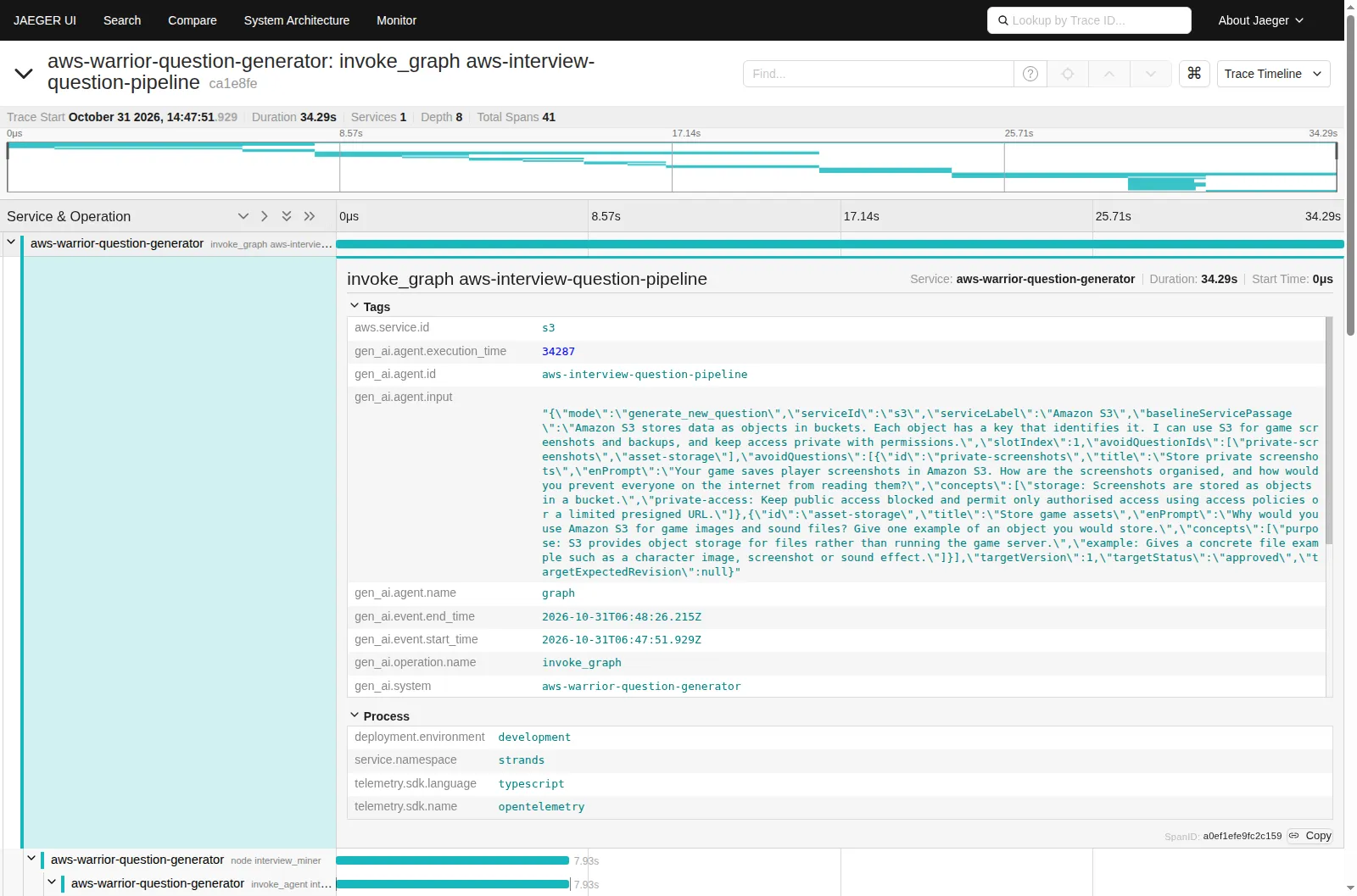
Clicking into the root
invoke_graph aws-interview-question-pipeline span displays Strands' native GenAI OpenTelemetry tags ( aws.service.id: s3 , gen_ai.agent.execution_time: 34287 , gen_ai.agent.input with avoidQuestions , service.namespace: strands , and token usage):

Plain text
invoke_graph aws-interview-question-pipeline (34,286.7ms | 35,711 tokens)├── node interview_miner (7,934.9ms)│ └── invoke_agent interview_miner -> cycle-1: nova_web_search (4,833.2ms) -> cycle-2├── node aws_docs_fact_checker (12,997.6ms)│ └── invoke_agent aws_docs_fact_checker -> search_documentation + 2x read_documentation├── node trilingual_localizer (3,414.3ms)│ └── invoke_agent trilingual_localizer (3,412.8ms)└── node calibration_critic (9,937.3ms)└── invoke_agent calibration_critic -> verify_and_calibrate_question (2,007.5ms)├── invoke_agent Strands Agent [goodEn -> 100/100] (2,001.8ms)├── invoke_agent Strands Agent [goodZhHk -> 100/100] (1,706.8ms)└── invoke_agent Strands Agent [wrongOutdated -> 50/100] (1,742.7ms)
4.3 The Resulting Calibrated S3 Question ( s3-lifecycle-optimization )
Because the two baseline S3 questions (
private-screenshots and asset-storage ) were passed in avoidQuestions , interview_miner selected S3 Lifecycle Cost Optimization, verified its storage class transitions against official AWS documentation via MCP, localized it into en-US , zh-HK , and zh-CN , and calibrated it against the live grader ( goodEnScore: 100 , goodZhHkScore: 100 , wrongOutdatedScore: 50 ):JSON
{"id": "s3-lifecycle-optimization","serviceId": "s3","version": 1,"status": "approved","title": "S3 lifecycle cost optimization","prompts": {"en-US": "Your application stores user-generated content in Amazon S3 and needs to reduce storage costs while maintaining quick access to recently used files. How would you configure S3 lifecycle policies to achieve this?","zh-HK": "你嘅應用程序將用戶產生嘅內容儲存喺 Amazon S3,而需要減少儲存成本,同時保持近期使用嘅文件快速存取。你點樣設定 S3 生命週期策略嚟達到呢個目標?","zh-CN": "您的应用程序将用户生成的内容存储在 Amazon S3 中,需要降低存储成本,同时保持最近使用文件的快速访问。您将如何配置 S3 生命周期策略来实现这一目标?"},"concepts": [{"id": "lifecycle-transition-rules","description": "Create lifecycle rules that transition objects to lower-cost storage classes like S3 Standard-IA, S3 One Zone-IA, or S3 Glacier after a defined period of inactivity, balancing cost savings with access performance requirements.","weight": 50},{"id": "storage-class-selection","description": "Select appropriate storage classes based on access patterns: S3 Standard for frequently accessed data, S3 Standard-IA for infrequent access with lower costs, and S3 Glacier for long-term archival with retrieval fees and time constraints.","weight": 30},{"id": "rule-scope-and-prefixes","description": "Define precise prefixes or tags in lifecycle rules to target specific object sets, avoiding unintended transitions and ensuring only appropriate data moves to lower-cost tiers.","weight": 20}]}
5. Series Conclusion and Key Takeaways
Across this 3-part series on The Legend of AWS Warrior V2, we showed how modern cloud education and generative AI engineering reinforce one another:
- Part 1 - The Game : Turning trilingual AWS oral interview practice into the Magic Power (MP) source for 19 Anime x AWS Cloud Arts in a 4-region Three.js 3D Action RPG—paired with Mobile QR-Code Wireless Microphone Handoff for mic-less lab PCs—defeats the "Copy-to-AI, Paste-Back" reflex and makes students want to practice speaking cloud architecture aloud.
- Part 2 - The AWS Design : Placing a Zero-Trust Referee Lambda in front of an IAM-isolated Amazon Bedrock AgentCore Runtime (
@strands-agents/harness+BedrockModel), backed by Two-PhaseNFKCVerbatim Substring Verification and Single-Table DynamoDB Transactions, eliminates hallucinated evidence, score drift, and prompt-injection reward theft.
- Part 3 - Gen Question: Applying Dual-Level Loop Engineering with
@strands-agents/harness(createHarness,GoalLoop,ContextOffloader),@strands-agents/sdk(Graph,McpClient,tool,invocationState), Amazon Nova Web Grounding, the AWS Knowledge MCP Server, and Native Strands OpenTelemetry Tracing lets educators autonomously scale and refresh a 100% documentation-grounded, live-calibrated question bank across all 302 AWS services.
Series: THE LEGEND OF AWS Warrior (4 articles)
- …
- 3The Legend of AWS Warrior (Part 3 - Gen Question): Autonomous AWS Question Bank Generation with Loop Engineering, Strands Multi-Agent Graphs, Harness Plugins and Live OpenTelemetry Tracing This article
Enjoyed reading this content? Let the author know!
Your likes, comments, shares, and saves help creators reach more builders.

Loading recommendations
Loading article