

REA (Reverse Engineer Anything) - The Black Box Just Got a Voice
Introduction and my perspective of REA - One MCP for reverse engineering across binaries, applications, and runtime behaviour.

For decades, software has lived behind a comfortable fiction:
“If you don’t have the source code, you can’t really understand it.”
That fiction is cracking now .
REA (Reverse Engineer Anything) — the open-source project that went from obscure to #1 on GitHub with 300K+ in 15 days — doesn’t just analyse binaries. Instead of requiring hours or days of manual decompilation by a human expert, REA lets an AI agent (like Claude Code, Cursor, or Codex) inspect compiled binaries, application runtimes, and websites to figure out exactly how a specific feature works and then rebuild it from scratch.
It gives AI agents the ability to interrogate compiled software the way a senior engineer would interrogate a codebase: with evidence, follow-ups, and clear limits on what is still unknown.
And that changes the game.
What REA Actually Changes
Most people are framing REA as “AI that reverse engineers apps.” That’s underselling it.
What it really does is collapse the distance between observation and understanding.
Previously:
- You saw a clever feature.
- You either reverse-engineered it yourself (slow, specialized) or you guessed.
Now:
- You point an agent at a local binary, Electron app, APK, or website you are authorized to inspect.
- You ask a precise question.
- The agent returns findings with evidence — pseudocode, call graphs, strings, limitations — and can then help you rebuild a clean version for your own product.
It’s not magic source recovery.
It’s structured, local, evidence-backed investigation at agent speed.
That distinction matters.
The Real Shift Isn’t Technical. It’s Psychological.
The most interesting part of REA isn’t Ghidra or Hopper integration. It’s the new default assumption it creates:
Software is no longer opaque by default.
This has quiet but profound consequences:
- Product teams can study competitor mechanics (legally and carefully) with far less friction.
- Security researchers can investigate malware or legacy systems without spending days on setup.
- Builders can learn from production software the same way they currently learn from open-source repos.
- Companies that treated binary opacity as a moat now have a new risk surface.
The winners will not be the ones who panic.
They will be the ones who treat legibility as a design constraint rather than an afterthought.
A Better Mental Model --
Think of REA less as a “reverse engineering tool” and more as a new sensory organ for coding agents.
Just as tools like browsers, terminals, and package managers became native capabilities for agents, deep software inspection is now joining the list. The agents that can see further will reason better. The organizations that understand this will design differently.
This is the same pattern we saw with:
- Code search becoming agent-native
- Terminal access becoming agent-native
- Browser control becoming agent-native
Now binary and application inspection is joining that stack.
How REA works --
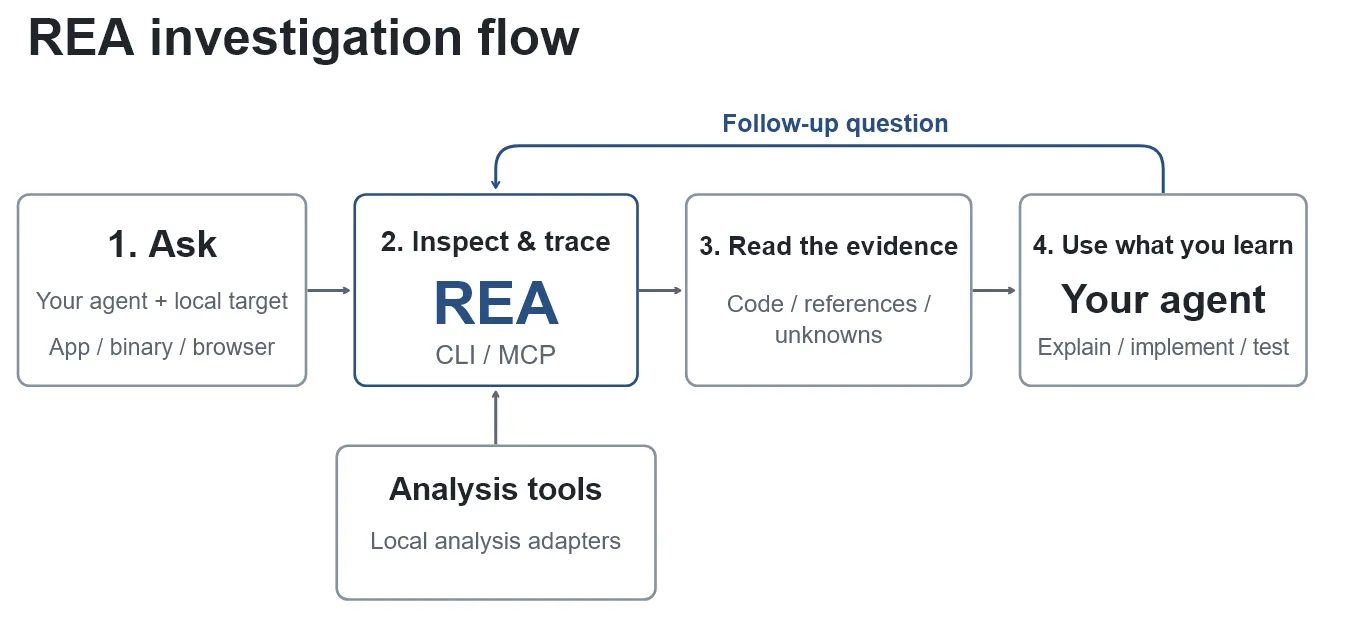
Your agent calls REA through MCP to inspect the target and trace relevant code. REA returns findings with their evidence. The agent uses them to ask follow-up questions, explain the behavior, or write and test an implementation. CLI commands use the same workflows.
How to Think About It Responsibly--
REA’s own documentation is unusually clear: it is intended for lawful analysis — security research, interoperability, education, preservation, and software you own or are authorised to examine. It does not support DRM circumvention, unauthorised access, or wholesale copying.
That boundary is not a footnote. It’s the difference between a powerful research tool and a liability.
If you’re exploring it:
- Stay on official sources only (github.com/morluto/rea, rea.tools, or the rea-agents npm package).
- Start with targets you fully control.
- Demand evidence, not just answers.
- Treat reconstructions as hypotheses that still need human judgment and legal review.
The Question That Actually Matters
The interesting question is no longer “Can AI reverse engineer software?”
The more useful questions are:
- What happens when understanding software becomes cheap?
- How do we design systems that remain robust even when their internals become legible?
- Which companies will treat this as a threat… and which will treat it as a new form of competitive intelligence and learning?
Software used to hide behind compilation.
That era is ending.
The black box just learned how to speak.
And the people who learn to listen carefully — with evidence, ethics, and intent — will shape what comes next.
Enjoyed reading this content? Let the author know!
Your likes, comments, shares, and saves help creators reach more builders.

Loading recommendations
Loading article