
Give your AWS architecture agent tools you can test: an open-source MCP workbench
Try 48 architecture tools for capacity, queues, IaC reviews and agent safety. Two reliability fixes show why deterministic tools still need explicit limits and regression tests.

An architecture assistant can explain a design convincingly. The harder question is: can I reproduce the calculation, inspect the assumptions, and make a pipeline fail when the review did not actually run?
That is the problem I am working on with Moretes Architect MCP, an independent, MIT-licensed project. It brings architecture calculations, structured reviews and planning tools into MCP clients, with a CLI for terminals and CI. The v0.4.1 release is also an invitation to the AWS community: try a small, synthetic scenario, challenge the assumptions, and help improve the result.
What is available today
The public server exposes 48 tools, 20 prompts and 18 resources. Ten architect personas organize useful perspectives; they are prompt templates, not ten autonomous agents. The toolset covers capacity and latency budgets, queue sizing, disaster recovery, unit economics, diagrams, IAM and infrastructure reviews, API contracts, and agent/MCP configuration checks.
The calculators and rule-based reviews run without model calls inside the server. Live AWS documentation tools are a separate network-backed capability. Your coding assistant may still use a paid model, and local execution still consumes your machine's resources.
The repository also contains a catalog of AWS MCP projects and opt-in local integrations. A catalog entry is discovery information, not a claim that every external server has been tested or is safe to enable automatically.

A demonstration from the existing project course: gathering missing requirements before recommending a design. The clips contain Portuguese narration/captions; the tool inputs and outputs are available in the repository examples.
A three-minute experiment: does this queue have enough headroom?
With Node.js 22.13 or newer, run the pinned CLI:
npx --yes --package moretes-aws-architect-mcp@0.4.1 moretes-architect call queue_sizing --arg arrivalsPerSecond=900 --arg serviceTimeMs=1000 --arg consumers=1000This is a synthetic scenario: 900 arrivals/second, one second of average service time, and 1,000 concurrent processing slots. The result includes 90% utilization, a wait probability rounded to
0.0006 , and a mean of 900.005 items in the system. It also warns about limited headroom.These numbers are an M/M/c model, not a benchmark of Amazon SQS, Lambda or ECS. Poisson arrivals and exponential service times are simplifying assumptions. Batch size, retries, visibility timeouts, downstream contention, service quotas and bursty traffic can change actual behavior. Use this as a reviewable baseline, then validate against measurements from your workload.
In an MCP client that supports remote Streamable HTTP, add:
https://mcp.moretes.com/mcpThen ask: “Use queue_sizing for 900 arrivals per second, 1000 ms service time and 1000 consumers. Explain its assumptions and what I must measure before applying this to an SQS worker.” Check that the assistant actually calls the tool and distinguishes its returned calculation from its own advice. Client-specific setup examples for Claude, Codex, Kiro and other clients are in the repository documentation.

Another calculation workflow from the course: inspecting a latency budget in Kiro. This is a different example from the queue scenario above.
What a real bug taught me about deterministic tools
The earlier Erlang C implementation used powers and a direct summation. For sufficiently large inputs, intermediate values could overflow even when the queue itself was stable. A deterministic calculation can be consistently wrong or non-finite.
Version 0.4.1 computes Erlang C through a bounded Erlang B recurrence. It tests large-load results against high-precision reference values and rejects inputs beyond 100,000 total concurrent slots. That bound applies to
consumers × maxConcurrencyPerConsumer , rather than independently accepting two large values and accidentally multiplying the work.The lesson is broader than queues: validate the mathematical model, the numerical implementation and the computational bound separately. A plausible-looking JSON response is not sufficient evidence of correctness.
A second experiment: report-only must still report execution failures
Architecture reviews often start in report-only mode so that teams can evaluate findings before enforcing a gate. That mode should tolerate findings; it should not conceal a missing input file or malformed JSON.
The GitHub Action now distinguishes three outcomes:
-
0: the review completed and satisfies the selected policy.
-
1: findings reached the configured severity threshold.
-
2: input, execution or artifact-writing error.
With
fail-on: "" , findings can leave the job green, but errors still fail it. The Action also accepts a JSON array of paths, including filenames with spaces, without shell evaluation. SARIF output is supported for a single input file.- uses: actions/checkout@v4- uses: fernando-moretes/moretes-aws-architect-mcp@v0.4.1 with: tool: terraform_plan_review files: plan.json fail-on: "" sarif: review.sarifProduce
plan.json in an earlier step using your normal Terraform workflow, or start with a synthetic fixture. A heuristic review can flag useful patterns; it cannot prove that an infrastructure plan is secure. Inspect findings in context and keep your existing controls.
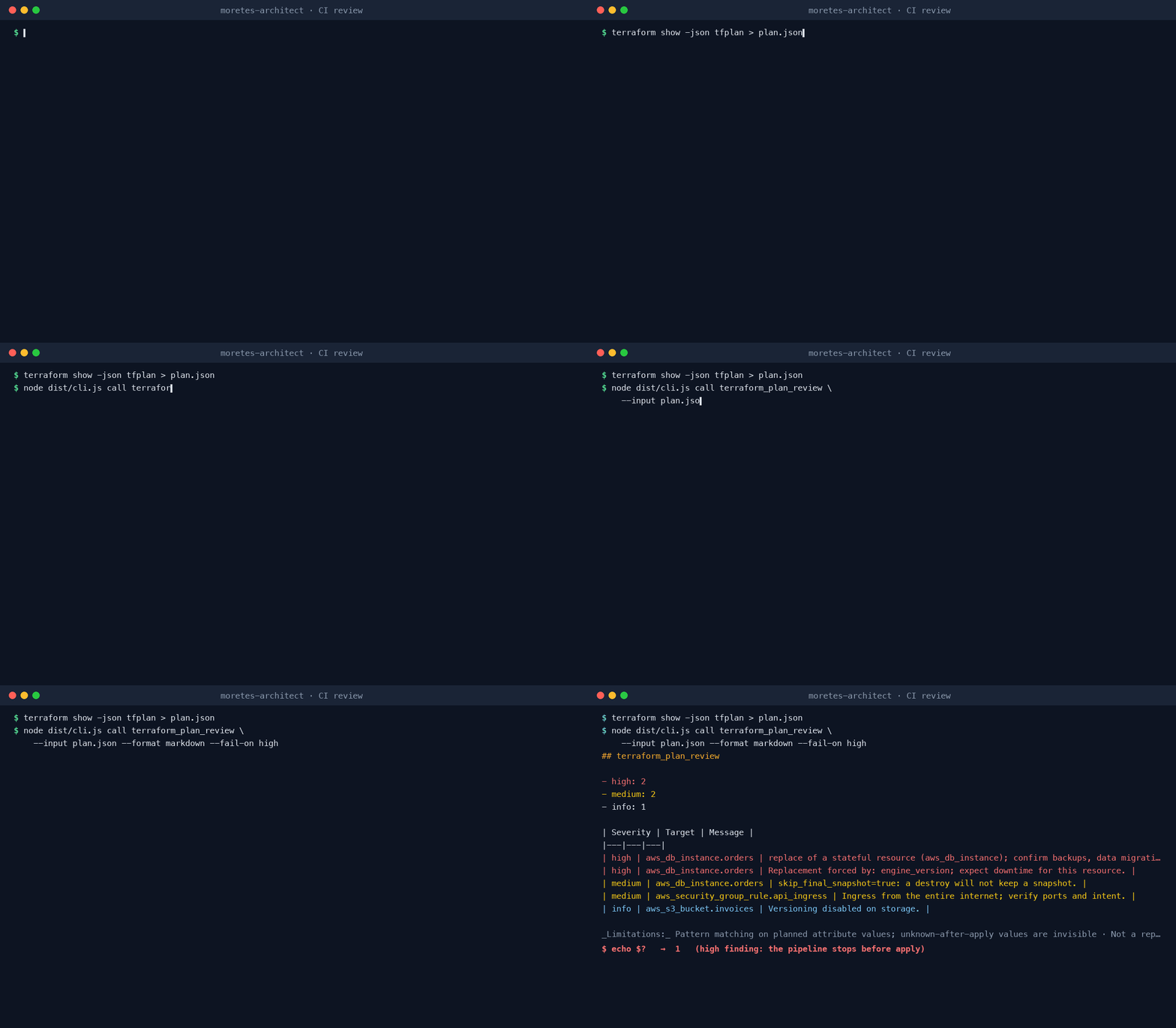
The CLI example uses
--fail-on high , so high findings return exit code 1. This differs intentionally from the report-only Action example above.Public exploration and private account access have different boundaries
The public endpoint is intended for documentation and synthetic or non-confidential inputs. It does not expose AWS account tools or local provider dispatch. Account-aware functionality is opt-in in the locally operated server, with AWS credentials and account guards controlled by the operator.
Keep customer plans, secrets and confidential source code local. Do not send those to a public demo. The hosted service has shared quotas, so sustained testing belongs on a local installation or container. Its usage counters measure attempted tool calls, not unique users or validated adoption.
Help shape the next iteration
If you prefer a guided path, the free project course walks through installation, requirements, architecture decisions, calculations and reviews. The existing README includes the same demonstrations, and the site provides PT/EN learning material.

A lesson from the project course. Treat screenshot UI/version labels as historical examples; the commands in this article are pinned to v0.4.1.
The release has 50 automated tests, version/contract consistency checks, and clean-package CLI and MCP stdio smoke tests. Those are useful evidence, not a substitute for community feedback across different clients and workloads.
I would especially value three kinds of feedback:
- A queue or capacity scenario where the documented assumptions are inadequate.
- An infrastructure review finding that needs better evidence, or a reproducible false positive.
- A client integration where installation, tool discovery or error reporting is confusing.
Please open a GitHub issue with the version, client, sanitized minimal input, expected outcome and actual result. Synthetic examples are ideal. Documentation improvements and focused PRs are welcome too.
What is one architecture decision you would want a tool to calculate or check before your assistant gives you a recommendation?
Enjoyed reading this content? Let the author know!
Your likes, comments, shares, and saves help creators reach more builders.

Loading recommendations
Loading article