Introduction
When building an application, developers need to think about more than just writing code. They must also consider servers, storage, scalability, and maintenance. Traditionally, managing these components requires time and infrastructure knowledge.
AWS offers serverless services that simplify many of these responsibilities. Two useful services to explore are AWS Lambda and Amazon Simple Storage Service (Amazon S3).
What Is Serverless Computing?
Serverless computing allows developers to build and run applications without directly managing the underlying servers. The cloud provider handles much of the infrastructure management, allowing developers to focus on application logic.
Serverless does not mean that servers do not exist. Instead, developers don't have to provision and maintain them in the traditional way.
Some benefits include:
- Reduced infrastructure management.
- Automatic scaling for supported workloads.
- Usage-based pricing for many services.
- Faster development of event-driven applications.
Understanding AWS Lambda
AWS Lambda is a compute service that runs code in response to events. You upload your function, configure its trigger and permissions, and AWS manages the execution environment.
For example, a Lambda function could process a file uploaded to Amazon S3, generate a notification, or transform data before storing it elsewhere.
Developers should also consider execution time limits, permissions, concurrency, and service costs when designing Lambda functions.
Understanding Amazon S3
Amazon S3 is an object storage service used to store and retrieve data. It can hold images, documents, application assets, backups, and many other types of files.
S3 is useful for applications that need durable storage without managing physical storage infrastructure.
For example, a web application could allow users to upload profile pictures to an S3 bucket and retrieve them when needed.
How Lambda and S3 Work Together
Consider a simple application that processes uploaded images.
The workflow could look like this:
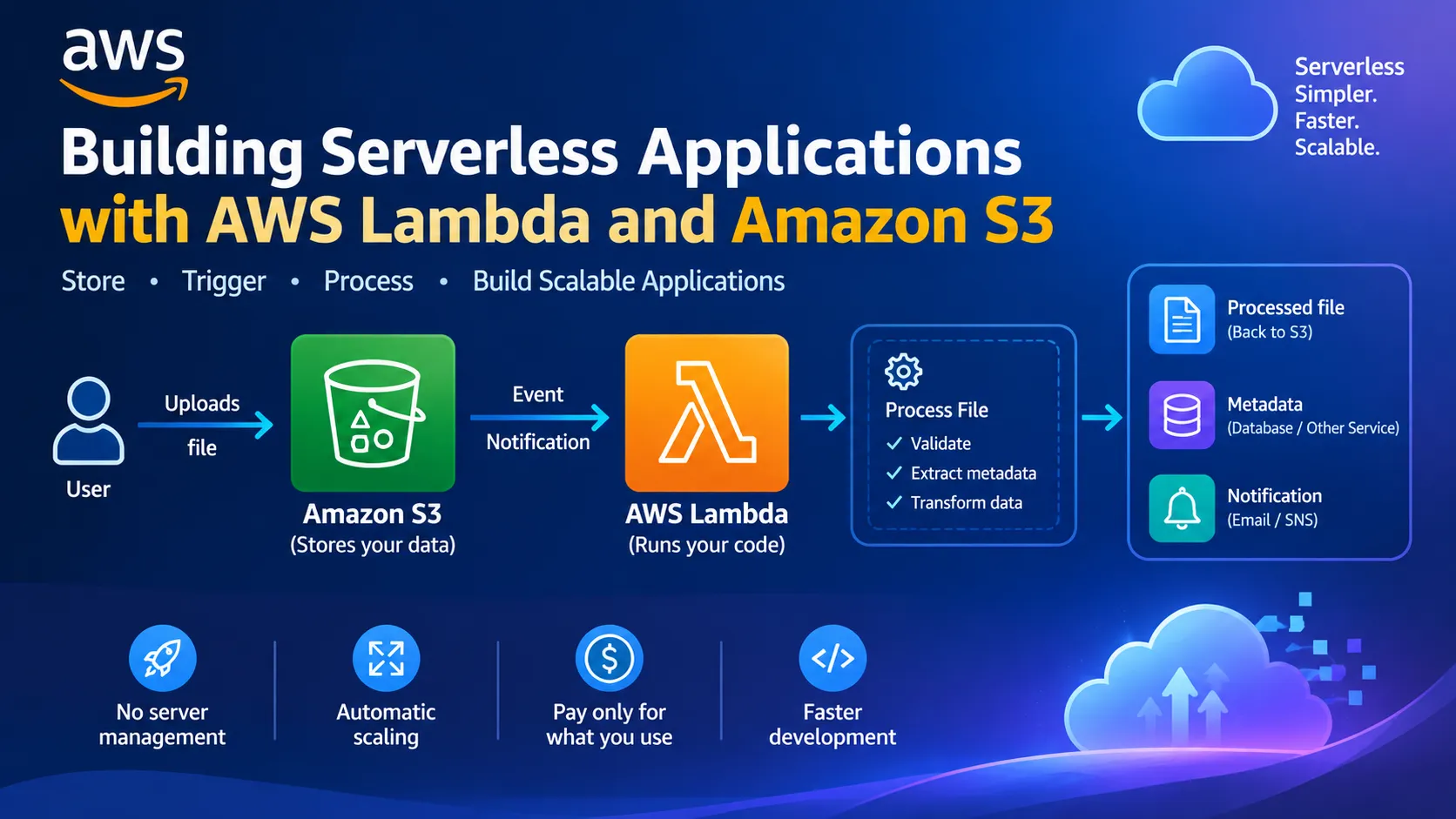
- A user uploads an image to an Amazon S3 bucket.
- S3 generates an event notification.
- The notification invokes an AWS Lambda function.
- The Lambda function processes the image or extracts its metadata.
- The application stores the resulting information or sends a notification.
This architecture separates file storage from processing logic, making the application easier to maintain and extend.
A Beginner-Friendly Project Idea
A practical project is an automated document processing system.
Users upload documents to an S3 bucket. An S3 event triggers a Lambda function that validates the file and records basic metadata, such as its name, size, and upload time.
You could extend the project by adding a database, monitoring, error handling, and a simple frontend.
Start with a small implementation and add features gradually as you become more comfortable with AWS.
Security and Cost Considerations
Before deploying a serverless application, remember these important practices:
- Follow the principle of least privilege when configuring IAM permissions.
- Keep S3 buckets private unless public access is genuinely required.
- Validate uploaded files and handle errors safely.
- Monitor executions and failures using Amazon CloudWatch.
- Review AWS pricing and configure budgets or alerts where appropriate.
Even small projects should follow good security practices from the beginning.
Conclusion
AWS Lambda and Amazon S3 provide a useful foundation for building event-driven applications. By combining compute and storage services, developers can create solutions that respond automatically to events while reducing infrastructure management.
For beginners, building a small file-processing project is a practical way to understand how cloud services interact.
What would you build first with AWS Lambda and Amazon S3?



Loading article