

Beyond Auto-Healing: Building a Safe, Closed-Loop Cloud Operations Control Plane on AWS
Build safer AWS operations with event-driven remediation, least-privilege execution, blast-radius controls, and automated recovery verification.

1. The 3:00 AM Problem: When Automation Becomes the Incident
Imagine a production service running across multiple Availability Zones. At 03:00, its error rate increases. Amazon CloudWatch detects the degradation, an alarm changes state, and an automated workflow starts restarting application instances.
The first restart succeeds. The second succeeds. Then the service's latency increases further because the actual problem is a saturated database connection pool, not a failed application process.
The automation has done exactly what it was instructed to do—and made the incident worse.
This is an important distinction in Cloud Operations: automating an action is not the same as automating a recovery.
A mature operational platform needs more than alerts and scripts. It needs a feedback loop that understands the observed condition, evaluates whether an action is safe, executes a bounded intervention, verifies the outcome, and escalates when recovery cannot be demonstrated.
In this article, we design a closed-loop Cloud Operations control plane using native AWS services. The architecture combines observability, event-driven orchestration, Systems Manager Automation, policy guardrails, progressive remediation, and post-action verification.
The goal is not to make every incident autonomous. It is to make routine recovery repeatable while ensuring that uncertain, high-impact, or potentially destructive actions remain under human control.
2. Architecture: From Signals to Verified Recovery
The proposed architecture separates the production workload from the operational control plane.
The workload generates telemetry and runs independently of the remediation system. The control plane evaluates operational events and executes approved actions through narrowly scoped permissions.

Figure 1: Reference architecture for closed-loop AWS Cloud Operations. Classification, policy evaluation, and verification are application logic built on AWS services, not individual managed services.
The architecture uses these components:
- Amazon CloudWatch: Detects operational symptoms through metrics, alarms, logs, and application-level signals.
- AWS CloudTrail: Provides an audit trail of supported AWS API activity to help correlate infrastructure changes with incidents.
- AWS Config: Evaluates resource configurations against defined rules and supports remediation workflows for applicable noncompliant resources.
- Amazon EventBridge: Routes relevant AWS service events and application-generated operational events.
- AWS Step Functions: Coordinates multi-step workflows, including classification, approvals, retries, and verification.
- AWS Systems Manager Automation: Executes approved operational runbooks against supported AWS resources.
- Amazon SNS: Delivers notifications when an intervention requires human attention.
These services are not interchangeable. CloudWatch observes operational signals; EventBridge routes events; Step Functions coordinates workflow state; Systems Manager performs infrastructure operations. Keeping those responsibilities separate makes the control plane easier to reason about and test.
3. Treat Telemetry as Evidence, Not a Command
An alert should not automatically authorize an infrastructure mutation.
High CPU utilization, for example, can indicate several different conditions:
- A legitimate traffic increase.
- A runaway process.
- A background job running at the wrong time.
- A dependency retry storm.
- A workload that has reached its configured capacity.
Restarting an instance in every case is a dangerous operational shortcut.
Instead, normalize incoming signals into an incident envelope containing enough information to classify the problem.
An example event generated by an operational detection component:
Plain text
{"incidentId": "inc-2026-00421","source": "cloudwatch","service": "checkout-api","environment": "production","resourceId": "i-0123456789abcdef0","signal": "application_error_rate","severity": "high","correlationWindowSeconds": 300,"proposedAction": "diagnose_only"}
This is an illustrative application-level schema, not a native CloudWatch event format.
AWS services emit different event structures. EventBridge rules should match the actual event source and detail type, while a normalization component converts incoming events into a consistent internal representation.
The classifier should correlate multiple signals rather than reacting to one threshold in isolation.
Observed evidence | Possible interpretation | Initial response |
|---|---|---|
High CPU, normal error rate | Legitimate demand | Evaluate scaling and capacity |
High CPU, elevated error rate | Application or resource saturation | Diagnose before intervention |
Instance status check failure | Instance-level fault | Consider an approved recovery runbook |
Rising database connections and API latency | Dependency saturation | Investigate connection pools and database health |
Unexpected security-group change | Potential configuration or security incident | Preserve evidence and investigate |
These are hypotheses, not deterministic diagnoses. Production implementations should define thresholds, correlation windows, and confidence requirements appropriate to each workload.
Engineering rule: The first automated action should often be diagnostic rather than corrective.
Collecting recent logs, inspecting instance health, checking deployment history, and examining dependency metrics can be safer than immediately restarting a resource.
4. Make Every Remediation a Controlled State Machine
A reliable remediation workflow should have explicit states.
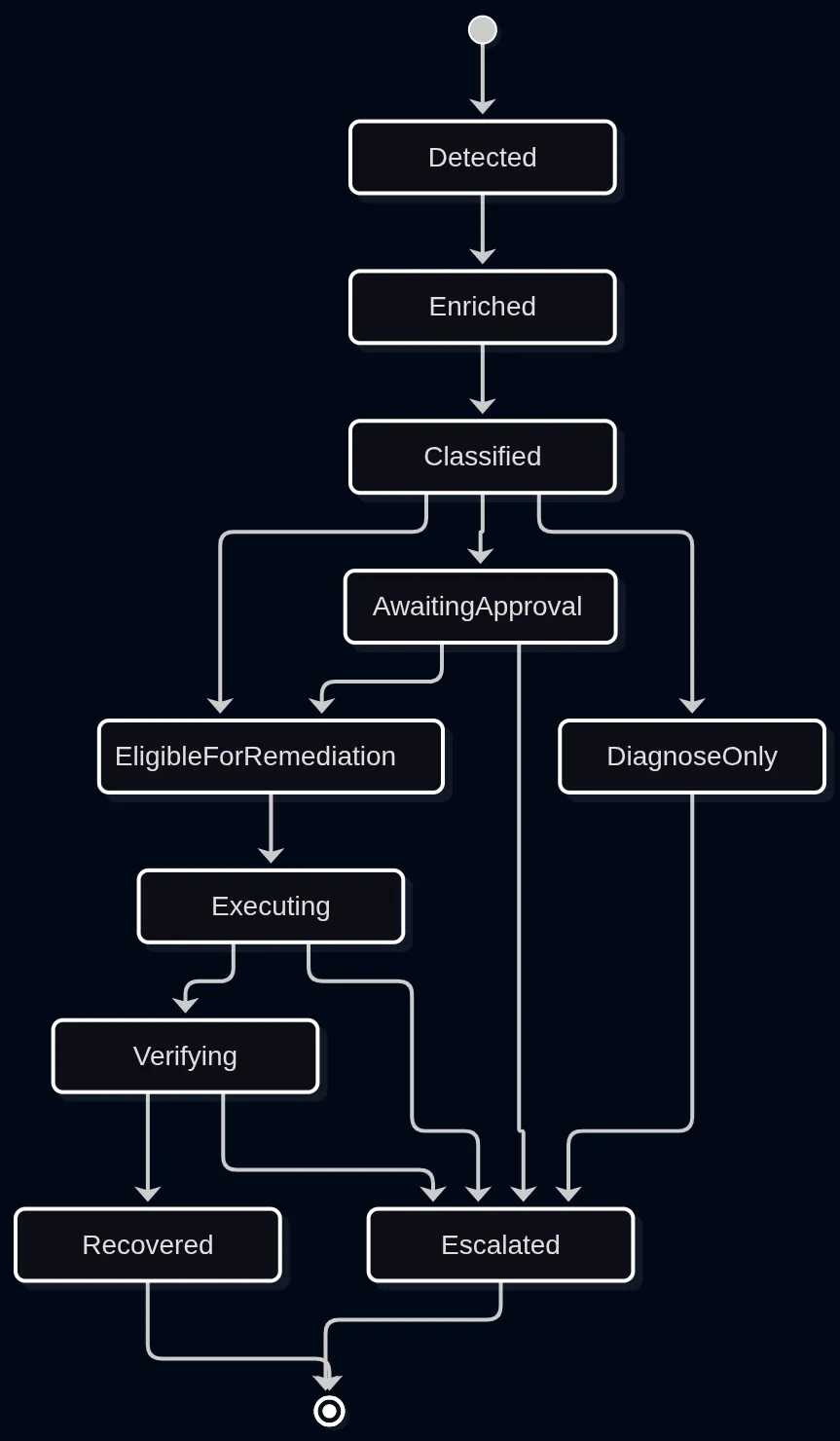
AWS Step Functions can coordinate this workflow, using Lambda functions or other supported integrations for classification, policy evaluation, and verification.
Each transition has a clear contract:
- Detected: An incoming event has passed basic validation.
- Enriched: The workflow has gathered resource ownership, environment, recent deployment information, relevant metrics, and current resource state.
- Classified: The incident has been assigned a failure category and severity.
- Eligible for remediation: The proposed action has passed safety checks, including environment restrictions, action allowlists, resource ownership validation, and cooldown rules.
- Executing: A specific, version-controlled Systems Manager Automation runbook is running.
- Verifying: The workflow checks whether the original symptom has improved and whether the intervention introduced new problems.
- Recovered: The recovery criteria have been satisfied within the defined observation window.
- Escalated: The workflow has stopped making changes and handed control to an operator or incident response process.
The critical transition is from eligibility to execution.
A model, script, or classifier can recommend an action, but the execution layer should independently validate the resource and operation against an explicit policy.
This separation prevents a classification error from becoming an unrestricted infrastructure change.
5. Bound the Blast Radius
AWS Systems Manager Automation supports rate controls when running automations across a fleet. You can define maximum concurrency and an error threshold to limit how many targets are processed simultaneously and when dispatch stops after failures.
For example, a fleet of 100 instances could use a canary-first strategy:
Phase | Target count | Maximum concurrency | Advancement condition |
|---|---|---|---|
Canary | 1 | 1 | Recovery checks pass |
Small batch | 5 | 1–2 | No material regression |
Broader rollout | 20 | 2–5 | Error rate and latency remain healthy |
Remaining fleet | 74 | Policy-dependent | Explicit health gate passes |
These are illustrative values, not universal production recommendations. For a stateful database or critical single-instance service, even one concurrent action may be too risky.
For a single approved EC2 instance, an illustrative AWS CLI command is:
Plain text
aws ssm start-automation-execution \--document-name "AWS-RestartEC2Instance" \--parameters '{"InstanceId":["i-0123456789abcdef0"]}' \--max-concurrency "1" \--max-errors "0"
This command illustrates starting an AWS-managed restart runbook with one target and zero tolerated automation errors before dispatch stops. Verify the document's availability, parameters, and permissions in your target environment.
It does not make restarting an instance intrinsically safe. A restart may interrupt active requests, disrupt stateful workloads, or remove evidence needed for diagnosis. Resource eligibility, application health, and business impact must be evaluated before execution.
For larger workflows, configure a CloudWatch alarm to monitor the effects of remediation. Systems Manager Automation supports CloudWatch alarm monitoring and can stop an execution when a monitored alarm enters the
ALARM state, subject to the execution's configuration and permissions.References:
6. Implement Event-Driven Operations with EventBridge
EventBridge connects operational signals to workflow entry points without requiring the workload to call the remediation system directly.
A rule can match an appropriate AWS service event and send it to a supported target, such as a Step Functions state machine or Systems Manager Automation workflow.
A conceptual event pattern for an application-generated event could look like this:
Plain text
{"source": ["com.example.cloudops"],"detail-type": ["Operational Incident Detected"],"detail": {"environment": ["production"],"severity": ["high"]}}
This is a custom event pattern. The producer must publish events with matching
source , detail-type , and detail fields.In this design, EventBridge routes the event to the incident workflow. It does not decide whether restarting an instance is safe.
A production event-driven workflow should account for:
- Duplicate events.
- Delayed or out-of-order signals.
- Retry behavior and failed deliveries.
- Dead-letter handling where supported.
- Throttling and service quotas.
- Correlation of events belonging to the same incident.
Event-driven systems must not assume that receiving an event means the underlying condition is still present. Before executing a mutation, recheck the current resource state and relevant health signals.
7. Build a Real Safety Gate
Before remediation runs, evaluate the proposed action against a policy.
A practical first version can use deterministic rules rather than machine learning:
Plain text
def authorize_remediation(incident, resource, action, policy):if resource.environment != incident.environment:return False, "environment_mismatch"if resource.environment == "production":if action.name not in policy.production_allowed_actions:return False, "action_not_allowlisted"if resource.is_stateful and action.may_interrupt_service:return False, "stateful_workload_requires_review"if resource.maintenance_window == "active":return False, "maintenance_in_progress"if resource.recent_remediation_count >= policy.max_attempts:return False, "remediation_limit_reached"if incident.severity == "critical" and not action.has_approval:return False, "approval_required"return True, "authorized"
This is pseudocode for an application-level policy gate, not a complete implementation or a substitute for AWS authorization controls.
The fields and rules must be defined by the platform. For example,
recent_remediation_count requires durable state, and has_approval must be tied to a trusted approval mechanism rather than a caller-controlled Boolean.The execution layer should also verify that the target resource is eligible for the requested operation. A stale event must not authorize an action against a resource that has changed ownership or entered a different operational state.
Useful policy checks include:
- Resource belongs to the intended AWS account, Region, and environment.
- Resource tags and ownership metadata satisfy operational policy.
- Action is explicitly allowlisted for that resource type.
- Current incident and resource state still justify the action.
- A cooldown prevents repeated remediation loops.
- The workflow has not exceeded its retry or cost budget.
- Required human approval is present for high-impact actions.
For organization-wide controls, combine application-level checks with AWS IAM, AWS Organizations service control policies where appropriate, and AWS Config compliance rules.
A custom safety gate is defense-in-depth. It must never replace IAM enforcement of which identities can perform which AWS API operations.
8. Least-Privilege Execution: Separate the Operator from the Runbook
Automated operations can become a privilege-escalation path if every workflow uses a broad IAM role.
Use distinct identities for distinct responsibilities:
- Event-processing identity: Validates and routes incoming events to approved workflow entry points.
- Workflow identity: Invokes only the functions and service integrations needed for orchestration.
- Automation execution role: Performs only the AWS operations required by approved runbooks.
- Read-only diagnostic identity: Inspects required metrics, logs, and resource metadata without modifying production resources.
Where supported, scope IAM policies to specific resources and approved Systems Manager documents. Restrict who can modify runbooks, who can start them, and which execution roles they may use.
An automation role that needs to restart approved EC2 instances should not automatically receive permission to modify IAM policies, disable security controls, or change account-wide networking.
Use temporary credentials and supported role-assumption mechanisms instead of embedding long-lived access keys in scripts.
Log relevant API activity through CloudTrail and capture execution results so operators can reconstruct who initiated a workflow, which identity performed the operation, which resource was targeted, and what happened afterward.
This audit trail is particularly important when a remediation succeeds technically but causes unexpected business impact.
9. Verify Recovery, Not Just Execution
A successful automation execution is not proof of a recovered service.
Consider a runbook that successfully restarts an instance. Systems Manager reports success because the requested operation completed. However, the application might still return errors, the load balancer might continue failing health checks, or the database might remain saturated.
Recovery must therefore be defined at the application or service level.
For an API service, a verification policy might require:
- The original alarm has returned to an acceptable state.
- Error rate remains below a defined threshold.
- p95 or p99 latency returns to the service's target range.
- Dependency health remains acceptable.
- The service remains healthy throughout an observation window.
- No new critical alarms have appeared.
The actual thresholds should come from the service's SLOs, workload characteristics, and baseline behavior.
An illustrative verification loop:
Plain text
def verify_recovery(service, baseline, policy):metrics = collect_service_metrics(service=service,window_seconds=policy.observation_window_seconds)if metrics.data_is_incomplete:return "INCONCLUSIVE"if metrics.error_rate > policy.max_error_rate:return "FAILED"if metrics.p95_latency_ms > policy.max_p95_latency_ms:return "FAILED"if metrics.dependency_health != "healthy":return "FAILED"if metrics.error_rate > baseline.error_rate * policy.max_error_multiplier:return "FAILED"return "RECOVERED"
This is illustrative Python, not a complete monitoring client. The policy must define how missing data, short-lived spikes, baseline changes, and statistical uncertainty are handled.
A mature verifier would evaluate multiple consecutive windows rather than declaring recovery from one favorable sample.
It should distinguish three outcomes:
- Recovered: The service satisfies all required recovery conditions.
- Failed: The service remains unhealthy or has materially deteriorated.
- Inconclusive: There is insufficient trustworthy telemetry to establish whether recovery occurred.
The inconclusive state is essential. Missing metrics must not be interpreted as proof of health.
When verification fails, the control plane should stop further automated mutations, preserve diagnostic evidence, and escalate. Blindly running another remediation can turn one failure into a remediation loop.
10. Prevent Remediation Loops and Event Storms
An automated control plane can generate more events than the original incident.
For example:
- A remediation restarts an instance.
- The restart triggers health-check failures.
- The failures trigger a new incident event.
- The new incident starts another restart.
- Repeated restarts produce additional failures and events.
Prevent this with several independent controls.
Incident deduplication: Maintain a stable incident key, such as service, resource, failure category, and correlation window. Multiple signals for the same underlying incident should be correlated rather than treated as independent permission to mutate infrastructure.
Idempotency: Repeated processing of the same event should not create duplicate destructive actions. Use durable workflow state and conditional writes where needed; a process-local dictionary is insufficient for a distributed system.
Cooldowns: Enforce a minimum interval between equivalent remediation actions on the same resource.
Attempt budgets: Limit remediation attempts per incident and per resource.
Circuit breakers: Suspend a remediation policy when its failure rate or the associated service's health crosses a defined threshold.
Concurrency controls: Limit simultaneous actions across the fleet.
Explicit escalation: Require an operator when a repeated action fails or the underlying cause remains uncertain.
The incident state should be durable, with transitions recorded alongside action identifiers and results. A new event should check this state before scheduling a potentially duplicate operation.
For multi-account operations, account and Region boundaries should be part of the idempotency and concurrency model. A per-account limit does not necessarily provide a safe global limit across an entire organization.
11. Observability for the Control Plane Itself
A remediation platform must be observable independently of the applications it manages.
Otherwise, the team may discover that the control plane is broken only when it fails to recover a production service.
Track at least four classes of signals.
Operational effectiveness
- Mean time to detect (MTTD).
- Mean time to recover (MTTR).
- Percentage of incidents resolved by approved automation.
- Percentage of remediations followed by verified recovery.
- Rate of false-positive remediation attempts.
- Percentage of incidents escalated because evidence was insufficient.
Safety
- Number of actions rejected by policy.
- Number of executions stopped by a safety alarm.
- Number of repeated actions blocked by cooldowns.
- Number of incidents requiring manual intervention after remediation.
- Number of actions executed against stale incident state.
Reliability
- Event-to-workflow latency.
- Workflow execution failure rate.
- Time spent in each state.
- Retry count and throttling rate.
- Verification timeout rate.
- Age of the oldest unresolved incident.
Cost
- Workflow executions per incident.
- Compute and logging costs attributable to remediation.
- Cost of diagnostic data collection.
- Cost of repeated or unsuccessful actions.
Use CloudWatch metrics and dashboards to expose these signals. Propagate a correlation identifier through the event, workflow, runbook, logs, and verification result so that an operator can trace a single incident across components.
CloudTrail provides a complementary record of supported AWS API activity; it does not replace application-level workflow logs or prove that a service recovered.
A useful operational metric is:
\frac{\text{Automated incidents with verified recovery}}
{\text{Incidents eligible for automation}}
\times 100
]
Define the denominator carefully. Incidents that were correctly escalated because they were unsafe to automate should not automatically be classified as failed recovery. Report eligibility, safety rejection, execution success, and verified recovery separately.
12. AWS Config: Continuous Compliance as Another Feedback Loop
Operational recovery is only one part of Cloud Operations. Configuration drift can also introduce reliability and security problems.
AWS Config can evaluate supported resource configurations against rules and initiate remediation actions for applicable noncompliant resources. Custom remediation actions can use Systems Manager Automation documents.
For example, a rule might identify a resource that violates an approved configuration standard. The remediation workflow could evaluate the resource's current state, determine whether an automatic correction is permitted, and apply an approved change.
However, AWS Config evaluations can be based on configuration snapshots that are not perfectly synchronized with the current state of a resource. A resource may change between evaluation and remediation.
Therefore, a remediation should revalidate the target's current state before modifying it.
Not every compliance violation should be automatically corrected. A security-group change affecting a critical application, for instance, may require investigation before reverting it because the change could have been part of an approved deployment or incident response.
Start with low-risk, reversible configuration corrections. Require approval or manual investigation for changes that could disrupt traffic, destroy data, alter access boundaries, or interfere with an active deployment.
13. An Implementation Roadmap
A production-ready control plane should be introduced incrementally, with measurable acceptance criteria.
Phase 1: Observe and classify
- Select one noncritical workload.
- Define its service-level indicators and recovery conditions.
- Route relevant alarms and operational events through EventBridge.
- Create a normalized incident schema.
- Build diagnostic workflows without making infrastructure changes.
Exit criterion: The platform can correlate incoming signals, identify a candidate failure category, and produce an auditable incident record.
Phase 2: Add controlled remediation
- Select one well-understood failure mode.
- Create a version-controlled Systems Manager Automation runbook.
- Configure a dedicated execution role with least privilege.
- Add action allowlists, cooldowns, and attempt limits.
- Begin with a single canary target.
- Add an alarm that can stop the automation if the workload deteriorates.
Exit criterion: The workflow can execute a permitted action and stop safely when its guardrails are triggered.
Phase 3: Add independent verification
- Define recovery criteria from service SLOs.
- Collect metrics over an observation window.
- Implement recovered, failed, and inconclusive outcomes.
- Stop retries when recovery cannot be demonstrated.
- Notify an operator with diagnostic evidence and execution history.
Exit criterion: The platform distinguishes a successful infrastructure operation from a verified service recovery.
Phase 4: Expand the safety boundary
- Test duplicate events, stale signals, and concurrent incidents.
- Simulate workflow failures and unavailable telemetry.
- Test the effects of a failed remediation.
- Add durable incident state and audit correlation.
- Validate IAM permissions and runbook modification controls.
- Expand to additional resource types only after the initial workflow passes its acceptance tests.
Exit criterion: The platform demonstrates bounded impact, traceability, and safe escalation under expected failure conditions.
Phase 5: Measure before scaling
Run controlled experiments in a nonproduction environment. Compare the automated workflow with the existing operational procedure using the same incident scenarios.
Record:
- Time to detect and classify.
- Time to complete the intervention.
- Time to verified recovery.
- Percentage of successful recoveries.
- Incorrect or unnecessary actions.
- Cost per incident.
- Operator time required for diagnosis and follow-up.
Do not publish performance improvements until the measurements have actually been collected. The architecture describes a testable engineering approach, not a claim that these results have already been achieved.
14. Research Questions: Can We Make Cloud Operations Measurably Safer?
The design raises several questions worth investigating.
Question 1: Does evidence-based remediation reduce unnecessary infrastructure changes?
Compare an alarm-triggered action with a workflow that first correlates application, dependency, and deployment signals. Measure unnecessary actions, time to recovery, and the number of incidents escalated.
Question 2: What is the right balance between automation speed and blast-radius control?
Compare different concurrency limits and canary strategies under controlled fault-injection scenarios. Measure recovery time alongside the number of resources affected before the system detects a failed intervention.
Question 3: How should the system handle uncertain telemetry?
Introduce delayed metrics, missing data points, stale events, and conflicting signals. Evaluate whether the control plane correctly chooses an inconclusive outcome rather than making an unsafe change.
Question 4: Can policy decisions remain explainable as the system grows?
Record the policy version, evidence used, action proposed, decision outcome, and reason for rejection. Measure how quickly an operator can reconstruct a remediation decision after an incident.
These experiments turn Cloud Operations from a collection of scripts into a measurable engineering discipline. They also create a path for future work on risk-aware automation, anomaly detection, and policy-assisted operational decision-making.
Machine learning could eventually help rank diagnostic hypotheses or recommend likely remediation paths. It should not receive unrestricted permission to mutate production infrastructure. Any recommendation must pass the same deterministic authorization, resource validation, blast-radius, and verification controls as a manually proposed action.
15. Final Thoughts: Recovery Is a Claim That Must Be Proven
Cloud Operations is often described in terms of monitoring coverage, automation coverage, and deployment speed. Those capabilities matter, but they do not establish whether an automated intervention actually restored service safely.
A mature operational system needs to answer five questions:
- What happened, and what evidence supports that conclusion?
- Why is this action appropriate for this resource?
- What is the maximum impact if the action is wrong?
- How will the system establish whether recovery occurred?
- What happens when the evidence is insufficient, or the intervention fails?
AWS provides the building blocks for this design: CloudWatch for observation, EventBridge for event routing, Step Functions for orchestration, Systems Manager Automation for controlled operations, AWS Config for configuration compliance, IAM for authorization, and CloudTrail for API auditing.
The engineering challenge is in the contracts between these services: how evidence becomes a decision, how a decision becomes an authorized action, and how an action becomes a verified outcome.
The future of Cloud Ops is not infrastructure that changes itself whenever an alarm fires. It is infrastructure that can explain why it changed, constrain what it is allowed to change, and demonstrate whether the change actually helped.
That is the difference between automated operations and trustworthy autonomous operations.
Architecture note: This is a proposed reference design. Service integrations, IAM permissions, event schemas, quotas, and runbook behavior should be validated in the target AWS account and Region before production deployment.
# application-load-balancer# cloud-operations# amazon-cloudwatch# aws-systems-manager# amazon-eventbridge
Any opinions in this article are those of the individual author and may not reflect the opinions of AWS.Enjoyed reading this content? Let the author know!
Your likes, comments, shares, and saves help creators reach more builders.

Loading recommendations
Loading article