
Building Durable Agent Harness with Amazon Bedrock AgentCore and Temporal
Key insights from AWS Community Day Bengaluru | July 11, 2026
Series: AWS Conferences Tour (42 articles)
- …
- 41Building Durable Agent Harness with Amazon Bedrock AgentCore and Temporal This article

I recently attended the AWS Community Day in Bengaluru on 11 July 2026, and there were several amazing technical sessions, but one presentation really stood out. Shubham Londhe gave a super informative session on “Building Durable Agent Harness with Amazon Bedrock Agentcore and Temporal”.
I work in infrastructure automation and get on-call pages every day thus the idea of an autonomous dependable AI agent stepping in and correcting problematic services right away really caught my eye. I know the architecture and I want to explain precisely how this new AI technology works.
The Reality Check: Prototypes vs. Production
Let’s face it, we’re in the golden age of AI hype. By the end of 2026, Gartner expects that 40% of enterprise apps will have AI agents. Also, the agentic-AI market is expected to balloon to $139 billion by 2034.
But the reality on the ground is somewhat more dark. Currently, just 23% of organisations have successfully deployed their agents in production environments.
Why such a big gap? Shubham said it well with a wonderful remark “Building an agent is easy. “The hard part is running one consistently in production.”
Why Prototype Agents Fail in the Real World
Does that ring a bell? You construct an awesome AI agent in a local notebook, it runs like a charm, but the moment you deploy it, everything goes wrong. A prototype will not make it through production.
Here are the main reasons why:
- State Loss: If the system crashes while doing a task, the entire state is lost.
- Duplicate LLM Calls: When an agent loses state it re-runs everything from the start. This leads to chaos and large, unexpected cloud costs.
- Human Bottlenecks: You can’t wait easily for human approval. Normally, in the classic sense, a human-in-the-loop (HITL) would stall a running computing process.
- Total Amnesia: Usually there is no memory, no audit trail, so each run starts from scratch.
Take a typical prototype agent such as ordering meals in a delivery app. If the app breaks just as you press the “pay” button, you have to start over, re-add your items, and complete the payment again. This is really irritating and unpractical.
What Exactly is an Agent Harness?
Perhaps you are asking how we actually fix this. The answer is to develop a “agent harness”.
An agent harness is the basic infrastructure that is created around your core Agent Loop. The agent loop itself is straightforward . AI reasons , acts , observes and repeat . But to get it into production it requires a strong support infrastructure.
Think of your AI agent like a high-performance race car engine. The chassis is the harness. The pit crew, telemetry tracking, that is what actually allows the car to survive a 24 hour race.
This harness is based on five fundamental pillars:
- Runtime: The agent’s operating environment.
- Memory: Ability to recall previous context.
- Gateway: How the agent interacts with external APIs
- Identity: How the agent authenticates in a secure manner .
- Observability: How we observe what the agent is doing.
Amazon Bedrock AgentCore
That’s where AWS comes in. Amazon Bedrock AgentCore provides you this harness out of the box.
It provides your agents a serverless, isolated runtime that can run up to 8 hours. It has memory inside to recollect earlier instances. For identity, it injects scoped tool credentials. It serves as a gateway for connectivity, integrating APIs to tools through the Model Context Protocol (MCP). And lastly, it offers observability by providing rich execution traces straight into CloudWatch.
Meet the Durable On-Call DevOps Agent
To explain this abstract concept, Shubham illustrated with a real-world example: a long-lived on-call DevOps agent.
This agent works through a series of logical steps:
- Check Health: It tells you whether a service is down.
- Get Metrics: It pulls performance statistics to get a sense of what the problem is.
- CloudWatch: It analyzes the logs.
- Restart (Human Approval): It suggests a fix, like restarting a database, but waits for a person to hit “approve.”
- Healthy: That tells you that the system is up again.
Traditional vs. Modern: The Temporal Advantage
Now, here's the interesting part. How can we deal with that “Human Approval” phase without the agent timing out or burning up expensive compute hours waiting for a tired engineer to wake up and look at their phone?
Before: The Plain Agent
In a typical setting, you’d write code like this:
Python
agent = Agent(model, tools)agent("fix it")
If you crash mid-run you lose all state and have to re-run all those expensive tool calls.
After: The Wrapped Agent
And then by wrapping that same agent in Temporal we make the loop permanent. The execution now looks like:
Python
@workflow.defnclass DevOpsAgentWorkflow:agent = TemporalAgent("claude",tools=[activity_as_tool(check),activity_as_tool(metrics),restart_tool]) # HITL signalawait agent.invoke_async(prompt)
In this current design, Bedrock AgentCore is the runtime entry-point while Temporal Cloud handles the durable state. The worker on AWS Fargate or Lambda does the actual loop against the target service.
Temporal is like a save-point in a video game. If your machine crashes, you don't have to start the game again at level one. You develop right where you left off.
So, when the workflow requires human approval, it waits as a Temporal signal. It's not an actively blocked process, so it can wait hours, even days, at absolutely $0 compute cost. If a crash does occur, it just replays from history and never re-runs a finished LLM or tool call.
Mission Control: Seeing it Live
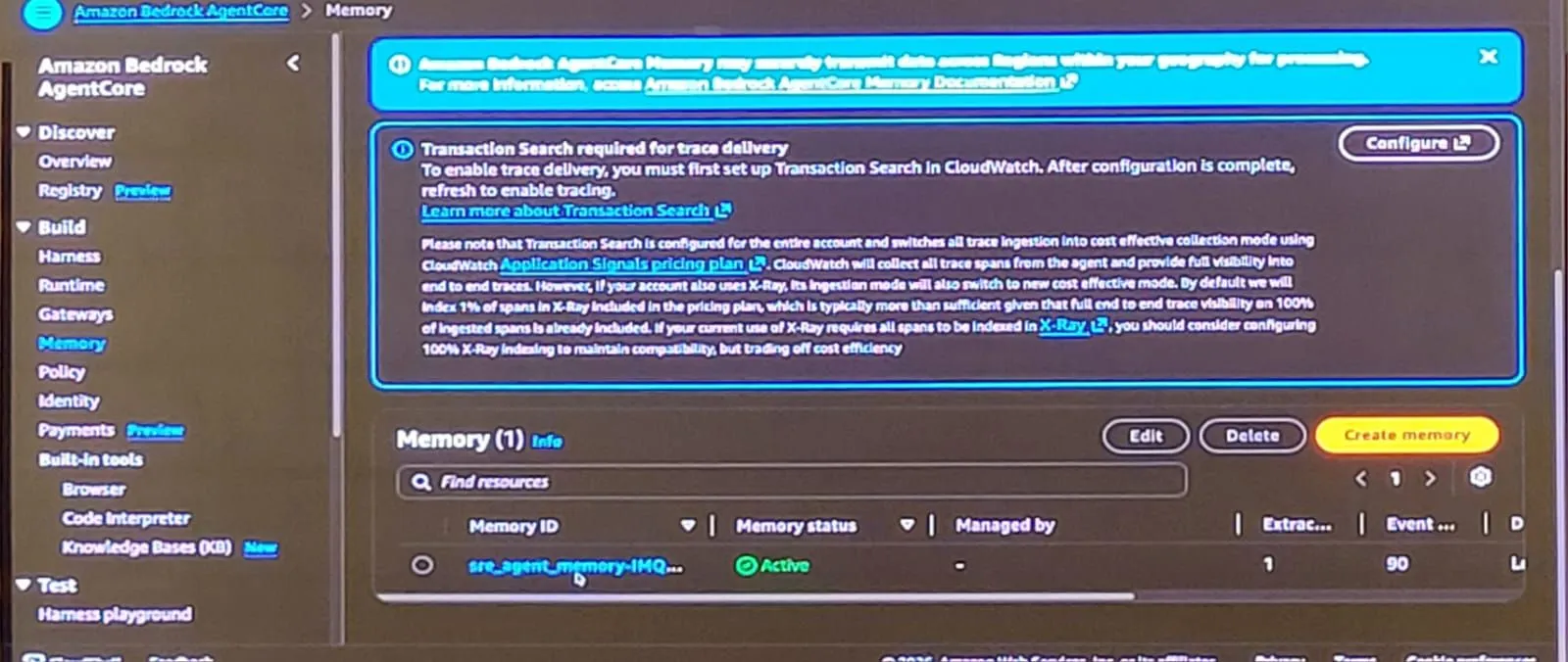
Shubham was able to perform this task with a custom “DevOps Mission Control” dashboard.
At first everything was perfect. The monitored service was active and the API, Database and Cache were all showing healthy. Behind the scenes, we can see that Bedrock AgentCore’s Memory feature is actively managing the data, using Transaction Search in CloudWatch to make sure that traces are delivered properly.
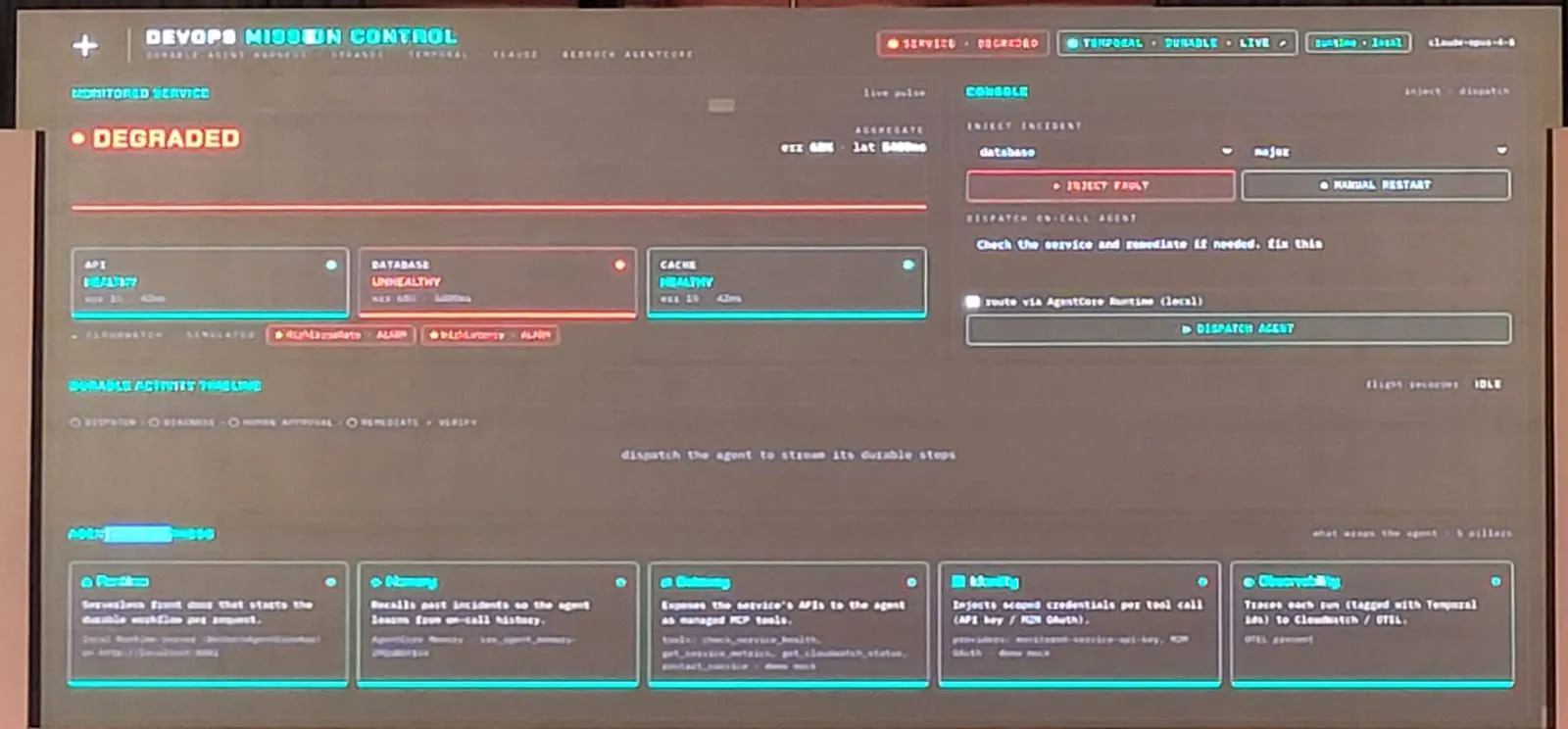
Then we introduced a failure. The service was immediately marked as DEGRADED. The database was now UNHEALTHY with huge latency and error rates.
The AgentCore runtime sent the agent immediately.
Switching over to the Temporal Web UI we saw the
devops-agent workflow come to life. The timetable listed step by step what was happening. The best thing? The UI showed the agent extracting "Related past incidents" from its memory, recognising the service had degraded previously at the API and database layers with comparable latency issues. Armed with this historical context, it knew what to do next without starting its troubleshooting from square one.

Key Takeaways
- Prototypes are fragile: A simple script works OK for a local demo, but in the real world AI agents need a suitable harness to survive mid-task crashes.
- Bedrock AgentCore provides the foundation: It does the heavy lifting by giving your agent a serverless runtime, built-in memory, secure identity management, and straightforward observability.
- Temporal acts as a safety net: Temporal gives you lasting execution when you wrap your agent workflow. If a failure occurs, it serves as a save-point, resuming just where it left off without re-running expensive LLM calls.
- Waiting is finally free: Need human approval to restart a degraded database? Temporal allows you to suspend an operation for hours or days with zero computing cost.
Conclusion
Ultimately it’s only half the battle to have an AI agent that only functions on your laptop. Making it live across the unexpected volatility of a real production environment takes some significant infrastructure.
Working with real cloud deployments, CI/CD pipelines and database migrations on a day-to-day basis really highlights the need for automated recovery and robust workflows. The union of Bedrock AgentCore and Temporal bridges the gap between a weak prototype and a durable, enterprise-grade AI buddy.
Long story short, if you're designing autonomous agents that interact with live infrastructure, durable execution is not a nice bonus, it's a must have.
About the Author
As an AWS Community Builder, I enjoy sharing the things I've learned through my own experiences and events, and I like to help others on their path. If you found this helpful or have any questions, don't hesitate to get in touch! 🚀
References
Event: AWS Community Day Bengaluru
Topic: Building Durable Agent Harness with Amazon Bedrock AgentCore and Temporal
Date: July 11, 2026
Series: AWS Conferences Tour (42 articles)
- …
- 41Building Durable Agent Harness with Amazon Bedrock AgentCore and Temporal This article
Enjoyed reading this content? Let the author know!
Your likes, comments, shares, and saves help creators reach more builders.

Loading recommendations
Loading article