
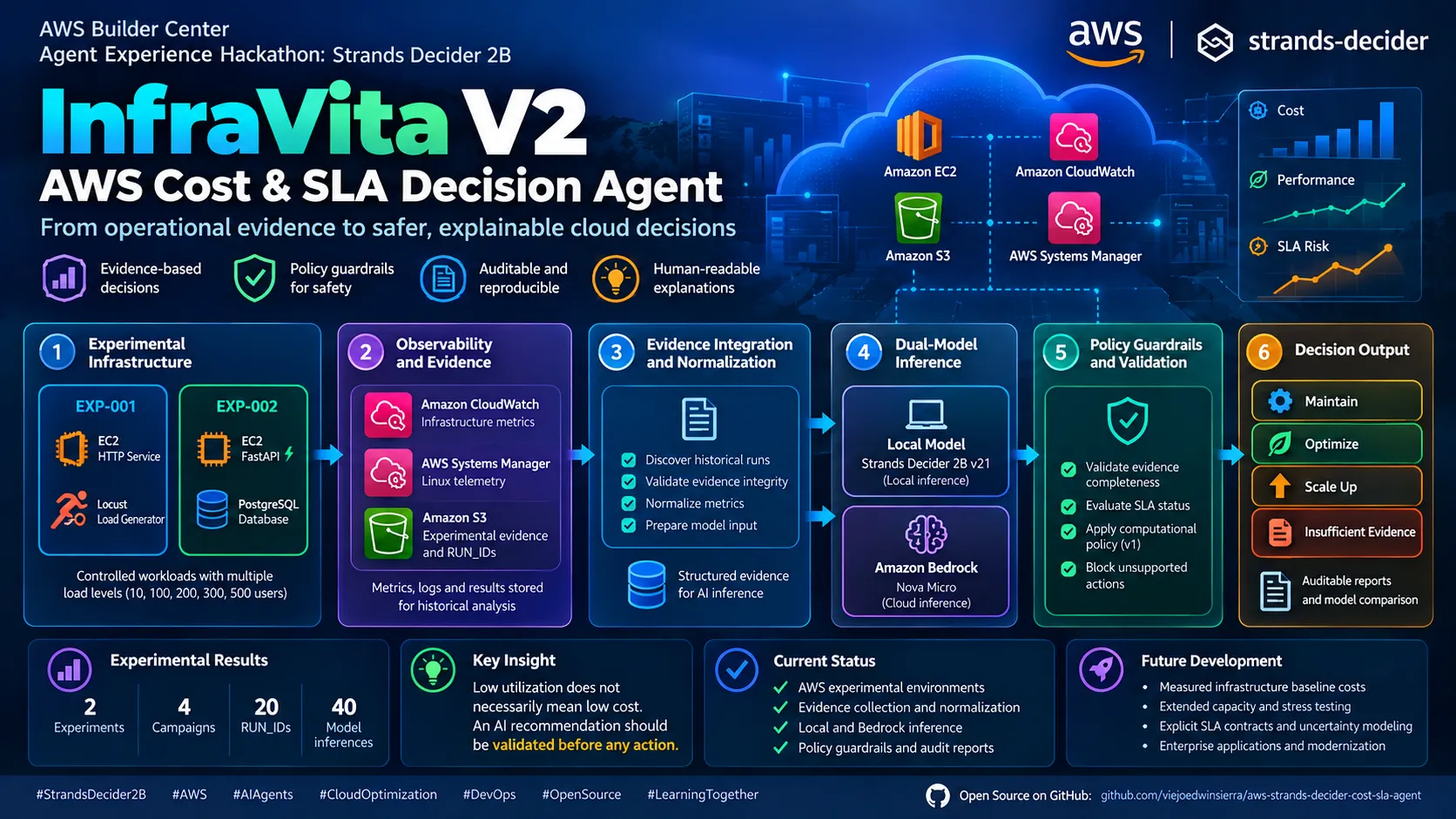
Beyond Cloud Cost Optimization: InfraVita V2 and Evidence-Based Architecture Decisions
Exploring how TM Forum ODA, operations research, infrastructure costs, and observability inform cross-architecture decisions through an experimental AI agent.

Beyond Cloud Cost Optimization: Evidence-Based Architecture Decisions
Architecture Decisions Are Cross-Domain Decisions
Cloud infrastructure optimization is often reduced to scaling resources or lowering monthly costs. However, changing infrastructure capacity can affect application performance, database throughput, integrations, data processing, and service-level commitments.
Architecture decisions are inherently transversal. Optimizing one component without considering its dependencies may transfer costs or risks to another part of the technology solution.
This principle connects my ongoing research with the TM Forum Open Digital Architecture (ODA): technology capabilities should be understood through their relationships with business processes, applications, data, integration, and infrastructure.
In this perspective, data architecture and observability connect the entire solution, making it possible to evaluate decisions using operational evidence rather than isolated resource metrics.
From Infrastructure Inventory to Effective Capacity
An infrastructure inventory describes provisioned resources: compute, storage, databases, networking, and deployed services. But provisioned capacity does not necessarily represent the amount of useful work a system can perform.
Effective capacity depends on workload behavior, concurrency, software design, database interactions, and resource contention.
For example, low CPU utilization does not automatically justify scaling down a server. Application latency may be influenced by database bottlenecks, network dependencies, or external services.
The research objective is to connect four dimensions:
Infrastructure inventory → Effective capacity → Service performance → Technology cost
This relationship is essential for identifying underutilization, capacity constraints, and optimization opportunities without compromising service quality.
Fixed Costs and Operations Research
Infrastructure can generate expenses even when business demand is low. Provisioned compute, persistent storage, networking, and supporting services may continue incurring costs throughout the evaluation period.
A simplified cost representation is:

Here, fixed costs represent provisioned commitments within the selected time horizon; variable costs depend on consumption; and operational costs represent supporting services and activities.
The challenge is not merely to minimize expenditure, but to balance cost, performance, service commitments, and risk.
Drawing on operations research, the decision problem can be represented conceptually as:

Where:
- u -> represents an architectural or operational decision.
- L -> represents performance or latency impact.
- SLA -> represents service-level violation risk or penalties.
- R -> represents operational or architectural risk.
- α, β, γ -> represent weights requiring calibration.
The system can also be expressed through a state-transition model:

Here, x_t describes the system state, u_t is a decision, and w_t represents uncertain external conditions.
These formulations provide a research framework, not an optimization model already calibrated or validated by the prototype.
InfraVita V2: An Experimental Decision Agent
To explore these ideas, I developed InfraVita V2, an open-source experimental AWS Cost & SLA Decision Agent for the Strands Decider Agent Hackathon.
The prototype combines controlled AWS experiments, Amazon CloudWatch, AWS Systems Manager, Amazon S3, Strands Decider 2B running locally, and Amazon Bedrock Nova Micro.
Two experimental environments were evaluated:
- EXP-001 — HTTP Capacity: simulated demand and infrastructure response.
- EXP-002 — Application and Database Capacity: FastAPI and PostgreSQL behavior under different workloads.
Across 20 historical experimental runs, the project generated 40 model inferences.
Experimental metric | EXP-001 | EXP-002 |
|---|---|---|
Runs | 10 | 10 |
Model inferences | 20 | 20 |
Original decision agreement | 80% | 50% |
These agreement rates measure consistency between model outputs, not prediction accuracy or verified financial savings.
The most significant observation came from EXP-002. Because SLA evaluation was unavailable, the computational policy classified all ten runs as Insufficient Evidence, regardless of recommendations initially generated by the models.
This illustrates a central design principle:
AI can propose an operational action, but evidence and explicit policies must determine whether that action is justified.
InfraVita therefore explores a reusable pattern: Evidence-Based Operational Decision Gating, separating AI-generated recommendations from effective operational decisions.
Toward End-to-End Architecture Optimization
InfraVita V2 remains a research prototype, not an autonomous production optimization platform.
The next research stages include mapping infrastructure inventories to effective capacity, modeling dependencies between architecture domains, calibrating costs with billing data, and applying simulation, queueing theory, and constrained optimization.
The broader objective is to support decisions such as scaling, consolidation, maintenance, optimization, and architectural evolution while considering the consequences across the entire technology solution.
The central hypothesis is that architecture decisions become more reliable when infrastructure inventory, effective capacity, operational evidence, cost, and cross-domain dependencies are evaluated together.
InfraVita V2 is an initial experimental step toward that objective.
Reproducibility guide: https://github.com/viejoedwinsierra/aws-strands-decider-cost-sla-agent/blob/main/docs/guides/INFRAVITA\_V2\_REPRODUCIBLE\_RUNBOOK.md
InfraVita V2 — From infrastructure monitoring to evidence-based architecture decisions.
Enjoyed reading this content? Let the author know!
Your likes, comments, shares, and saves help creators reach more builders.

Loading recommendations
Loading article