
Buying Time: Using AWS WAF to Defend Against Zero-Days Before the Patch Lands
Using the October 2026 PHP remote-code-execution emergency as a case study, this guide shows how AWS WAF can act as a virtual patch, blocking zero-day exploits at the edge while you work on the real fix.
Series: Security On AWS (1 article)
- 1Buying Time: Using AWS WAF to Defend Against Zero-Days Before the Patch Lands This article

When a critical vulnerability drops, the window between "exploit is public" and "my servers are patched" is where breaches happen. Here's how to use AWS WAF to shrink that window to near-zero risk.
The problem: patches are slow, attackers are fast
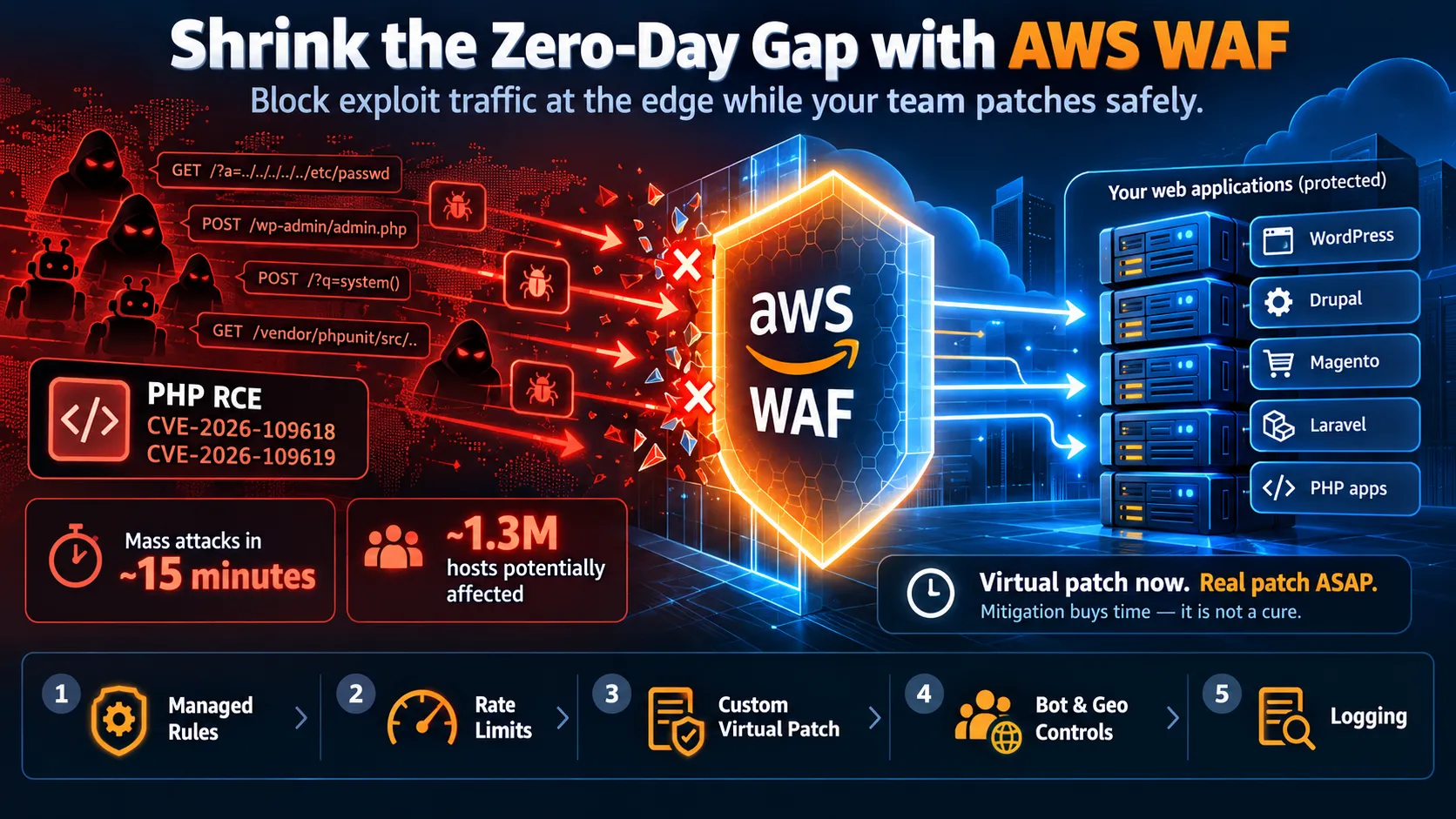
On October 21, 2026, the PHP maintainers shipped emergency patches for two critical remote-code-execution vulnerabilities: CVE-2026-109618 and CVE-2026-109619, each rated 9.2 out of 10. These weren't niche bugs. They affected essentially every PHP installation serving web requests: mod_php, PHP-FPM, php-cgi, FrankenPHP, and LiteSpeed. A demonstrated exploit tool ran code against sites built on WordPress, Drupal, Joomla, Magento, Laravel, phpBB, and MediaWiki, in other words a very large share of the internet.
As Ars Technica's Dan Goodin reported, one security researcher estimated that roughly 1.3 million internet-connected hosts were likely affected, a sense of just how much of the web rides on PHP (Ars Technica ).
The most chilling detail wasn't the severity score. It was the timeline. One security firm expected mass automated attacks to begin within 15 minutes of the patch release. For mod_php specifically, an unauthenticated request can trigger the exploit before any of your application code runs.
Think about what that means operationally:
- You can't patch every server in 15 minutes.
- You often can't patch at all without a maintenance window, regression testing, or a vendor backport.
- Legacy systems (that decade-old WordPress install nobody wants to touch) may never get patched promptly.
This is the zero-day gap: the period where the exploit is known and weaponized, but your fix isn't deployed yet. This is exactly what a Web Application Firewall is for.
What AWS WAF actually does
AWS WAF sits in front of your application, on Amazon CloudFront, an Application Load Balancer, API Gateway, AWS App Runner, or AppSync, and inspects every HTTP/S request before it reaches your backend. You attach a Web ACL (a collection of rules) to one of those resources, and WAF evaluates each request against those rules: allow, block, count, or challenge.
Because WAF operates at the edge and examines requests before they hit your PHP (or Node, or Java) process, it can intercept exploit traffic even when the vulnerability lives deep in your runtime. That makes it the ideal tool for a virtual patch: a rule that blocks the attack pattern while you work on the real fix underneath.
The zero-day playbook: five moves in order
When a critical CVE drops and you're exposed, here's a practical sequence using AWS WAF.
1. Turn on managed rule groups (fastest coverage)
AWS and partners maintain managed rule groups that are updated as new threats emerge. If you do nothing else, enable these:
- Core rule set (CRS): broad protection against common exploitation patterns, including many RCE and injection techniques.
- Known Bad Inputs: catches request patterns associated with exploitation and vulnerability discovery.
- PHP application rule group: PHP-specific attack signatures (directly relevant to the example above).
- Amazon IP reputation list: blocks sources known for malicious activity and bots.
If you run a packaged app, add the matching managed group (e.g., the WordPress application rule group).
The beauty here: when a widespread CVE lands, AWS frequently refreshes managed rules quickly. Simply having them enabled means you may already be covered before you've even read the advisory.
2. Add rate-based rules to blunt the flood
The "mass attacks within 15 minutes" scenario is automated scanning, with bots spraying the exploit across every reachable IP. Rate-based rules block any client that exceeds a request threshold within a rolling five-minute window. This won't stop a single targeted request, but it crushes the volumetric scan-and-exploit wave that follows a public disclosure.
3. Write a custom rule as a targeted virtual patch
This is the heart of zero-day defense. Once you understand the exploit's signature (a specific header, a malformed body, an unusual
Content-Length, a particular request path or payload shape) you write a custom rule that matches it and blocks it.For the PHP example, that might mean inspecting request bodies for the file-upload / out-of-memory trigger pattern described in the advisory, or blocking the characteristics associated with the public exploit tool. The rule doesn't fix the bug; it denies the only path attackers have to reach it.
Start the rule in Count mode to confirm it isn't catching legitimate traffic, then flip it to Block.
There is an excellent AWS Secuity blog post on doing this and coverers these current exploits here .
There is an excellent AWS Secuity blog post on doing this and coverers these current exploits here .
4. Layer in Bot Control and geo-restrictions
- AWS WAF Bot Control identifies and manages automated traffic, cutting off much of the tooling used in mass exploitation.
- Geo-match rules let you temporarily restrict traffic to the regions you actually serve, or allow-list known administrator IPs for sensitive paths (like
/wp-admin).
5. Watch the logs
Send WAF logs to Amazon CloudWatch, Amazon S3, or Amazon Data Firehose, and review sampled requests in the console. This tells you whether you're being probed, whether your virtual patch is catching attempts, and whether you're about to see false positives before they cause an outage.
The rule you must never forget
A WAF is mitigation, not a cure.
The PHP advisory said it plainly: measures short of patching "reduce exposure to specific attack paths but do not make an installation safe." For the mod_php case, the exploit fires before application logic even executes, so a WAF can block the known attack shape, but a sufficiently different payload might slip past a signature-based rule.
So the correct mental model is defense-in-depth with a clock running:
- Immediately: enable/refresh managed rules + rate limiting to stop the mass-scan wave.
- Within the hour: deploy a custom virtual-patch rule matching the known exploit signature.
- As soon as possible: patch the actual vulnerability (for PHP: upgrade to 8.5.12, 8.4.27, 8.3.36, or 8.2.35, or your distro's backport).
- Afterward: leave the WAF rules in place as a permanent layer of defense.
The WAF buys you the hours or days you need to patch safely. It does not excuse you from patching.
Why this matters beyond PHP
The PHP incident is a template, not a special case. Every few months, a critical vulnerability in a widely deployed component (Log4j, Struts, a web server, a CMS plugin) follows the same arc: quiet, then disclosure, then a race between defenders patching and attackers exploiting.
A WAF sitting in front of your applications turns that race from "patch everything in 15 minutes or lose" into "block the attack at the edge, then patch on a sane timeline." For any internet-facing application, a well-tended Web ACL (managed rules on, rate limiting active, and a team ready to write a custom virtual patch) is one of the highest-leverage controls you can have in place before the next zero-day drops.
Because the next one is always coming. The only question is whether you'll be scrambling to patch, or calmly writing a rule while your WAF holds the line.
Based on reporting of the October 2026 PHP emergency patch release (CVE-2026-109618 and CVE-2026-109619). Primary source: Dan Goodin, "PHP warns it plans to release 2 emergency patches imminently," Ars Technica, October 21, 2026.
Series: Security On AWS (1 article)
- 1Buying Time: Using AWS WAF to Defend Against Zero-Days Before the Patch Lands This article
Enjoyed reading this content? Let the author know!
Your likes, comments, shares, and saves help creators reach more builders.

Loading recommendations
Loading article