
🚀 Day 11 of my 90-Day AWS Learning Journey: Amazon RDS
Amazon RDS || Database Engines || Multi-AZ || Security || Managed Operations ||

🚀 Day 11 of my 90-Day AWS Learning Journey: Amazon RDS
Where does an application store its customer information, orders, and other structured data?
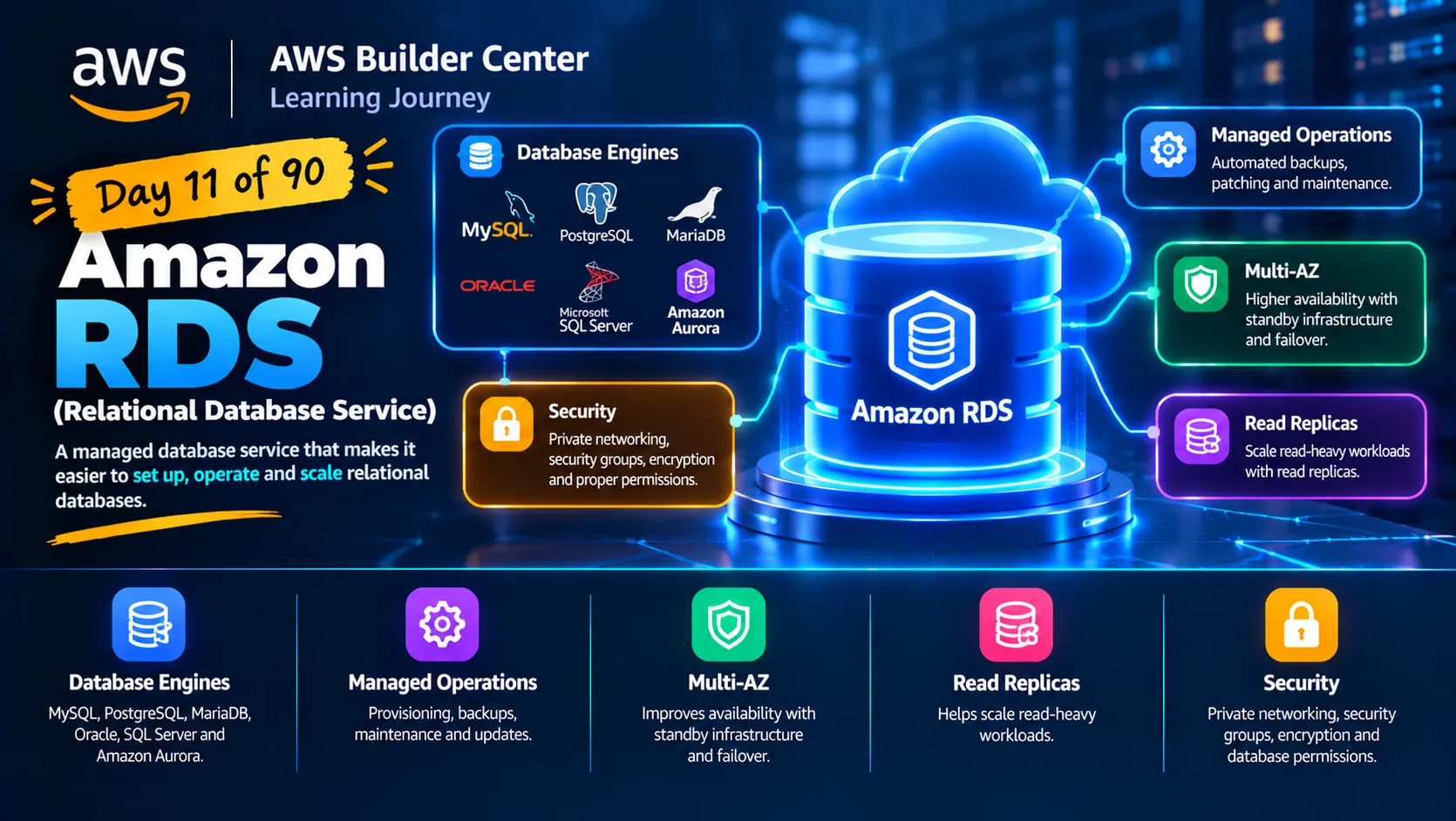
Today, I explored Amazon RDS (Relational Database Service), an AWS managed service that makes it easier to set up, operate, and scale relational databases.
Here are five important concepts I learned:
🗄️ Database Engines: RDS supports engines such as MySQL, PostgreSQL, MariaDB, Oracle, and Microsoft SQL Server. Amazon Aurora is another option.
⚙️ Managed Operations: RDS helps with tasks such as provisioning, automated backups, and database maintenance.
🛡️ Multi-AZ: Helps improve database availability through standby infrastructure and failover capabilities.
📖 Read Replicas: Can help scale read-heavy workloads by serving read queries.
🔐 Security: Private networking, security groups, encryption, and appropriate database permissions help protect data.
💡 My key takeaway: A managed database reduces infrastructure administration, but security, performance, backups, and cost management still matter.
For example, an application running on EC2 can use Amazon RDS to store customer and order information, while security groups control which resources can connect to the database.
💬 Question for the AWS community: When designing a production database, which would you prioritize first: high availability with Multi-AZ, read scaling with read replicas, or security? Why?
#AWS #AmazonRDS #CloudComputing #CloudEngineering #AWSLearning #90DaysOfAWS
Enjoyed reading this content? Let the author know!
Your likes, comments, shares, and saves help creators reach more builders.

Loading recommendations
Loading article