
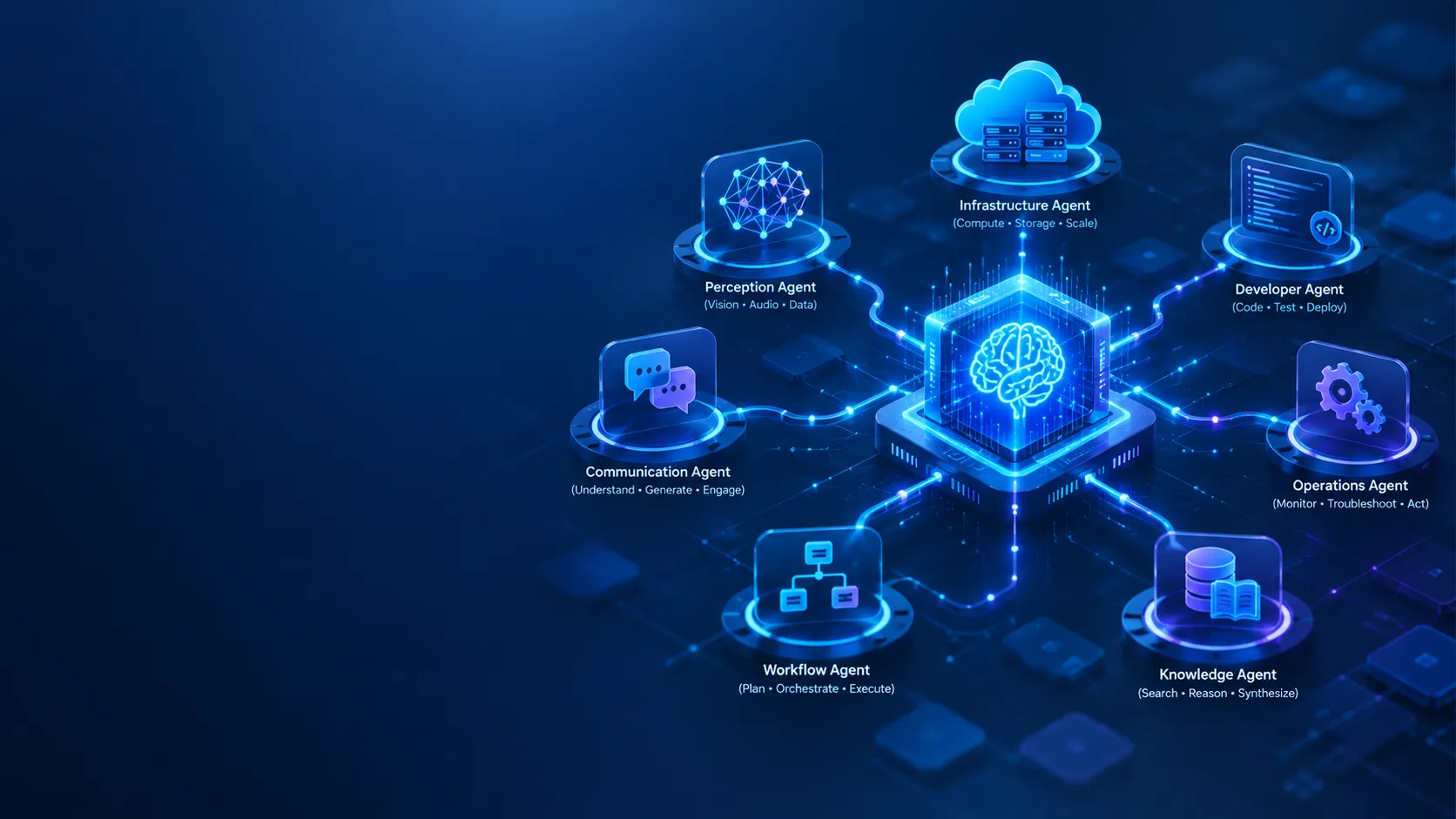
Agentic AI: Understanding the Different Types of AI Agents
Learn how Agentic AI enables intelligent systems to reason, plan, use tools, and execute tasks autonomously. Explore the major types of AI agents, their real-world applications, and how AWS services can help developers build intelligent applications.

Introduction
Artificial Intelligence is evolving beyond traditional chatbots toward systems that can independently work toward defined goals. This evolution has introduced Agentic AI, which enables AI systems to plan tasks, make decisions, interact with external tools, and adapt their actions based on results.
Unlike traditional AI systems that primarily respond to prompts, agentic AI can manage multi-step workflows and solve complex problems with minimal human intervention. Understanding the different types of AI agents helps developers select the right architecture for building intelligent applications.
In this article, we will explore the major types of AI agents, their working principles, practical applications, and how AWS services can support agentic AI development.
What Is Agentic AI?
Agentic AI refers to AI systems that can pursue objectives through reasoning, planning, tool usage, and feedback.
Key capabilities include:
- Goal understanding: Identifies the objective and expected outcome.
- Planning: Breaks complex tasks into smaller steps.
- Tool usage: Interacts with APIs, databases, and external services.
- Memory: Maintains relevant context across tasks.
- Execution: Performs actions within defined permissions.
- Evaluation: Checks results and adjusts the next steps.
These capabilities help AI systems complete multi-step tasks instead of generating responses alone.
Types of AI Agents
AI agents can be classified by their decision-making approaches and their roles in modern AI applications.
1. Simple Reflex Agents
- Make decisions using predefined condition-action rules.
- Respond only to the current situation.
- Example: A support system that routes billing questions to the billing department.
2. Model-Based Reflex Agents
- Maintain an internal representation of the environment.
- Use previous information to understand the current situation.
- Example: A monitoring agent that tracks service status and detects changes.
3. Goal-Based Agents
- Plan actions to achieve a specific objective.
- Evaluate possible steps before taking action.
- Example: An agent that investigates application failures and develops a recovery plan.
4. Utility-Based Agents
- Compare different outcomes using predefined preferences or utility measures.
- Balance competing objectives such as cost, speed, and reliability.
- Example: An agent that recommends cost-efficient cloud resource configurations.
5. Learning Agents
- Improve their behavior using feedback, data, or experience.
- Adapt to changing patterns and requirements.
- Example: A recommendation system that improves its suggestions based on user interactions.
6. Tool-Using AI Agents
- Connect AI models with APIs, databases, and external tools.
- Retrieve information and perform actions beyond text generation.
- Example: A developer assistant that searches documentation and analyzes error logs.
7. Autonomous Workflow Agents
- Manage multi-step tasks with limited human intervention.
- Evaluate results and determine the next action.
- Example: An IT support agent that investigates incidents and creates support tickets.
8. Multi-Agent Systems
- Use multiple specialized agents to collaborate on a complex objective.
- Divide work among agents responsible for research, execution, or validation.
- Example: A software development workflow involving separate coding, testing, and review agents.
Note: These categories can overlap. For example, a goal-based agent may also use external tools, while a multi-agent system may combine several agent types.
How Does Agentic AI Work?
A typical agentic AI workflow follows these steps:
- Understand: Interpret the user's objective.
- Plan: Break the objective into smaller tasks.
- Act: Execute actions using approved tools or APIs.
- Observe: Analyze the results of each action.
- Adapt: Modify the plan if the results are unexpected.
- Complete: Validate the outcome and report the result.
This cycle enables agents to handle dynamic workflows rather than following only fixed instructions.
Enjoyed reading this content? Let the author know!
Your likes, comments, shares, and saves help creators reach more builders.

Loading recommendations
Loading article