
When AI Needs a Brain: Exploring Amazon Bedrock and Generative AI
This article explores Amazon Bedrock and how it helps developers build generative AI applications using foundation models. It explains the basic workflow, real-world applications, and how students can use AWS to develop AI-powered solutions. It also highlights the importance of security, accuracy, and responsible AI development.

Introduction
Artificial Intelligence is changing how people learn, work, and solve problems. From answering questions to generating content, AI applications are becoming part of everyday life. But have you ever wondered how developers can build AI-powered applications without creating an AI model from scratch?
Amazon Web Services provides Amazon Bedrock, a service that helps developers build generative AI applications using foundation models through a single platform.
In this article, I will explore how Amazon Bedrock works, why it is useful, and how beginners can understand its role in modern AI development.
What Is Amazon Bedrock?
Amazon Bedrock is a fully managed AWS service that provides access to foundation models from Amazon and other model providers through a unified API.
Foundation models are AI models trained on large amounts of data. They can perform tasks such as answering questions, summarizing text, generating content, and supporting conversational applications.
Instead of managing the infrastructure required to host a model, developers can use Amazon Bedrock to experiment with supported models and integrate them into their applications.
How Does Amazon Bedrock Work?
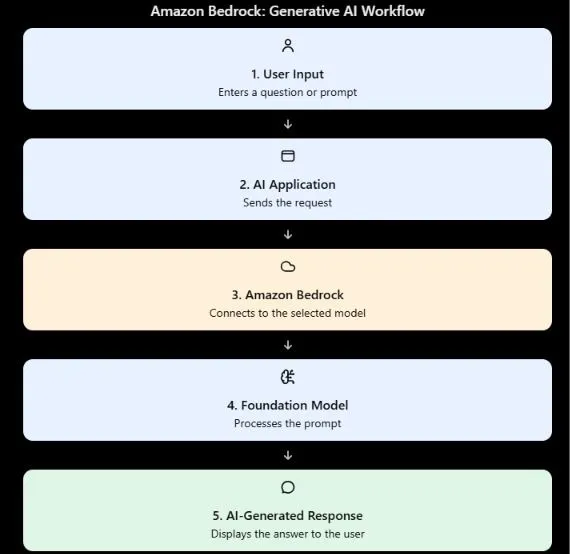
The process can be understood in four simple steps.
1. User Input
A user enters a question or instruction into an application.
2. Application Request
The application sends the input to an appropriate foundation model through Amazon Bedrock.
3. AI Processing
The selected model processes the request and generates a response based on its capabilities.
4. Generated Output
The application displays the response to the user.
Simple Architecture Diagram
User Question
↓
AI-Powered Application
↓
Amazon Bedrock API
↓
Foundation Model
↓
Generated Response
↓
AI-Powered Application
↓
Amazon Bedrock API
↓
Foundation Model
↓
Generated Response
This workflow demonstrates how an application can connect a user to a foundation model without requiring the developer to build the entire AI infrastructure from scratch.
Real-World Example: An AI Study Assistant
Imagine building an AI study assistant for college students.
A student enters a question about a difficult programming concept. The application sends the question to a foundation model through Amazon Bedrock. The model generates an explanation, which the application displays in simple language.
The same application could also help summarize notes, generate practice questions, or explain programming errors.
For a more reliable study assistant, developers could connect the application to trusted course materials and use retrieval-augmented generation (RAG) to provide answers grounded in those materials.
This is one example of how generative AI can support personalized learning.
Why Is Amazon Bedrock Useful?
- Access to foundation models: Developers can explore supported models through a common service.
- Faster development: Teams can build generative AI applications without training a foundation model from scratch.
- Application integration: Models can be connected to websites, chatbots, and other applications.
- Security features: AWS provides security and access-management capabilities that developers can configure for their applications.
- Flexible experimentation: Developers can compare model capabilities and select an appropriate model for their requirements.
However, AI-generated answers may contain incorrect information. Developers should test their applications, protect sensitive data, and evaluate responses before using them in important situations.
What Can Students Build With It?
As an AI and Data Science student, I find Amazon Bedrock interesting because it creates opportunities to explore practical AI projects.
Some beginner project ideas include:
- An AI-powered college FAQ assistant.
- A study-notes summarizer.
- A question-and-answer chatbot for academic materials.
- An AI assistant that explains programming concepts.
- A study-notes summarizer.
- A question-and-answer chatbot for academic materials.
- An AI assistant that explains programming concepts.
Before starting a project, students should check model availability, AWS account permissions, regional support, and pricing. Some models require access to be enabled, and usage may incur charges.
What I Learned
Exploring Amazon Bedrock helped me understand that developing an AI application does not always mean building and training a model from the beginning.
Cloud services can make powerful AI models accessible to developers and help them focus on solving real-world problems. I also learned that responsible AI development requires more than generating answers: accuracy, privacy, security, and proper testing are equally important.
Conclusion
Amazon Bedrock provides a way to build generative AI applications using foundation models through AWS. From educational assistants to customer-support chatbots, it offers developers a starting point for exploring practical AI solutions.
For students who want to enter the fields of Artificial Intelligence and Data Science, learning how cloud services connect AI models with real applications can be a valuable step.
The key takeaway: The future of AI is not only about creating intelligent models; it is also about using them responsibly to solve meaningful problems.
Enjoyed reading this content? Let the author know!
Your likes, comments, shares, and saves help creators reach more builders.

Loading recommendations
Loading article