
Building an Enterprise Knowledge Base Agent
Discover how to build and deploy a production-grade enterprise knowledge base agent over complex customer data.


Modern enterprise applications demand more than simple vector search. When handling complex customer feedback, support issues, and feature requests across hundreds of internal documents, isolated similarity searches often miss critical relational context.
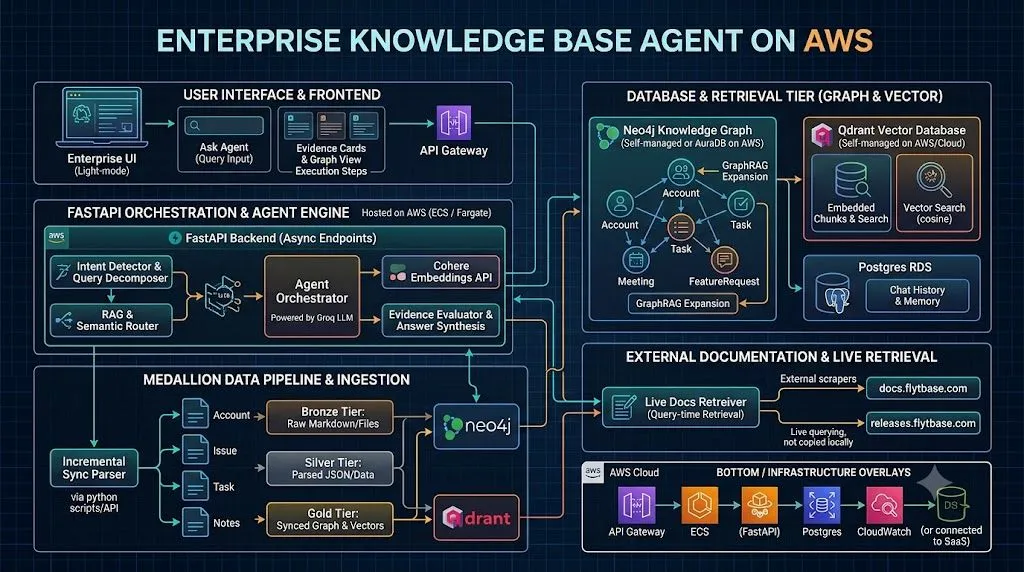
This guide explores the design and architecture of an advanced Knowledge Intelligence Agent—a production-style system built using FastAPI, Neo4j for graph intelligence, Qdrant for vector retrieval, and Groq for high-performance grounded answer synthesis.
Core Architecture & Capabilities
The system bridges unstructured markdown customer pipelines with structured graph representation, offering several core features:
- Idempotent Incremental Sync: Parses markdown tables and meeting notes, computes content hashes, maintains stable record IDs (e.g.,
account:acct-001,issue:iss-0001), and performs soft-deletes for missing entries. - Hybrid GraphRAG Retrieval: Fuses Neo4j graph expansion, Neo4j full-text search, Qdrant vector similarity chunks, structured metadata filtering, and reranking to deliver deep context.
- Live Query-Time Docs Integration: Seamlessly queries live external documentation sources (such as release notes and developer portals) at query time without duplicating raw files into the core customer corpus.
- Rigorous Grounding & Contradiction Detection: Separates concise answers, reasoning summaries, customer evidence, product evidence, and warnings. If a required source is missing, the API flags it to prevent hallucinations.
Key Technology Stack
- Backend Framework: FastAPI (async endpoints for chat, ingestion, graph state, and history)
- Knowledge Graph: Neo4j (managing entities like Account, Issue, FeatureRequest, Task, Meeting, Person, Plan, and ProductFeature)
- Vector Database: Qdrant (storing embedded chunks)
- Orchestration & Embeddings: Cohere/Local embeddings combined with LLM orchestrators for intent detection, query decomposition, and source selection.
Conclusion
By combining knowledge graphs with vector search and strict grounding rules, this architecture ensures that customer support and product teams get verifiable, context-aware answers every time.
Enjoyed reading this content? Let the author know!
Your likes, comments, shares, and saves help creators reach more builders.

Loading recommendations
Loading article