
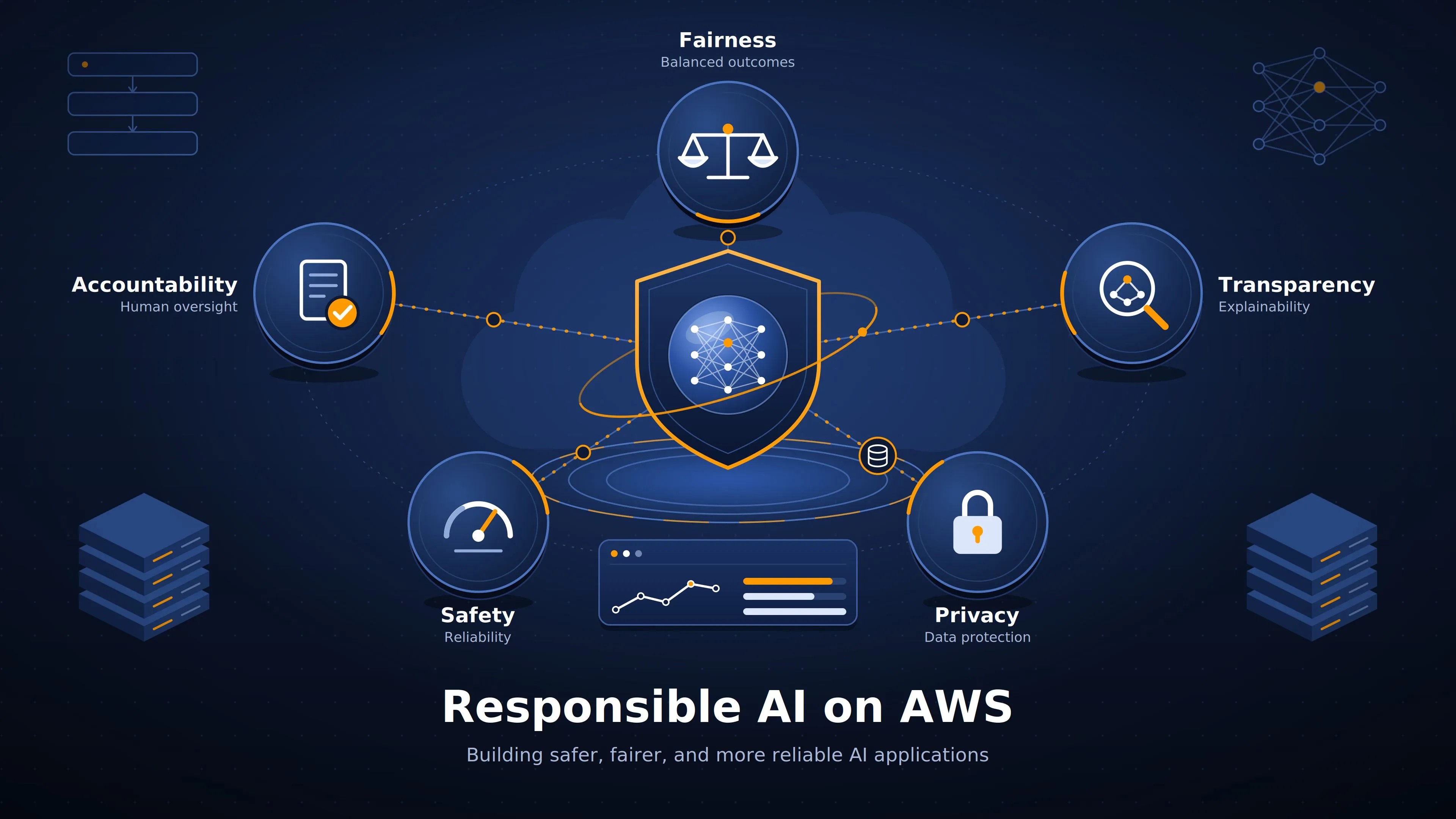
Responsible AI on AWS: Building Safer, Fairer, and More Reliable AI Applications
Explore the principles of Responsible AI and learn how developers can build AI applications with greater transparency, fairness, security, and reliability. Discover how AWS services and tools, including Amazon Bedrock Guardrails and Amazon SageMaker Clarify, can support responsible AI development throughout the machine learning lifecycle.

Artificial Intelligence is transforming industries ranging from education and healthcare to finance and customer service. AI systems can automate tasks, analyze large amounts of data, and generate useful responses. However, building a powerful AI model is only one part of creating a successful AI application.
Developers must also consider how their systems behave, whether their outputs are reliable, how sensitive information is protected, and whether their decisions could negatively affect users.
This is where Responsible AI becomes important.
Responsible AI focuses on developing and using AI systems in ways that consider fairness, safety, privacy, transparency, and accountability. In this article, we will explore these principles and examine how AWS services can help developers put them into practice.
What Is Responsible AI?
Responsible AI refers to the practices and principles used to develop, deploy, and operate AI systems while considering their potential benefits and risks.
An AI application should not be evaluated only by its accuracy or ability to complete a task. Developers should also consider how it handles uncertain information, whether it produces biased results, and what happens when it makes a mistake.
For example, an AI-powered educational assistant should provide useful explanations, protect students' personal information, and avoid presenting uncertain answers as guaranteed facts.
Responsible AI is not a single tool or setting. It requires a combination of thoughtful design, suitable testing, technical safeguards, and ongoing monitoring.
Five Important Principles of Responsible AI
1. Fairness
AI systems learn patterns from data. If the training data contains historical biases or does not adequately represent different groups, the resulting model may produce unfair outcomes.
Developers should evaluate their datasets and test model performance across relevant groups where appropriate.
For example, a model used to support recruitment should be assessed for potentially unfair differences in its recommendations.
Fairness depends on the application and its context. A single overall accuracy score cannot establish that an AI system is fair.
2. Transparency and Explainability
Users should have an appropriate understanding of how an AI system is being used and what its outputs mean.
Transparency may include explaining an application's purpose, identifying AI-generated content, communicating important limitations, and providing information about how outputs are produced.
In machine learning, explainability techniques can help developers understand which features influence a prediction.
This is especially important when AI outputs influence significant decisions.
3. Privacy and Security
AI applications may process personal information, confidential documents, or sensitive business data.
Developers should apply appropriate access controls, minimize unnecessary data collection, protect information in transit and at rest, and follow relevant data-handling requirements.
They should also consider whether sensitive information could appear in prompts, retrieved documents, model outputs, logs, or training datasets.
Security and privacy must be considered throughout the system's design rather than added only after deployment.
4. Reliability and Safety
An AI application should be tested under realistic conditions before it is made available to users.
Generative AI models can produce incorrect information, misunderstand questions, or generate responses that are inappropriate for a particular application.
Developers can reduce these risks through evaluation, input validation, output checks, suitable guardrails, and clear escalation paths for situations the system cannot handle safely.
No safeguard eliminates every possible failure, so testing and monitoring remain essential.
5. Accountability
Organizations and developers should define who is responsible for an AI system's behavior and how problems will be investigated.
Useful practices include maintaining records of model versions, documenting evaluation results, reviewing important changes, and creating procedures for responding to incidents.
Human oversight may also be necessary, especially when AI systems support high-impact decisions.
Responsible AI Tools on AWS
AWS provides services and features that can support different aspects of responsible AI development.
Amazon Bedrock Guardrails
Amazon Bedrock Guardrails provides configurable safeguards for supported generative AI applications.
Depending on the configuration and supported features, guardrails can help filter harmful content, detect or filter sensitive information, and apply topic-related restrictions.
For example, an educational chatbot could use suitable guardrail policies to reduce the risk of producing inappropriate responses.
Guardrails should be configured and evaluated for the application's specific requirements. They are not a guarantee that every unsafe or incorrect response will be blocked.
Amazon SageMaker Clarify
Amazon SageMaker Clarify provides capabilities for examining potential bias in machine learning data and models, as well as helping explain model predictions.
Developers can use appropriate analyses to investigate whether a model exhibits concerning differences across selected groups or how particular input features influence predictions.
These analyses can help identify issues that deserve further investigation. They do not automatically establish that a model is completely fair or free from bias.
Amazon CloudWatch
Amazon CloudWatch provides monitoring and observability capabilities for supported AWS resources and applications.
When appropriately instrumented, an AI application can use logs, metrics, and alarms to help identify operational failures, unexpected behavior, and performance issues.
Monitoring should be designed carefully so that logs do not unnecessarily expose prompts, personal information, or confidential content.
These services address different needs and can be combined as part of a broader responsible AI strategy.
Example: Building a Responsible AI Learning Assistant
Consider an AI-powered learning assistant designed to help students understand programming and machine learning concepts.
A basic application might accept a question and return an AI-generated explanation. A more responsibly designed version would consider several additional safeguards.
Input handling: Validate user inputs and avoid collecting unnecessary personal information.
Knowledge grounding: Retrieve relevant information from approved learning materials when appropriate, helping the application provide context-specific answers.
Output safeguards: Apply suitable content restrictions and test how the application handles inappropriate requests.
Accuracy evaluation: Test responses against reference answers and identify situations where the model produces unsupported claims.
Privacy controls: Restrict access to uploaded notes and other documents, and establish appropriate data-retention practices.
Monitoring: Track relevant application errors and performance indicators while minimizing sensitive information in logs.
Human oversight: Clearly communicate the assistant's limitations and allow students to verify important information against trusted educational sources.
AWS services such as Amazon Bedrock, Amazon Bedrock Guardrails, and Amazon CloudWatch could support selected parts of this design, depending on the architecture.
This is a proposed example architecture, not a claim that the application has already been implemented or deployed.
A Practical Responsible AI Workflow
Responsible AI can be integrated into the development process rather than treated as a final checklist.
- Define the purpose: Identify the problem the AI system is intended to solve and the risks associated with its use.
- Review the data: Check data quality, relevance, representation, permissions, and privacy considerations.
- Select and develop the model: Choose an appropriate model and document important design decisions.
- Evaluate performance and risks: Test accuracy, robustness, fairness where relevant, and behavior under unexpected inputs.
- Implement safeguards: Apply suitable access controls, guardrails, validation, and human-review procedures.
- Deploy carefully: Release the application with appropriate permissions, operational monitoring, and incident-response plans.
- Review continuously: Investigate failures, reassess risks, and update the system when evidence or requirements change.
The exact workflow will vary depending on the application, its users, and the consequences of its outputs.
Challenges in Responsible AI
Responsible AI introduces important challenges that developers must manage.
- Bias in data: Historical patterns can influence model behavior in undesirable ways.
- Hallucinations: Generative AI can produce plausible but incorrect information.
- Privacy risks: Prompts, datasets, and retrieved documents may contain sensitive information.
- Evaluation complexity: A model can perform well on standard tests but fail in less common situations.
- Changing behavior: New data, model updates, and changing user needs can introduce new risks.
- Trade-offs: Improving one objective, such as response restrictions, may affect usefulness or accessibility.
These challenges cannot always be solved through automation alone. Technical tools work best when combined with clear requirements, appropriate testing, and human judgment.
Conclusion
Responsible AI is an essential part of building dependable AI applications. Fairness, transparency, privacy, reliability, and accountability help developers consider not only what an AI system can do, but also how it should be used.
AWS services such as Amazon Bedrock Guardrails, Amazon SageMaker Clarify, and Amazon CloudWatch provide capabilities that can support selected safeguards, evaluation, and monitoring activities.
For students and developers entering the AI field, understanding Responsible AI is just as valuable as learning algorithms, training models, and deploying applications. Building useful AI systems means considering their limitations, evaluating their behavior, and taking responsibility for how they affect the people who use them.
Enjoyed reading this content? Let the author know!
Your likes, comments, shares, and saves help creators reach more builders.

Loading recommendations
Loading article