
AWS vs. Azure in 2026: Why Developer Experience and Integration Define the Cloud Leadership Battle
An analytical comparison of AWS and Azure, exploring how the battle for cloud dominance has moved beyond infrastructure to developer experience, ecosystem synergy, and cost optimization. Discover why AWS remains the leader in modular flexibility, developer tooling, and open-source stacks, while Microsoft Azure dominates enterprise workflows through unified toolchains, Azure DevOps, and hybrid licensing advantages like Azure Hybrid Benefit.

As of Q1 2026, the global cloud infrastructure market has surpassed the $400 billion mark. Amazon Web Services (AWS) maintains its position as the market leader with approximately 31% to 32% global market share. However, Microsoft Azure has firmly secured the second position with an estimated 23% to 25% share, growing at an accelerated year-over-year rate of 40%.
For cloud architects and developers, deciding between these two platforms is no longer a simple feature comparison. Both providers offer highly capable storage, compute, and networking foundations. The decision now hinges on three core factors: modularity versus ecosystem integration, accessibility of the developer experience, and cost optimization strategies.
Capabilities: Modular Granularity vs. Enterprise Synergy
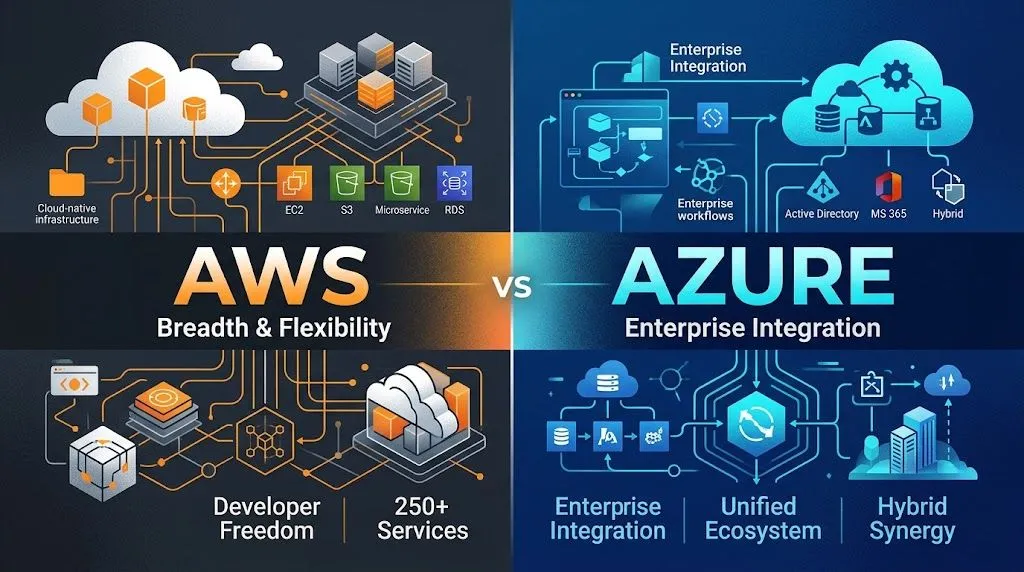
AWS was built as a cloud-native platform designed to provide granular, building-block services. This modular philosophy gives developers immense flexibility to assemble highly tailored, distributed architectures. AWS offers an unmatched breadth of capabilities, with a portfolio of over 250 services and a massive ecosystem of open APIs. This makes AWS the preferred platform for teams building diverse, open-source stacks, or complex, portable workloads.
Azure, conversely, is built upon its enterprise roots. Its greatest capability is its deep integration with the broader Microsoft ecosystem, including Microsoft 365, Dynamics 365, Windows Server, and SQL Server. For organizations whose digital infrastructure is heavily reliant on Microsoft identity and productivity tools, Azure provides a cohesive ecosystem that reduces operational friction. This is further reinforced by Azure Arc, which provides consistent management across hybrid infrastructure.
Accessibility and Developer Experience
The developer experience on both platforms is sophisticated, but they cater to different workflows:
- AWS: The Best-of-Breed Toolkit. AWS favors a "best-of-breed" toolkit approach. It provides extensive SDKs, CloudFormation, and the Cloud Development Kit (CDK). Its documentation system is often praised as easier to navigate than Azure's. Furthermore, AWS boasts a significantly larger community, supported by extensive AWS User Groups, developer forums, and robust third-party integrations. It is the logical default for startups and teams that prioritize granular control and a vast selection of tools.
- Azure: The Unified Experience. Azure champions an all-in-one model. Azure DevOps provides a unified platform that packages essential development tools together, making it highly accessible for enterprise teams seeking streamlined, out-of-the-box setups. For developers working with .NET, C#, or F#, Azure's native tooling and deep integration with Visual Studio create an incredibly fluid development cycle.
Cost Optimization and Licensing Strategies
Both providers offer substantial discounts for committed usage, such as AWS Savings Plans and Reserved Instances, or Azure's equivalent Reserved VM Instances and Savings Plans.
However, Azure holds a significant advantage for enterprises with existing Microsoft investments through the Azure Hybrid Benefit. This program allows organizations to bring their existing Windows Server and SQL Server licenses to the cloud. For a large migration of Microsoft-based applications, this licensing perk can result in Total Cost of Ownership (TCO) savings of 40% or more compared to running the same setup on AWS. AWS, while capable of hosting Microsoft-heavy environments, typically requires more re-architecting and lacks these native licensing benefits.
Conclusion
If your organization is building heavily customized architectures on open-source stacks and requires the broadest possible array of mature cloud-native services, AWS remains the undisputed leader. However, if your enterprise relies on Microsoft's ecosystem, values unified development environments like Azure DevOps, and needs a strong hybrid cloud strategy, Azure's seamless integration and licensing advantages make it the more logical, accessible choice.
Enjoyed reading this content? Let the author know!
Your likes, comments, shares, and saves help creators reach more builders.

Loading recommendations
Loading article