
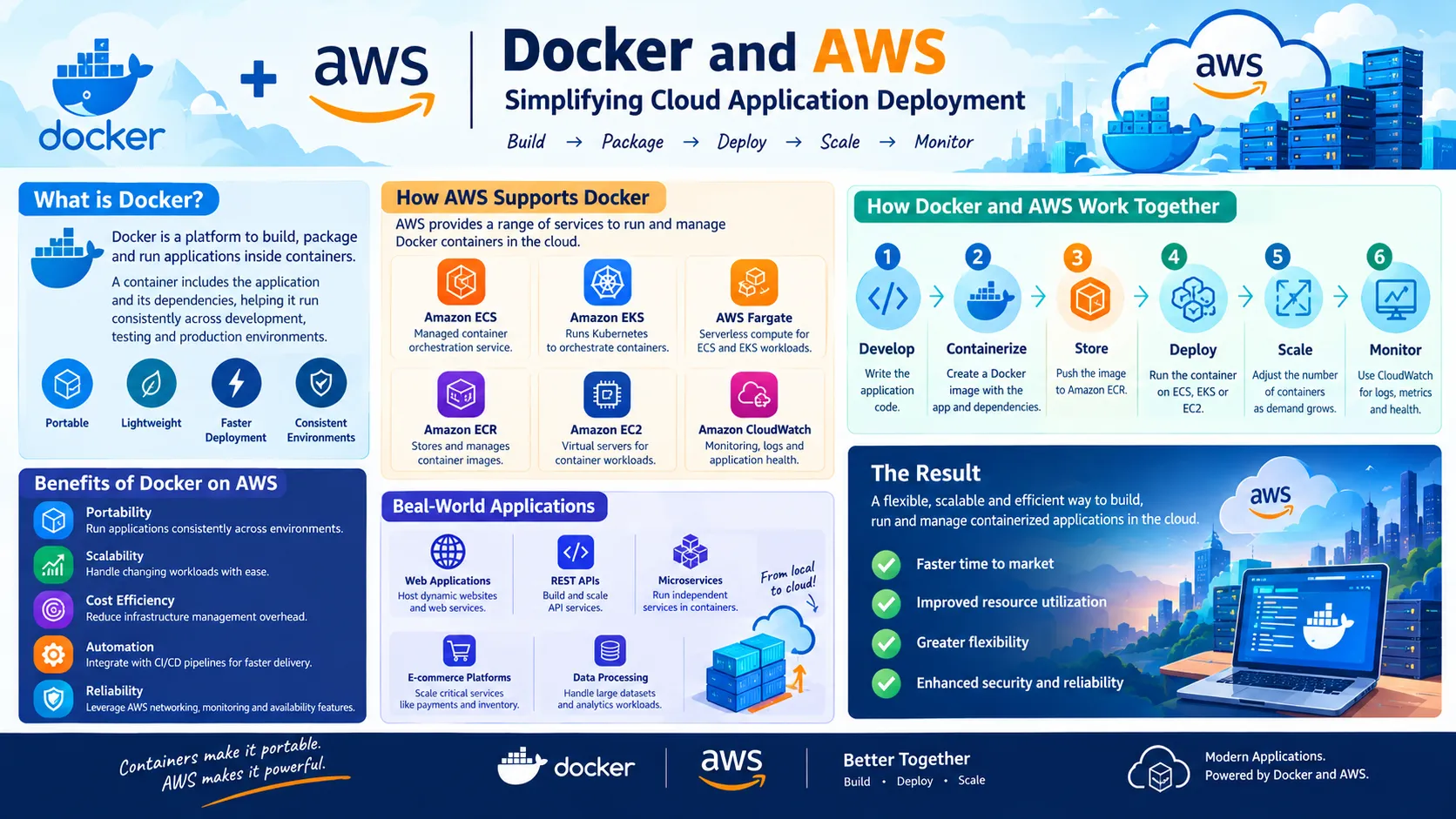
Docker and AWS: Simplifying Cloud Application Deployment
Docker packages applications into portable containers, while AWS provides cloud services to run, manage, and scale them.

Docker and AWS: Simplifying Cloud Application Deployment
Introduction
Modern software applications need to be portable, scalable, and reliable. Docker and Amazon Web Services (AWS) work together to simplify application development and deployment. Docker packages applications into containers, while AWS provides cloud infrastructure and managed services to run them efficiently.
What Is Docker?
Docker is a platform used to build, package, and run applications inside containers. A container includes the application and its required dependencies, helping it run consistently across development, testing, and production environments.
Docker offers several benefits, including portability, lightweight resource usage, faster deployment, and consistent application environments.
How AWS Supports Docker
AWS provides several services for running Docker containers in the cloud:
- Amazon ECS (Elastic Container Service): A managed service for deploying and managing containerized applications.
- Amazon EKS (Elastic Kubernetes Service): Runs Kubernetes to orchestrate containers.
- AWS Fargate: Provides serverless compute for supported ECS and EKS workloads, reducing the need to manage servers.
- Amazon ECR (Elastic Container Registry): Stores and manages Docker container images.
- Amazon EC2: Provides virtual servers where container workloads can run.
- Amazon CloudWatch: Helps monitor application performance, logs, and resource usage.
How Docker and AWS Work Together
The process of deploying an application typically follows these steps:
- Develop: Write the application code.
- Containerize: Create a Docker image containing the application and its dependencies.
- Store: Upload the image to Amazon ECR.
- Deploy: Run the container using Amazon ECS, Amazon EKS, or a suitable EC2 setup.
- Scale: Increase or decrease the number of running tasks or containers according to demand.
- Monitor: Use Amazon CloudWatch to track logs, metrics, and application health.
This workflow helps developers move applications from local development to cloud production environments more efficiently.
Benefits of Docker on AWS
Portability: Containers help applications run consistently across different environments.
Scalability: AWS services can scale container workloads to meet changing demand.
Cost efficiency: Managed and serverless options can reduce infrastructure-management overhead.
Automation: Container deployment can be integrated with CI/CD pipelines.
Reliability: AWS networking, monitoring, and availability features help support dependable applications.
Real-World Applications
Docker and AWS are useful for deploying web applications, REST APIs, microservices, e-commerce platforms, and data-processing services. For example, an online shopping application can package its payment and inventory services into separate Docker containers and deploy them on Amazon ECS, allowing each service to be managed and scaled independently.
Conclusion
Docker simplifies application packaging, while AWS provides the infrastructure and services needed to deploy, manage, and scale containers. Together, they enable developers to build portable, automated, and scalable cloud applications with less operational complexity.
Enjoyed reading this content? Let the author know!
Your likes, comments, shares, and saves help creators reach more builders.

Loading recommendations
Loading article