
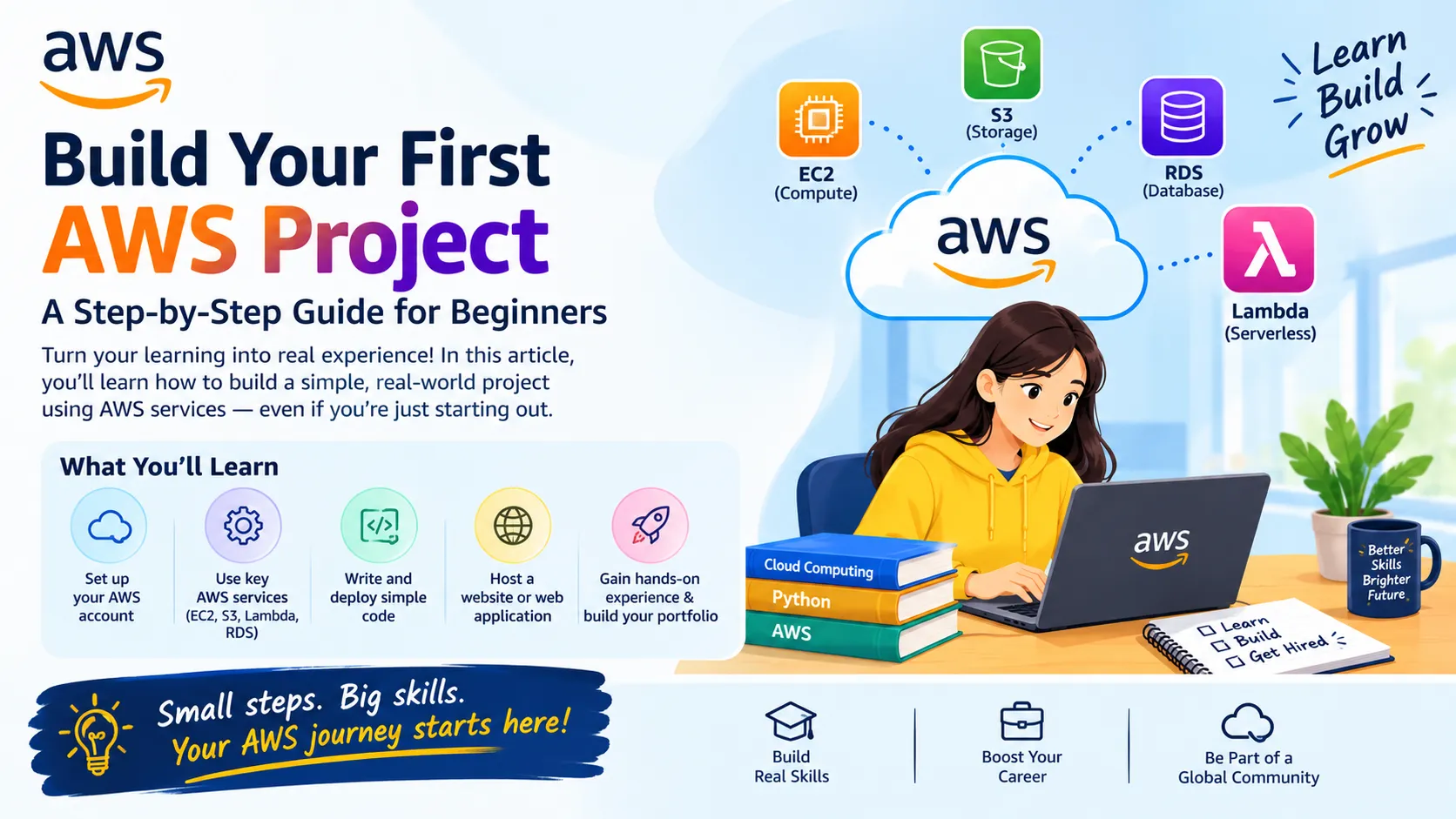
Generative AI on AWS: Turning Ideas into Intelligent Applications
Explore how AWS helps developers build generative AI applications using foundation models, cloud infrastructure, and managed AI services. Discover practical use cases, responsible AI principles, and beginner-friendly project ideas.

Introduction
Artificial Intelligence is changing how people learn, work, create, and solve problems. One of the most exciting developments is Generative AI, which can generate text, summarize information, answer questions, create images, and assist with software development.
Amazon Web Services (AWS) provides cloud infrastructure and AI services that help developers experiment with and build generative AI applications. By combining AI models with cloud technologies, developers can transform creative ideas into useful applications.
What Is Generative AI?
Generative AI is a type of artificial intelligence that learns patterns from data and uses them to generate new content. Unlike traditional systems that mainly classify information or make predictions, generative AI can produce responses and content based on user instructions.
Examples include:
- AI chatbots that answer questions.
- Tools that summarize long documents.
- Coding assistants that help developers write and understand code.
- Applications that search documents and retrieve relevant information.
- Systems that generate personalized learning materials.
How AWS Supports Generative AI
AWS provides services and infrastructure that developers can use to build, test, and deploy AI-powered applications.
1. Amazon Bedrock
Amazon Bedrock provides access to foundation models through a managed service. Developers can use supported models to create chatbots, generate content, summarize documents, and build other generative AI applications without managing the underlying foundation-model infrastructure themselves.
2. Amazon SageMaker AI
Amazon SageMaker AI provides tools for building, training, customizing, and deploying machine learning models. It is useful for developers and data scientists who need more control over their machine learning workflows.
3. AWS Lambda
AWS Lambda can run application logic in response to events. It can connect different parts of an AI application, such as processing requests, validating inputs, or triggering other services.
4. Amazon S3
Amazon S3 provides object storage for documents, datasets, application files, and other content. It can support applications that need to store and retrieve information for processing.
5. Amazon CloudWatch
Amazon CloudWatch helps developers monitor application logs, metrics, and operational performance. Monitoring is important when maintaining reliable AI-powered applications.
A Practical Project Idea: Build an AI Study Assistant
Students can explore generative AI by designing a simple study assistant that answers questions about learning materials.
A basic version could work like this:
- A student enters a question into a simple application.
- The application sends the request to a backend.
- The backend invokes a supported foundation model through Amazon Bedrock.
- The model generates a response.
- The application displays the answer to the student.
A more advanced version could retrieve information from approved study documents before generating a response. This approach is commonly associated with Retrieval-Augmented Generation (RAG).
Such a project can help students understand APIs, cloud architecture, prompt design, and AI application development.
Important Principles for Responsible AI
Generative AI offers many opportunities, but developers must also understand its limitations.
Accuracy: AI-generated responses may contain incorrect information. Important claims should be verified.
Privacy: Avoid sending confidential or sensitive information to AI systems without appropriate authorization and safeguards.
Security: Validate user inputs, apply least-privilege permissions, and protect application credentials.
Bias and fairness: Evaluate outputs for unfair or misleading results.
Cost management: Review model pricing, usage limits, and service costs before deploying applications.
Human oversight: Important decisions should receive appropriate human review rather than relying entirely on generated responses.
How Students Can Get Started
Students interested in generative AI can follow a simple learning path:
- Learn basic Python programming.
- Understand APIs and fundamental cloud computing concepts.
- Explore the official AWS documentation for Amazon Bedrock.
- Experiment with a small, low-risk application.
- Learn about prompts, model limitations, and responsible AI.
- Document the project and explain how its components work together.
Before creating resources, review current AWS pricing, eligibility, permissions, and regional availability. Do not assume every AI service is included in a free offer.
The Future of Generative AI
Generative AI is becoming an important part of software development, education, customer support, business automation, and data analysis. Cloud platforms help developers access the infrastructure and tools needed to experiment with these technologies.
However, successful AI development requires more than selecting a model. Developers must also consider data quality, application design, security, cost, and the needs of the people using the system.
Conclusion
Generative AI on AWS creates opportunities for students, developers, and organizations to build intelligent applications that address real-world problems.
By starting with a simple project, learning the available services, and following responsible development practices, beginners can gradually develop valuable cloud and AI skills.
The best way to learn is to start small, experiment thoughtfully, and keep improving your ideas.
Enjoyed reading this content? Let the author know!
Your likes, comments, shares, and saves help creators reach more builders.

Loading recommendations
Loading article