
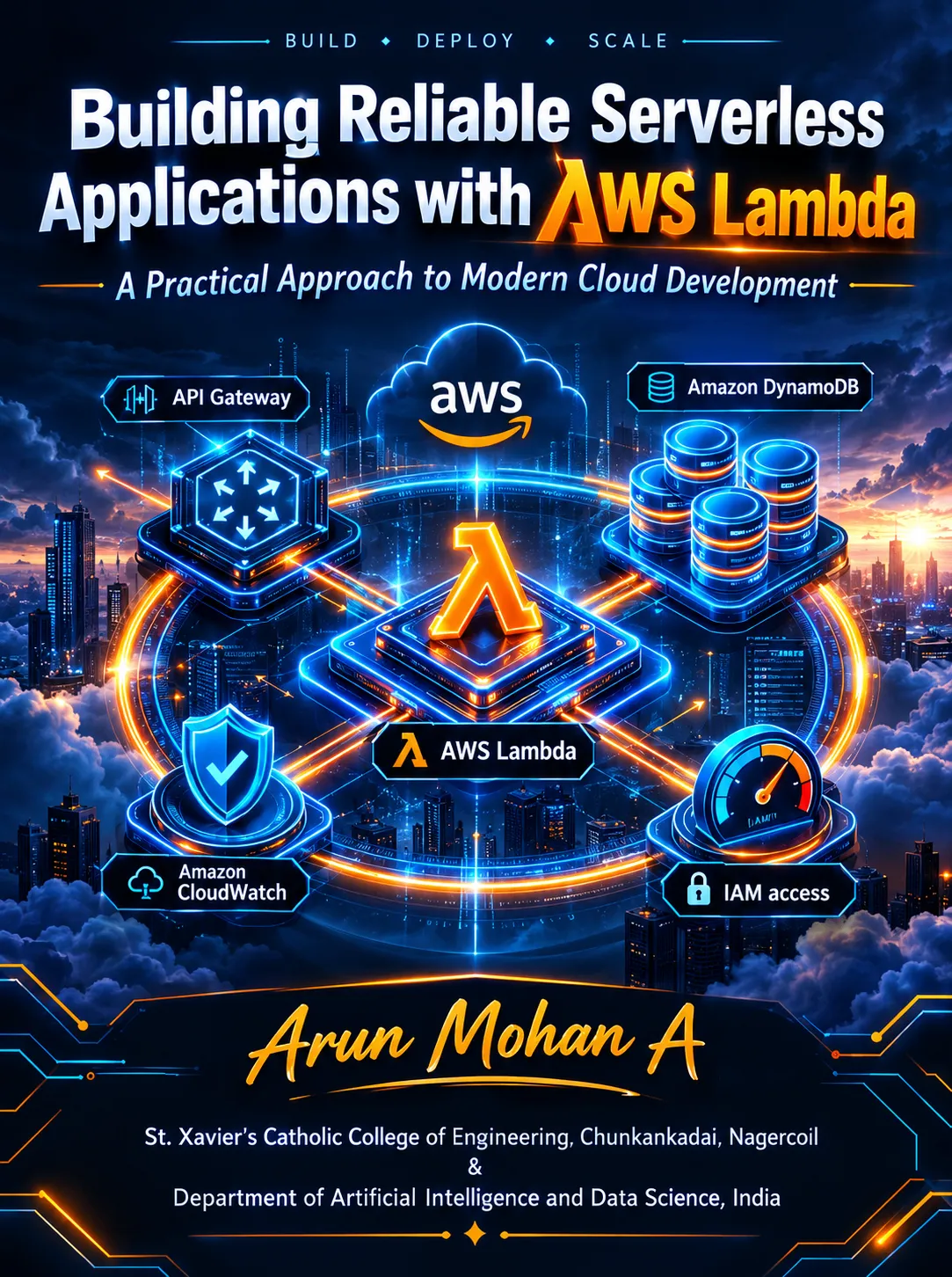
Building Reliable Serverless Applications with AWS Lambda: A Practical Approach to Modern Cloud DevelopmentBuilding Reliable Serverless Applications with AWS Lambda: A Practical Approach to Modern Cloud Development
Explore how to build reliable serverless applications using AWS Lambda, Amazon API Gateway, and Amazon DynamoDB. This article explains the architecture, practical Python implementation, security best practices, error handling, monitoring, and cost optimization strategies required to develop scalable cloud applications. It also examines common serverless challenges and demonstrates why careful design, reliable data storage, and testing are essential for building secure and maintainable applications on AWS.

Building Reliable Serverless Applications with AWS Lambda: A Practical Approach to Modern Cloud Development
Abstract
Cloud computing has changed the way developers build, deploy, and maintain applications. Traditional applications often require developers to manage servers, plan computing capacity, and handle infrastructure maintenance. Serverless computing offers another approach by allowing developers to focus more on application logic while the cloud provider manages the underlying infrastructure.
This article explores how AWS Lambda can be used to build a serverless REST API with Amazon API Gateway and Amazon DynamoDB. It explains the architecture, demonstrates a practical implementation using Python, and discusses important considerations such as security, reliability, monitoring, and cost optimization. It also highlights common challenges that developers should understand before deploying a serverless application in a production environment.
The main objective is to show that building a successful serverless application involves more than connecting cloud services. Careful planning, appropriate security controls, reliable data handling, and proper testing are equally important.
Keywords: AWS Lambda, serverless computing, Amazon API Gateway, Amazon DynamoDB, Python, cloud architecture, application security.
1. Introduction
Developing a web application involves more than writing code. Developers must also consider where the application will run, how it will handle incoming requests, where its data will be stored, and what happens when the number of users increases.
In a traditional architecture, these responsibilities may include configuring servers, maintaining operating systems, and adjusting computing resources to match demand. These tasks can become difficult to manage, particularly for small development teams or applications with unpredictable traffic.
AWS Lambda provides an alternative by allowing developers to run code in response to events without managing the underlying servers directly. When combined with Amazon API Gateway and Amazon DynamoDB, it provides the foundation for building web APIs using managed cloud services.
However, serverless computing does not remove every challenge. Applications must still handle invalid requests, database failures, security risks, and unexpected traffic. Developers must understand these issues and design their applications accordingly.
This article presents a practical approach to building a serverless REST API on AWS, with an emphasis on reliability, security, and maintainability.
2. Understanding the Proposed Architecture
The application considered in this article allows users to create and retrieve simple records through HTTP requests. It uses three main AWS services, with additional services supporting monitoring and access control.
2.1 Amazon API Gateway
Amazon API Gateway acts as the entry point for the application. It receives HTTP requests from clients and routes them to the appropriate backend function. It can also be configured with authorization, throttling, and request-handling controls.
2.2 AWS Lambda
AWS Lambda executes the application code when a request arrives. In this example, the function validates incoming data, creates a record, and communicates with the database.
Developers do not need to maintain a conventional application server for this workload. Instead, they configure the function's runtime, permissions, resource allocation, and other execution settings.
2.3 Amazon DynamoDB
Amazon DynamoDB stores the application's records. It is a managed NoSQL database that can support applications requiring predictable access patterns and flexible scaling.
Using a separate database also means that application data is not dependent on an individual Lambda execution environment remaining available.
2.4 How the components work together
The request follows a straightforward path:
- A client sends a request to the API endpoint.
- API Gateway applies the configured access and request controls.
- Lambda executes the application logic.
- The function validates the input and writes the record to DynamoDB.
- The function returns an HTTP response to the client.
- CloudWatch collects logs and metrics that help developers monitor the application.
The basic architecture can be represented as:
Client → API Gateway → AWS Lambda → Amazon DynamoDB
CloudWatch supports monitoring, while IAM controls which AWS resources the Lambda function is permitted to access.
This design separates the API, processing, and storage responsibilities. Each component can be configured and monitored independently, making the application easier to understand and maintain.
3. Important Design Considerations
A serverless application may look simple because its infrastructure is managed by AWS. Nevertheless, several design decisions have a direct impact on its reliability.
3.1 Keeping application state outside Lambda
Lambda functions should not rely on local memory or temporary files as their permanent data store. An execution environment may be reused, replaced, or removed, so locally stored information cannot be treated as durable application state.
In this architecture, DynamoDB stores the records permanently according to the database's durability guarantees and configuration. The function returns a successful response only after the database operation succeeds.
3.2 Writing small, focused functions
A function should have a clearly defined responsibility. For example, one function may create records while another retrieves them.
This separation can make testing and troubleshooting easier. However, dividing an application into too many functions can increase deployment and operational complexity. The appropriate design depends on the application's requirements.
3.3 Handling repeated requests
Consider a situation in which a client sends a request to create a record but does not receive the response because of a temporary network problem. The client may send the same request again.
If the application creates a new record every time, the repeated request may produce duplicate data. This problem is particularly important in payment systems, booking applications, and other workflows where duplicate operations can have real consequences.
A production implementation should consider idempotency keys, conditional database writes, and appropriate handling of concurrent requests. The exact approach depends on the operation and the business rules.
3.4 Managing errors carefully
Applications should respond differently to invalid input and unexpected internal failures.
For example, a missing required field should produce a client error. A database failure should be logged for investigation and returned as a controlled server error.
Internal exception details should not be exposed to clients because they may reveal implementation details or sensitive information.
4. Practical Implementation Using Python
The following example demonstrates how to create a basic record through AWS Lambda.
Before using the code, create a DynamoDB table with a string partition key named
id. Configure the Lambda execution role with the necessary permissions and set an environment variable named TABLE_NAME to the table's name.Save the following code as
app.py.1
2
3
4
5
6
7
8
9
10
11
12
13
14
15
16
17
18
19
20
21
22
23
24
25
26
27
28
29
30
31
32
33
34
35
36
37
38
39
40
41
42
43
44
45
46
47
48
49
50
51
52
53
54
55
56
57
58
59
60
61
62
63
64
65
66
67
68
69
70
71
72
73
74
75
76
77
78
79
80
81
82
83
84
85
86
import json
import os
import uuid
import logging
from datetime import datetime, timezone
import boto3
from botocore.exceptions import ClientError
logger = logging.getLogger()
logger.setLevel(logging.INFO)
table = boto3.resource("dynamodb").Table(
os.environ["TABLE_NAME"]
)
def response(status, data):
return {
"statusCode": status,
"headers": {
"Content-Type": "application/json"
},
"body": json.dumps(data)
}
def lambda_handler(event, context):
try:
raw_body = event.get("body")
if isinstance(raw_body, str):
body = json.loads(raw_body)
elif isinstance(raw_body, dict):
body = raw_body
else:
return response(400, {
"error": "A JSON body is required"
})
name = body.get("name")
if not isinstance(name, str) or not name.strip():
return response(400, {
"error": "A valid name is required"
})
if len(name) > 100:
return response(400, {
"error": "Name must not exceed 100 characters"
})
item = {
"id": str(uuid.uuid4()),
"name": name.strip(),
"created_at": datetime.now(
timezone.utc
).isoformat()
}
table.put_item(Item=item)
logger.info(json.dumps({
"event": "record_created",
"request_id": context.aws_request_id,
"record_id": item["id"]
}))
return response(201, item)
except (json.JSONDecodeError, UnicodeDecodeError):
return response(400, {
"error": "Invalid JSON"
})
except ClientError:
logger.exception("Database operation failed")
return response(500, {
"error": "Unable to process the request"
})
except Exception:
logger.exception("Unexpected application error")
return response(500, {
"error": "Internal server error"
})4.1 How the code works
When a request reaches the Lambda function, the application first reads the request body and checks whether it contains valid JSON. It then verifies that the
name field contains a non-empty string and does not exceed the permitted length.After validation, the function generates a unique identifier and records the current time in UTC. The new record is written to DynamoDB, and the function returns an HTTP
201 Created response.If the input is invalid, the function returns an HTTP
400 Bad Request response. If an unexpected database or application error occurs, it returns a controlled server error and records diagnostic information in CloudWatch logs.The DynamoDB client is initialized outside the handler. This allows Lambda to reuse the client when an execution environment is reused, avoiding unnecessary initialization on every invocation.
This example demonstrates the basic application flow. It does not yet include authentication, an idempotency mechanism, or a retrieval endpoint. Those features should be implemented and tested before the application is used in production.
5. Improving Reliability
Reliability should be considered from the beginning rather than added only after problems appear.
5.1 Configure appropriate timeouts
API Gateway and Lambda have separate timeout settings. The application should be configured so that the total request duration fits within the expected client response time.
The function should not wait indefinitely for downstream operations. Timeouts should reflect the application's requirements and the behavior of the services it calls.
5.2 Use retries carefully
Retries can help recover from temporary failures, but they must be designed carefully. Repeating a request that performs a non-idempotent operation may create duplicate records or other unwanted effects.
Developers should identify which operations can safely be retried and which require additional safeguards.
5.3 Monitor service limits
Lambda concurrency, API request rates, and database capacity all have practical limits. A sudden increase in traffic may cause throttling or increased latency if the application is not configured appropriately.
API Gateway throttling, Lambda concurrency controls, and suitable DynamoDB capacity settings can help manage these risks. Monitoring should be used to identify problems before they significantly affect users.
For applications involving multiple processing steps, Amazon SQS or AWS Step Functions may also be useful, depending on whether the application needs asynchronous processing, durable message handling, or explicit workflow orchestration.
6. Security Considerations
Security is a fundamental part of serverless application design.
6.1 Authentication and authorization
An API should not be assumed to be secure simply because its backend uses Lambda. The application needs an appropriate authorization mechanism, such as Amazon Cognito or IAM authorization, depending on its intended users and access model.
Authentication verifies the identity of a caller, while authorization determines what that caller is permitted to do.
The example presented here does not implement authentication. A production deployment must add appropriate access controls before exposing the endpoint to untrusted users.
6.2 Apply least-privilege permissions
The Lambda execution role should contain only the permissions required by the function.
For example, a function that creates records should generally receive
dynamodb:PutItem permission for the specific table it uses rather than broad access to every DynamoDB resource in the account.If additional functionality is introduced, the required permissions should be reviewed and updated deliberately.
6.3 Protect sensitive information
Use HTTPS for data in transit and appropriate encryption for stored data. If the application uses API keys, database credentials, or other secrets, they should not be embedded in source code or written to logs.
CloudWatch log access should also be restricted. Logging should help developers diagnose failures without exposing passwords, tokens, or unnecessary personal information.
6.4 Validate incoming data
Input validation helps prevent malformed requests from reaching database operations. Applications should check data types, permitted values, field lengths, and request sizes.
Throttling and other abuse-prevention controls should also be considered, particularly when the endpoint is publicly accessible.
These measures reduce risk, but they do not replace security reviews, dependency updates, and testing.
7. Monitoring and Deployment
A working application needs more than successful API responses. Developers also need to understand how it behaves when errors occur or traffic increases.
Amazon CloudWatch can be used to monitor Lambda invocations, execution duration, errors, and throttles. API Gateway metrics can help identify request failures and latency, while DynamoDB metrics can reveal capacity-related problems.
Structured logging makes it easier to identify individual operations and investigate failures. Request identifiers can help connect application logs with the corresponding invocation.
For deployment, AWS Serverless Application Model (AWS SAM) or AWS CloudFormation can define the infrastructure as code. This makes the configuration easier to review, reproduce, and maintain.
A sensible development workflow includes:
- Writing unit tests for request validation and application logic.
- Deploying the application to a development environment.
- Testing successful requests and expected error conditions.
- Checking database persistence and IAM permissions.
- Monitoring execution and reviewing logs.
- Deploying to production only after the required checks pass.
A rollback plan should be available so that a faulty release can be addressed without unnecessary disruption.
8. Understanding the Cost
One reason developers consider serverless computing is that it can reduce the need to maintain continuously running application servers. However, whether it is economical depends on the workload and configuration.
AWS Lambda pricing depends on factors such as invocation volume, execution duration, and memory allocation. Additional charges may arise from API Gateway, DynamoDB, CloudWatch, data transfer, and other services.
Developers should therefore estimate the cost of the complete architecture rather than focusing only on Lambda.
Several practical measures can help manage spending:
- Choose memory and timeout settings based on testing.
- Avoid unnecessary function invocations and database operations.
- Configure throttling and concurrency controls where appropriate.
- Monitor usage and create billing alerts.
- Select DynamoDB capacity and billing options according to expected traffic.
- Remove temporary development resources when they are no longer needed.
For applications with irregular traffic, pay-per-use services may be attractive. Applications with sustained, predictable workloads may benefit from comparing alternative configurations. Actual usage and current AWS pricing should guide the decision.
9. Evaluation and Future Improvements
The architecture described in this article provides a starting point for a practical serverless application. Its reliability and performance should be evaluated through testing rather than assumed from the services used.
A useful evaluation should examine whether valid requests create records correctly, invalid requests are rejected, and stored data remains available after subsequent invocations. Security testing should verify that unauthorized users cannot access protected operations and that the Lambda role has only the required permissions.
Performance testing can measure response latency, execution duration, throttling, and error rates under representative traffic. Cost estimates should use a clearly defined workload and the applicable AWS pricing.
The test environment, AWS Region, runtime configuration, database settings, request volume, and test duration should be documented so that other developers can understand and reproduce the evaluation.
Future improvements could include implementing an authenticated retrieval endpoint, adding idempotency protection, introducing asynchronous processing with Amazon SQS, and using AWS Step Functions for more complex workflows.
These improvements would make the application a stronger foundation for studying how serverless systems behave under realistic conditions.
10. Conclusion
AWS Lambda, Amazon API Gateway, and Amazon DynamoDB provide a practical foundation for developing serverless applications without directly managing a traditional application server fleet.
However, the quality of the final application depends on the decisions made during design and implementation. Durable storage, careful input validation, appropriate IAM permissions, reliable error handling, monitoring, and cost awareness are all essential parts of the process.
The most important lesson is that serverless computing does not eliminate engineering responsibility. It changes where that responsibility lies. Developers can spend less time managing infrastructure, but they must still design for failures, protect data, verify performance, and maintain the application over time.
By combining managed AWS services with sound software engineering practices, developers can build serverless applications that are easier to maintain, understand, and improve as their requirements evolve.
References
- Amazon Web Services, “Designing Lambda applications.” https://docs.aws.amazon.com/lambda/latest/dg/concepts-application-design.html
- Amazon Web Services, “Best practices for working with AWS Lambda functions.” https://docs.aws.amazon.com/lambda/latest/dg/best-practices.html
- Amazon Web Services, “AWS Lambda Pricing.” https://aws.amazon.com/lambda/pricing/
- Amazon Web Services, “Building well-architected serverless applications: Introduction.” https://aws.amazon.com/blogs/compute/building-well-architected-serverless-applications-introduction/
- Amazon Web Services, “AWS Serverless Application Model (AWS SAM).” https://docs.aws.amazon.com/serverless-application-model/latest/developerguide/what-is-sam.html
- Amazon Web Services, “AWS Well-Architected Framework.” https://docs.aws.amazon.com/wellarchitected/latest/framework/welcome.html
About the Author
Arun Mohan A is an Artificial Intelligence and Data Science student with an interest in cloud computing, software development, and emerging technologies. He is passionate about exploring practical applications of AWS services and developing reliable, scalable, and secure cloud-based solutions. Through his technical work, he aims to strengthen his understanding of cloud architecture and contribute to the technology community.
Affiliation: St.Xavier's Catholic College of Engineering,Chunkankadai,Nagercoil , Department of Artificial Intelligence and Data Science, India.
Areas of Interest: AWS Cloud Computing, Serverless Architecture, Artificial Intelligence, and Software Engineering.
Enjoyed reading this content? Let the author know!
Your likes, comments, shares, and saves help creators reach more builders.

Loading recommendations
Loading article