

An Agent That Remembers: Short-Term and Long-Term Memory on AgentCore
AgentCore Memory, measured: a preference recalled four minutes later in a new session, three managers kept apart by actor id, and a failed restock quoted seventeen minutes later.

An agent that forgets when the reply finishes is the right default and the wrong behaviour for a reorder assistant. This article adds memory to one and proves it three ways: a preference survives into a new session, three managers never see each other's memory, and a failed restock is quoted back seventeen minutes later. Every number was measured in one account, in
us-east-1 .The use case
Northwind Gear runs forty stores and restocks them every Monday. A store manager told the reorder assistant, once, that only the North China region matters to them. The next Monday, in a new session, the assistant asked which region again. Nothing was wrong with the model: the sentence never left the session it was said in.
What AgentCore does here
Three of the nine capabilities carry this use case.
- Memory: one resource holds both halves. Short term is an append-only event log keyed by actor and session; long term is what the service extracts from those events into namespaces. This article goes deep on that split.
- Runtime: hosts
app/aia_uc02/as a managed endpoint, one microVM per session, which is why the session id matters.
- Identity, lightly: the actor id becomes the partition key of the namespace and travels as
--user-id. No Cognito pool here.
The other six stay off: no Gateway, no Policy, no Evaluations, no Code Interpreter, no Browser, and no Observability beyond the traces the runtime emits.
Requirements
- Node.js 20 or newer (22.22.2 here), the AgentCore CLI 0.31.1, AWS CLI 2.x, uv 0.11.9
- Python 3.10 to 3.14 on the host; the runtime target is PYTHON_3_13, set in the contract
- An AWS account with Bedrock model access; region
us-east-1for everything
- Model
deepseek.v3.2, passed to the code throughMODEL_ID
- IAM permissions to create a runtime, its role, and a memory resource with an execution role; the CLI writes both roles
The code
02-memory/├── agentcore/│ ├── agentcore.json # the runtime plus one memory with three strategies│ └── aws-targets.json # account 123456789012, region us-east-1├── app/aia_uc02/│ ├── main.py # the agent: prompt, tool, actor resolution, entrypoint│ ├── memory.py # the only file that knows short term from long term│ ├── model/load.py # MODEL_ID -> BedrockModel│ └── pyproject.toml # dependencies packaged into the zip└── tests/ └── test_sanitize.py # offline unit tests for the sanitizer, no AWSmemory.py is the subject of the article; agentcore.json decides the namespace layout.How it works
The memory resource is declared once, and the strategies decide what long-term records exist at all:
"memories": [{ "name": "aia_uc02_mem", "eventExpiryDuration": 30, "strategies": [ {"type": "USER_PREFERENCE", "namespaceTemplates": ["/users/{actorId}/preferences"]}, {"type": "EPISODIC", "namespaceTemplates": ["/episodes/{actorId}/{sessionId}"], "reflectionNamespaceTemplates": ["/episodes/{actorId}"]}, {"type": "SEMANTIC", "namespaceTemplates": ["/users/{actorId}/facts"]} ]}]The actor id sits inside the namespace, so isolation is a property of the key space rather than a filter some code path has to remember. The reflection namespace sits one level up, so a prefix read of
/episodes/{actorId}/ reaches a single episode and the lessons written across all of them.The agent never stores a preference itself. It appends the turn and asks a question:
def remember(self, actor, session_id, turns):    # ... the real one wraps this in try/except and returns None on failure    event = self.client.create_event(        memory_id=self.memory_id, actor_id=actor,        session_id=session_id, messages=turns)    return event.get("eventId")
def recall(self, actor, query):    # ... condensed: the real one also drops records whose text is empty,    # and continues past a namespace that failed instead of falling through    found = []    for label, ns, by_path in (("preference", f"/users/{actor}/preferences", False),                               ("fact", f"/users/{actor}/facts", False),                               ("episode", f"/episodes/{actor}/", True)):        try:            kwargs = {"memory_id": self.memory_id, "query": query, "top_k": TOP_K}            kwargs["namespace_path" if by_path else "namespace"] = ns            found += [{"kind": label, "text": _text(r)}                      for r in self.client.retrieve_memories(**kwargs)]        except Exception as exc:  # one bad namespace is not fatal            log.warning("uc02 recall failed for %s: %s", label, exc)    return found
Writing the event starts extraction, which is how a later session finds a sentence the earlier one said. It is not part of the invoke: the call returned in 17 seconds, the record arrived later.
Retrieval runs before the model, because the records become part of the system prompt:
records = store.recall(actor, prompt) if store else []agent = Agent( model=load_model(), system_prompt=f"{SYSTEM_PROMPT}\n\nWhat you remember about this manager:\n{render(records)}", # ... tools=list(TOOLS) and conversation_manager=NullConversationManager() too)A fresh
Agent per invoke: a cached one would keep serving the first turn's memories. A retrieval failure is logged and swallowed.Deploy it
From the use case folder:
agentcore deploy -y --target default
Wall clock: 4 minutes 20 seconds, ending in a memory id and a runtime ARN.
agentcore status
One contract, so one deploy creates both halves, and the memory names its three strategies: the cheapest proof the extraction was requested.
agentcore invoke --user-id store_manager_south --session-id 7d1f4a0c9b2e4d38a5c6e7f801234567-229cdb2d \ --prompt "From now on, only reorder for the South China region. Ignore every other region."
A new session, four minutes later:
agentcore invoke --user-id store_manager_south --session-id 8b2c5d1e0f3a4b6c9d8e7f6054321098-33438667 \ --prompt "Draft this week's reorder list."
255 seconds separate the event from the answer, and this session never saw the sentence. Only the memory resource could have supplied it.
agentcore invoke --user-id store_manager_east --session-id 9c3d6e2f1a4b5c7d8e9f0a1b23456789-584aa045 \ --prompt "From now on, only reorder for the East China region. Ignore every other region."
agentcore invoke --user-id store_manager_east --session-id 0d4e7f3a2b5c6d8e9f0a1b2c34567890-37ad719d \ --prompt "Draft this week's reorder list."
236 seconds after its own event, the eastern manager is answered for East China. Now the same question to the southern one, seconds later:
agentcore invoke --user-id store_manager_south --session-id 1e5f8a4b3c6d7e9f0a1b2c3d45678901-4a0d1bea \ --prompt "Draft this week's reorder list."
Two actors, one prompt, two answers, no overlap: the actor id is part of the key.
agentcore invoke --user-id store_manager_east --session-id 2f6a9b5c4d7e8f0a1b2c3d4e56789012-0fa33c38 \ --prompt "I tried restocking my stores from the Guangzhou warehouse last month. It failed: the lead time was 9 days and three stores stocked out. Make a note of it."
Seventeen minutes later, nobody re-sends that sentence:
agentcore invoke --user-id store_manager_east --session-id 3a7b0c6d5e8f9a1b2c3d4e5f67890123-31527d8a \ --prompt "Is it a good idea to ship this week's East China restock from the Guangzhou warehouse?"
1,022 seconds after the episode was written, the answer recommends against Guangzhou and names the 9-day lead time: the episodic strategy recalling an event by meaning.
Every invoke left a trace:
agentcore traces list
agentcore traces get 6ad46781381df402758baa6d42b96dd3

Three
RetrieveMemoryRecords calls at 349, 268 and 262 milliseconds, one per namespace, then invoke_agent at 2,228 milliseconds with 1,400 input and 94 output tokens. Memory work happens before the model runs, which is what the code promises.aws resourcegroupstaggingapi get-resources --tag-filters Key=Project,Values=agentcore-in-action --region us-east-1
Four resources, all this use case.
Teardown is two commands, and the second one deletes:
agentcore remove all -yagentcore deploy -y --target defaultagentcore status
remove all empties the local contract and deletes nothing on AWS; the deploy after it reconciles the stack to nothing in 4 minutes 13 seconds, and the tag query then returns zero rows. Both JSON files are emptied, so restore them from git.What it produced
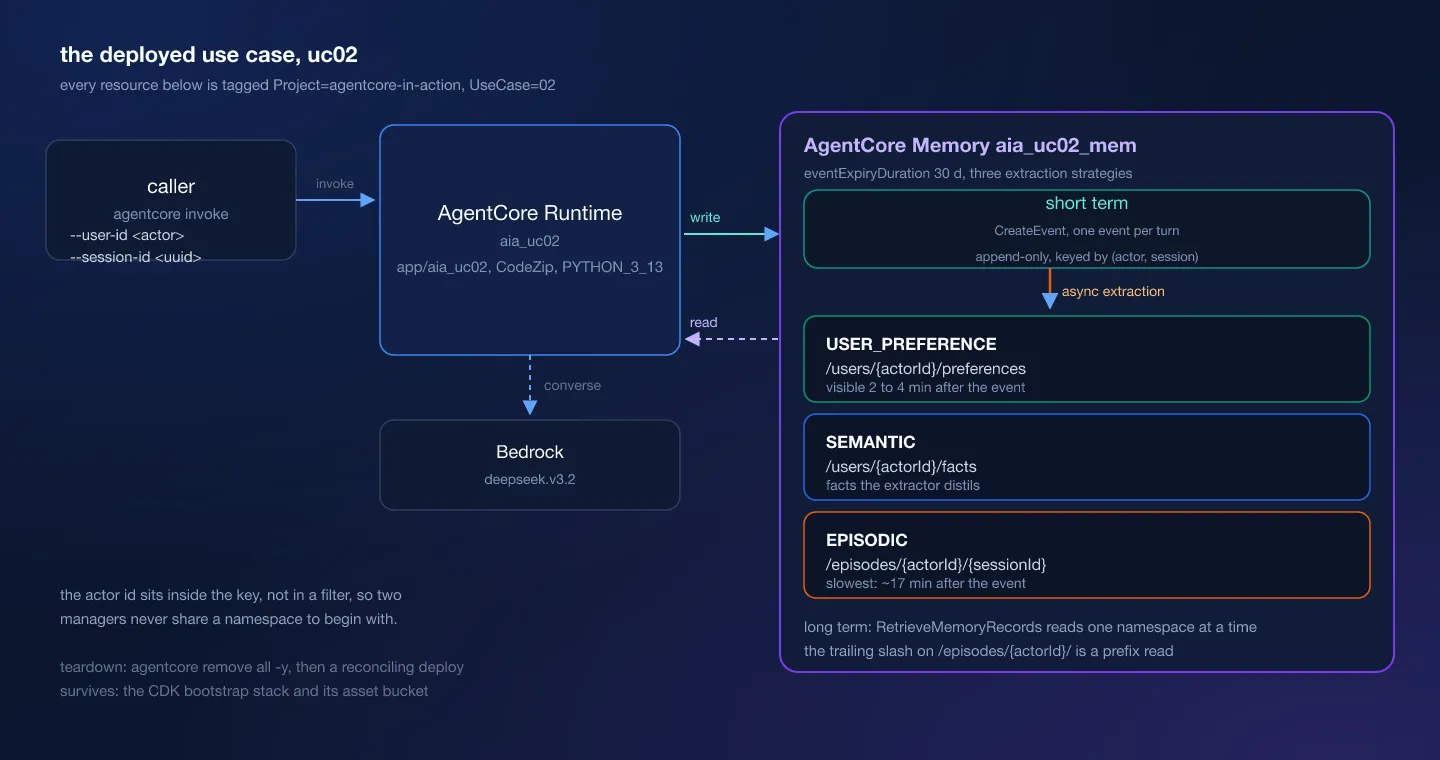
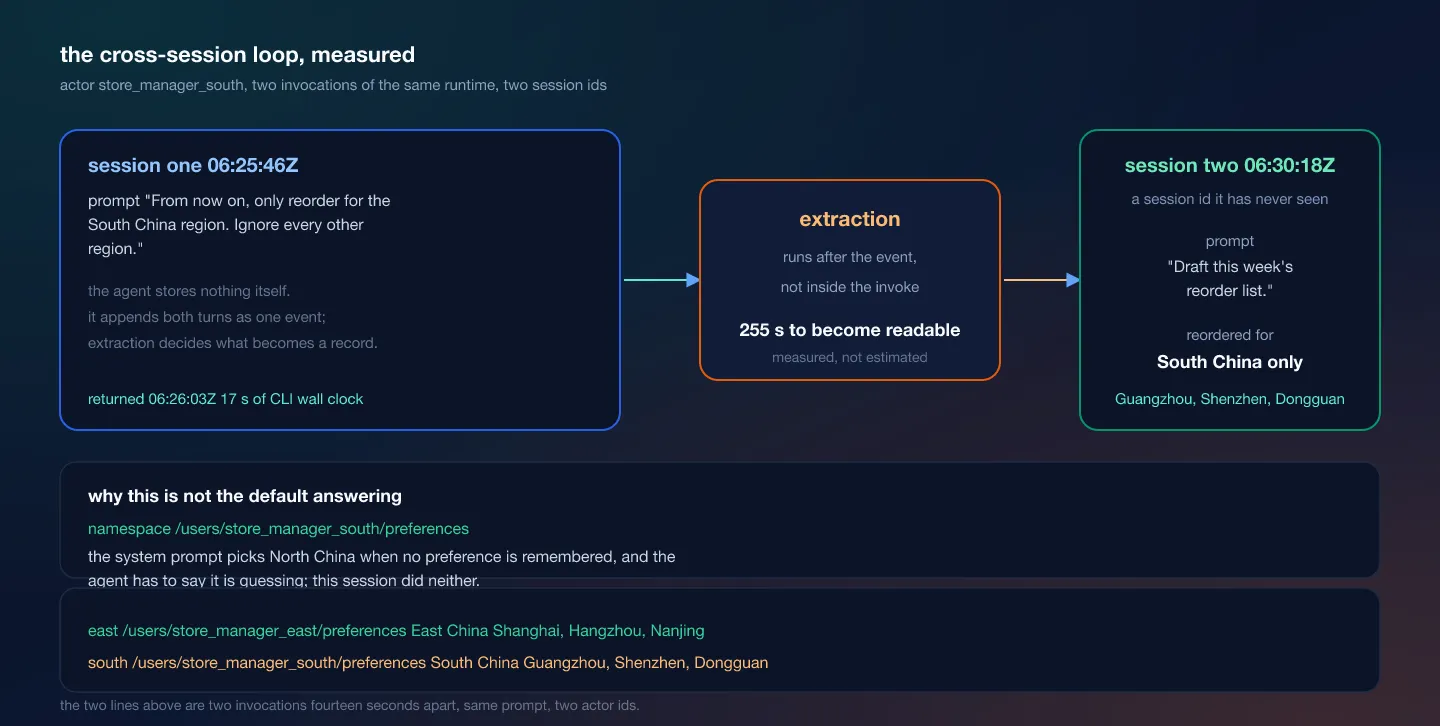
Three actors, three namespaces, one prompt producing two different lists. Extraction lag was 255 seconds for a preference and 1,022 for an episode, which decides every deadline you write.
A prefix read of
/episodes/store_manager_east/ returns a BASE episode filed under its session and a REFLECTION written one level up, hence the {sessionId} in one template and not the other.Troubleshooting
-
Invalid length for parameter runtimeSessionId, value: 22, valid min length: 33. Short readable session ids fail before they are sent. Build them from two uuid4 halves, because one hex uuid is 32 characters, one short of the minimum.
- The actor id sent as
-H x-amzn-bedrock-agentcore-runtime-custom-actor-id: ...never reached the agent, and the reply described the northern manager's memory because the code fell back to its default actor. Send it as--user-id, which arrives asx-amzn-bedrock-agentcore-runtime-user-id, and log the header names you receive once. This cost one deploy to find and is kept inevidence/27.
- Episodic extraction took 17 minutes, so a 300-second deadline can only fail. Choose the deadline from a measurement.
-
remove allneeds-yin any non-interactive shell, and it emptiesagentcore.jsonandaws-targets.json. Restore both from git before deploying again.
Takeaways
- Memory is two mechanisms: an event log you write, and records the service extracts. Only the second reaches a new session.
- Put the actor id inside the namespace template. Isolation then costs nothing and cannot be forgotten in a code path.
- Extraction is asynchronous and slow, and strategies differ. Every assertion needs a deadline longer than the slowest one.
- Send the actor id with
--user-idand verify it arrived. A silent fallback to a default actor looks like working memory and is the opposite.
- Teardown is real:
remove allempties the contract, the deploy after it does the deleting.
Enjoyed reading this content? Let the author know!
Your likes, comments, shares, and saves help creators reach more builders.

Loading recommendations
Loading article