
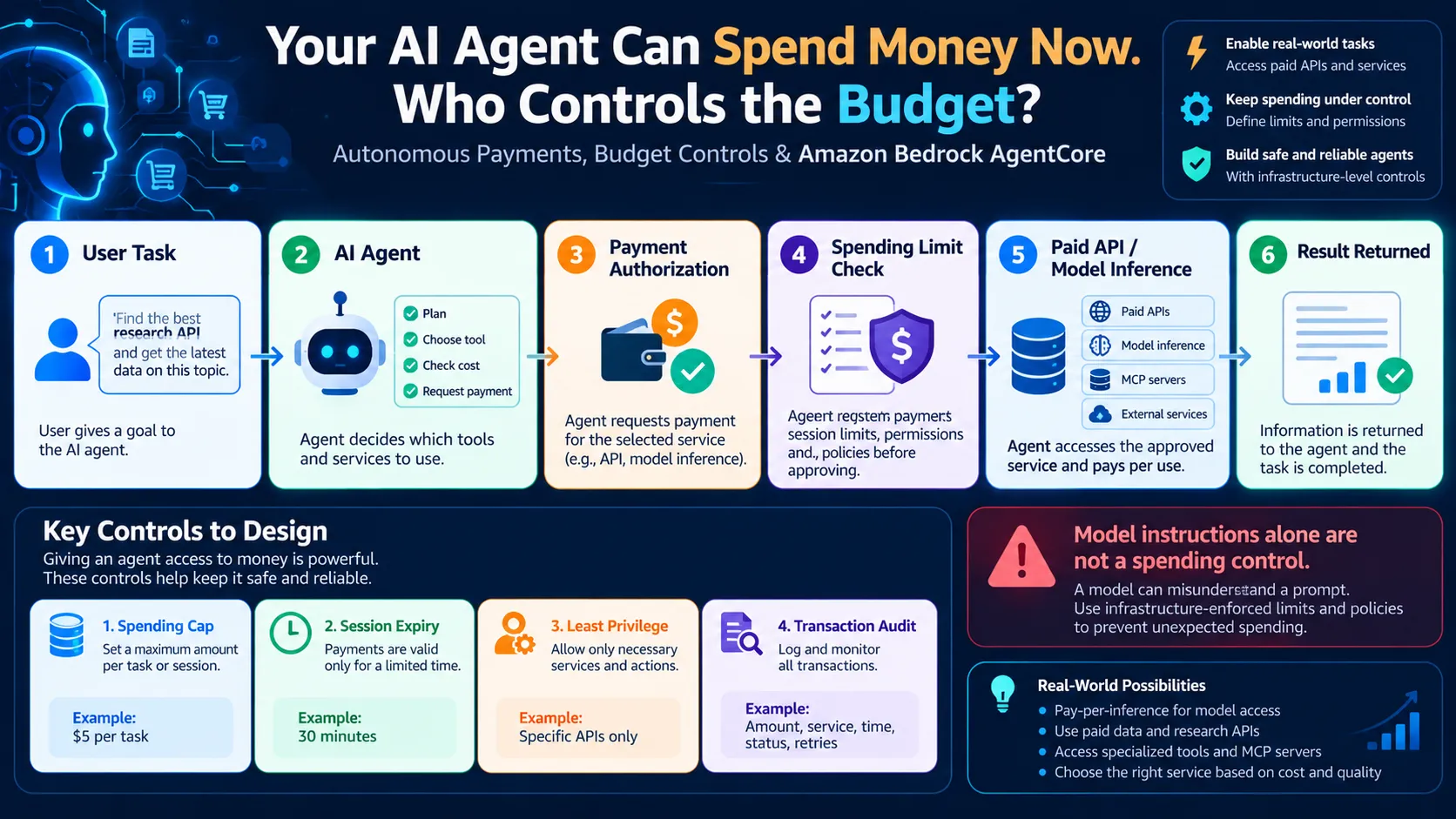
Your AI Agent Can Spend Money Now. Who Controls the Budget?
AI agents are evolving beyond chatbots. Explore how autonomous payments work with Amazon Bedrock AgentCore Payments, why spending controls matter, and how developers can design safer agentic applications.

Your AI Agent Can Spend Money Now. Who Controls the Budget?
Imagine asking an AI agent to research a topic, compare different models, retrieve information from paid APIs, and return the best possible answer.
The agent understands the task. It knows which tools to use. It can plan the steps required to complete the work.
But then it encounters a paid API.
What happens next?
Traditionally, developers have to manage subscriptions, API keys, payment integrations, and billing relationships for the services their applications use.
This creates an interesting challenge: an AI agent may be capable of making decisions, but how should it pay for the resources required to execute those decisions?
This is where agentic payments become interesting.
1. From AI That Answers to AI That Transacts
Most people initially experience AI through chat interfaces. We ask a question, and the model generates a response.
AI agents can go further. Depending on their tools and permissions, they can search for information, call APIs, interact with external services, and execute multi-step workflows.
Now imagine an agent that needs to access a paid research API or a service that charges for individual requests.
An agentic payment system can provide a controlled mechanism for accessing and paying for supported services.
This introduces a new design question:
How do we give an agent enough freedom to complete its task without giving it unlimited spending authority?
2. How Amazon Bedrock AgentCore Payments Fits In
Amazon Bedrock AgentCore Payments is an AWS capability designed to help AI agents discover, access, and pay for supported paid APIs, MCP servers, and content.
AWS announced its general availability on August 18, 2026.
The service supports payment infrastructure integrations, payment protocols, configurable spending limits, and transaction observability.
One particularly interesting use case is pay-per-inference.
Instead of relying exclusively on traditional subscription arrangements, an agent can access supported inference services and pay according to usage.
For example, AWS describes how Incarna uses AgentCore Payments to pay BlockRun for model inference one request at a time.
This demonstrates how autonomous agents can access supported paid services without developers having to build every payment mechanism themselves.
Official AWS announcement:
3. The Interesting Part Is Not the Payment. It Is the Control.
Giving an autonomous system access to money introduces a different category of risk.
Consider a simple example.
An agent receives a task that should require only a small amount of paid API usage.
A tool times out, the agent retries several times, and it selects an unnecessarily expensive service.
The agent might still complete the task, but the final cost could exceed the developer's expectations.
This is why payment controls matter.
A developer should consider several questions:
- What is the maximum amount the agent may spend during a task?
- When should its payment permission expire?
- What happens if a transaction is retried?
- Can a transaction be rejected before money is spent?
- Can the developer inspect transactions afterwards?
AgentCore Payments supports configurable spending and session-expiry limits. When a payment would exceed the active session's configured spending limit, the payment request is denied.
This is an important architectural distinction.
A model instruction saying "never spend more than $5" is not the same as an enforceable spending limit.
Models can misunderstand instructions. Critical financial controls should not depend exclusively on the model remembering to follow a prompt.
4. A Simplified Architecture
Imagine an AI research agent that needs information from a paid service.
The workflow could look like this:
Step 1: The user submits a request.
⬇️
Step 2: The AI agent plans the task and identifies a paid service.
⬇️
Step 3: The agent initiates a payment request.
⬇️
Step 4: The payment system checks the session's spending limit.
⬇️
Step 5: If the request is permitted, the payment is processed and the supported service can return its response.
⬇️
Step 6: The agent uses the returned information to complete the task.
If a transaction would exceed the configured limit, the payment system should reject it rather than silently allowing the agent to exceed its budget.
The agent can then choose another permitted approach or ask the user how to proceed.
This is a simplified conceptual workflow. The exact implementation depends on the application's architecture and the payment protocol being used.
Official documentation:
5. Five Controls I Would Consider Before Enabling Agent Payments
1. Spending Limits
Set a maximum budget for a task or payment session. The limit should reflect the value of the task and the potential cost of failure.
2. Session Expiry
Payment permissions should not remain valid indefinitely when they are needed only for a particular interaction.
3. Least Privilege
Give the agent access only to the services and actions required for its task.
4. Transaction Visibility
Record transaction status, amounts, failures, retries, and other information needed to investigate unexpected spending.
5. Human Approval
Not every action should be fully autonomous. Depending on the application, high-value or irreversible transactions may require explicit approval.
These controls address different risks, and no single mechanism automatically makes every agent application safe.
6. An Interesting Use Case: Choosing Between Models
Imagine a research agent that can access several supported model endpoints.
A lightweight request might be handled by a less expensive model, while a complex request might justify a more capable model.
In a supported pay-per-inference workflow, an agent could potentially pay for individual inference requests rather than depending entirely on separate fixed subscriptions.
However, lower cost alone does not guarantee better results.
An application should also evaluate answer quality, latency, reliability, and the total cost of completing a task.
The goal should be to choose the right resource for the job, not simply the cheapest available option.
AWS explored this approach in its technical article about BlockRun and Incarna.
Read more:
7. What This Could Mean for AI Applications
As more services become accessible to software agents, developers may need to think beyond conventional API authentication.
They may also need to consider how agents discover paid resources, obtain transaction authorization, respect budgets, and provide auditable records of their actions.
This does not mean every AI agent needs a wallet. Many applications should continue using conventional authentication and centrally managed billing.
Autonomous payments are most interesting when an agent genuinely needs to access supported pay-per-use resources as part of its workflow.
The architecture should follow the use case, not the hype.
My Takeaway
I am currently exploring LLM fundamentals, AI agents, and AWS services. This is one of the developments that makes agentic AI particularly interesting to study.
An agent's ability to reason is only one part of the system. Once it can interact with paid external services, authorization, spending limits, transaction visibility, and failure handling become equally important engineering problems.
The bigger question is not simply whether an AI agent can spend money.
It is whether we can design systems that allow it to do so within clear, enforceable boundaries.
Question for the AWS Community
Suppose you were building an autonomous research agent that could pay for APIs and model inference.
Would you allow it to make transactions automatically within a fixed budget, or would you require human approval for every purchase?
What safeguards would you put in place before deploying such a system?
I'd especially like to hear from developers experimenting with Amazon Bedrock AgentCore, MCP-based services, or autonomous agent workflows
Enjoyed reading this content? Let the author know!
Your likes, comments, shares, and saves help creators reach more builders.

Loading recommendations
Loading article