
Smart Serverless RAG Architecture: Combining Amazon Bedrock, AWS Lambda, and Vector Storage
Learn how to build a fully serverless, highly scalable, and cost-effective Retrieval-Augmented Generation (RAG) pipeline on AWS. This guide covers end-to-end ingestion, query workflows using Amazon Bedrock and AWS Lambda, vector storage selection, and key production optimization techniques to lower latency and compute costs.

Smart Serverless RAG Architecture: Combining Amazon Bedrock, AWS Lambda, and Vector Storage
Generative AI applications are transforming how organizations query and interact with enterprise data. While Retrieval-Augmented Generation (RAG) has become the gold standard for grounding Large Language Models (LLMs) with private data, running dedicated infrastructure 24/7 for AI workloads can quickly become expensive and complex to manage.
By moving to a fully serverless architecture, you can build a highly resilient, automatically scaling, and pay-per-use RAG pipeline without managing GPU instances or dedicated cluster nodes.
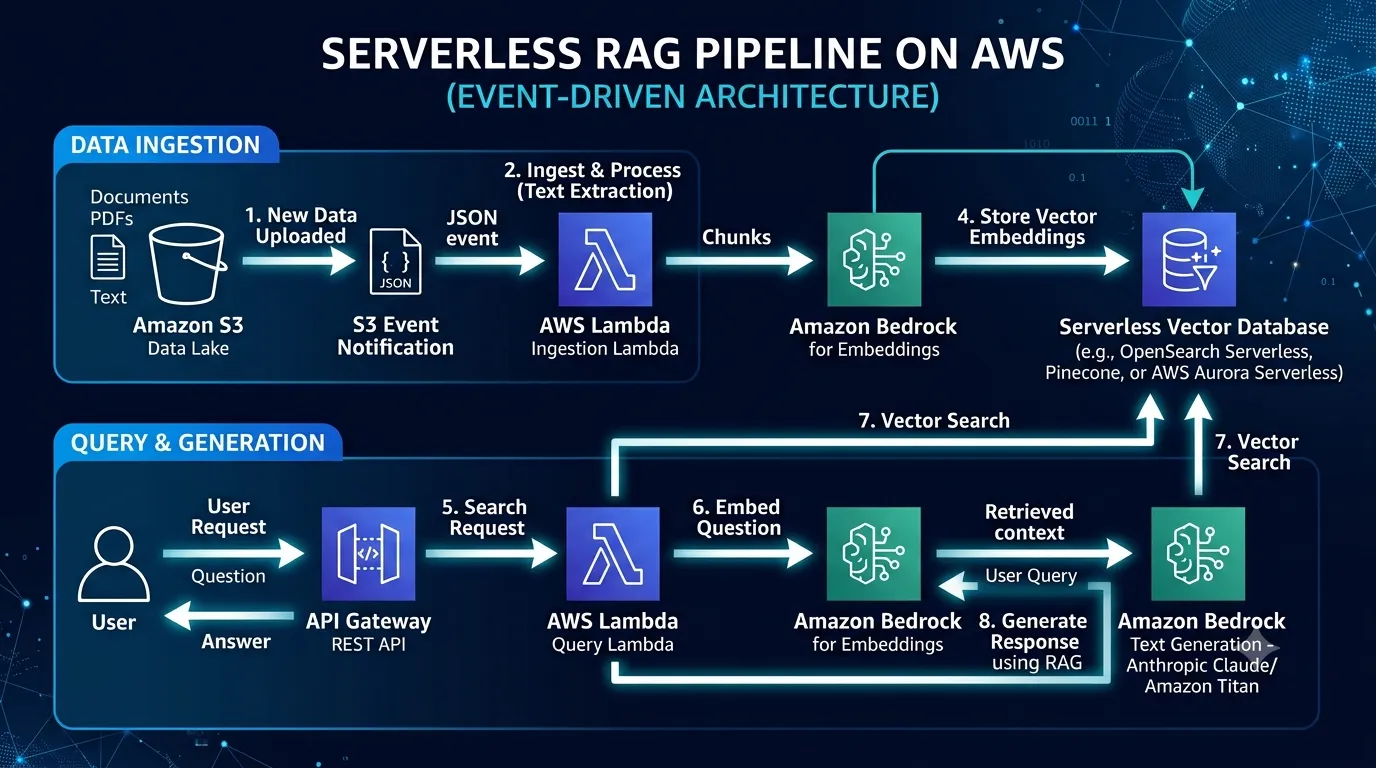
In this article, we will break down the end-to-end architecture for building a serverless RAG pipeline on AWS using Amazon Bedrock, AWS Lambda, and Serverless Vector Storage.
🏗️ Why Go Serverless for RAG?
Traditional RAG deployments rely on always-on compute instances and persistent database nodes. While effective, they introduce unnecessary overhead during low-traffic hours. A serverless approach brings several distinct advantages:
- 💰 Cost Efficiency: Pay strictly for active execution time (Lambda execution, Bedrock API calls, and vector search operations).
- 📈 Seamless Scalability: Scale automatically from zero to thousands of concurrent requests without manual capacity planning.
- 🛠️ Reduced Operational Overhead: Focus heavily on chunking quality, prompt engineering, and response evaluation rather than patching servers or managing cluster health.
📐 High-Level System Architecture
The architecture is divided into two decoupled pipelines: the Document Ingestion Pipeline (Offline) and the Query & Retrieval Pipeline (Online).
Enjoyed reading this content? Let the author know!
Your likes, comments, shares, and saves help creators reach more builders.

Loading recommendations
Loading article