
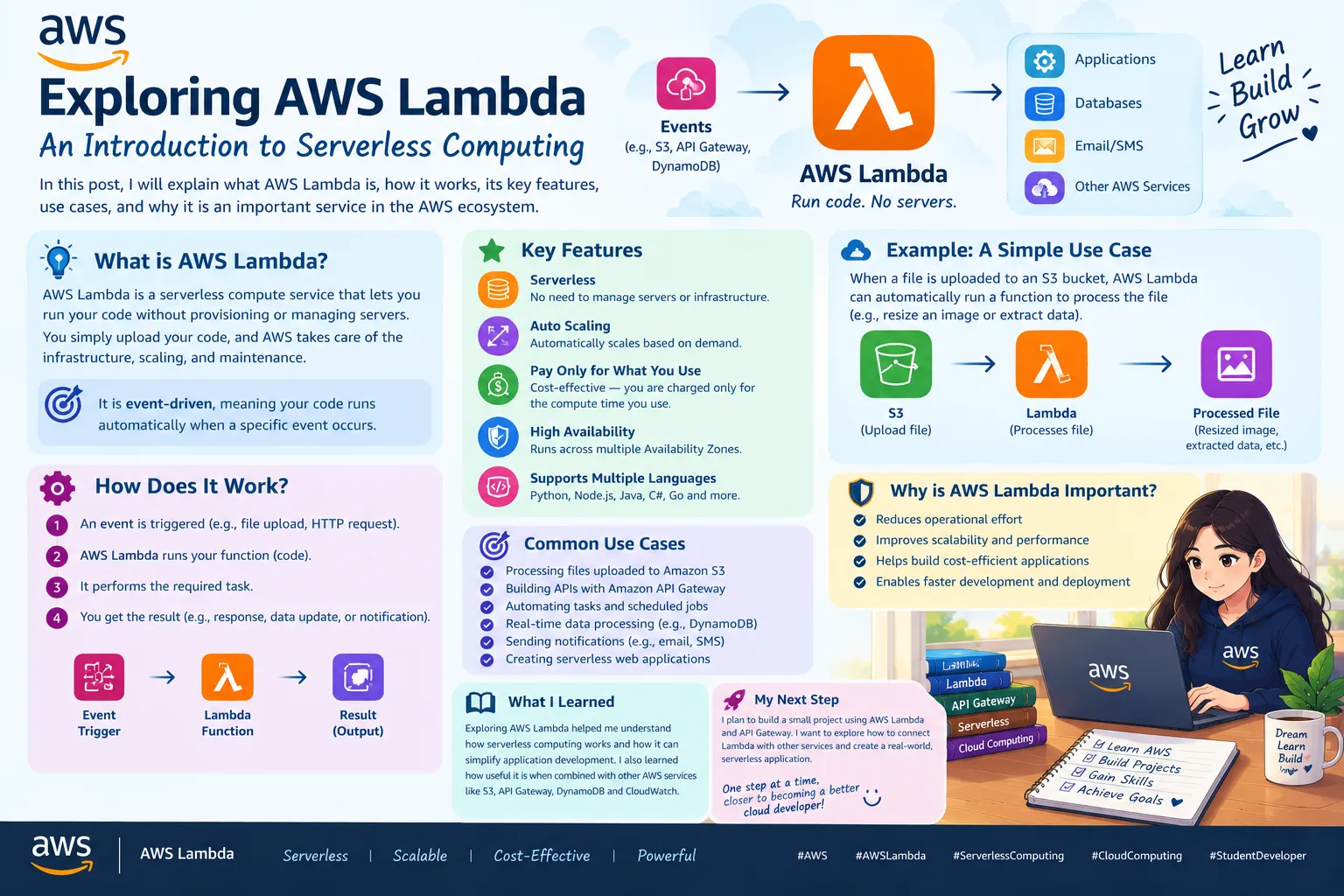
Exploring AWS Lambda: An Introduction to Serverless Computing.
Discover how AWS Lambda enables developers to run code without managing servers. This article explores event-driven computing, key features, practical use cases, and how Lambda integrates with other AWS services to build scalable applications.

Exploring AWS Lambda: An Introduction to Serverless Computing ☁️
As I continue learning about AWS, I am exploring AWS Lambda, a service that helps developers run code without managing the underlying servers.
In traditional application development, developers may need to configure servers, manage infrastructure, and plan computing capacity. AWS Lambda simplifies this process by managing the infrastructure required to execute functions.
What Is AWS Lambda?
AWS Lambda is a serverless compute service that runs code in response to events.
Developers upload their code as a function, configure its triggers, and let AWS Lambda execute it when required.
For example, when a user uploads an image to Amazon S3, a Lambda function can automatically process the image.
The term serverless does not mean that servers do not exist. It means AWS manages the underlying server infrastructure for you.
How Does AWS Lambda Work?
The basic process involves four steps:
- Create a function: Write code to perform a particular task.
- Configure a trigger: Choose an event that should start the function.
- Execute the function: Lambda runs the code when the configured event occurs.
- Process the result: The function completes its task, such as processing a file or returning a response.
Lambda can respond to events from services such as Amazon S3, Amazon API Gateway, and Amazon EventBridge.
Key Features of AWS Lambda
🔹 No Server Management
AWS manages the underlying computing infrastructure, allowing developers to focus on writing code.
🔹 Automatic Scaling
Lambda can adjust the number of function executions according to incoming demand, subject to service limits and configuration.
🔹 Event-Driven Execution
Functions can run in response to supported events and requests.
🔹 Pay-for-Use Pricing
For many Lambda workloads, charges are based on requests and execution duration, subject to the applicable pricing model.
🔹 Multiple Programming Languages
Lambda supports runtimes for languages such as Python, Java, and Node.js, along with other supported runtimes and custom runtimes.
Common Use Cases
AWS Lambda is useful for:
- 📁 Processing files uploaded to Amazon S3
- 🌐 Creating backend functions for web applications
- 🔔 Sending automated notifications
- 🔄 Performing scheduled tasks
- 📊 Processing data in response to events
- 🔗 Connecting different AWS services
A Simple Real-World Example
Imagine developing a website where users upload profile pictures.
The workflow could be:
User uploads an image → Amazon S3 stores the image → AWS Lambda processes it → The processed image is saved.
This automation can reduce the need for developers to manage a dedicated server for the image-processing task.
Why Is AWS Lambda Important?
AWS Lambda helps developers build event-driven applications while reducing the amount of infrastructure they need to manage.
When combined with services such as Amazon S3, Amazon API Gateway, and Amazon DynamoDB, Lambda can be part of a flexible serverless application architecture.
What I Learned
Exploring AWS Lambda helped me understand how serverless computing can simplify application development. I also learned how event-driven functions can automate tasks and connect different cloud services.
This concept is especially interesting for students who want to build practical projects without managing a complete server infrastructure.
My Next Step
I plan to experiment with a small Python-based Lambda function and explore how it can interact with Amazon S3 or API Gateway.
My goal is to understand serverless architecture through hands-on practice and apply it to future academic projects.
Learning one AWS service at a time is helping me build a stronger foundation in cloud computing. I look forward to turning these concepts into practical applications! 🚀
#AWS #AWSLambda #ServerlessComputing #CloudComputing #AWSCloud #StudentDeveloper
Enjoyed reading this content? Let the author know!
Your likes, comments, shares, and saves help creators reach more builders.

Loading recommendations
Loading article