
Latest AWS Service Updates: Transforming Serverless Compute for Builders
A quick roundup of the most significant recent AWS Lambda announcements, including new execution models like Web Functions, MicroVMs, and major performance enhancements for container workloads.

The serverless landscape has been evolving rapidly in late 2026. AWS has expanded the capabilities of AWS Lambda beyond its traditional event‑driven roots, introducing new execution models and performance boosts to handle a wider variety of workloads. Whether you are building web applications, orchestrating AI agents, or running heavy data processing, here are the most important Lambda updates you should know about.
Three Distinct Lambda Form Factors
AWS Lambda now officially offers three form factors, each optimized for specific programming models and workload requirements.
AWS Lambda now officially offers three form factors, each optimized for specific programming models and workload requirements.
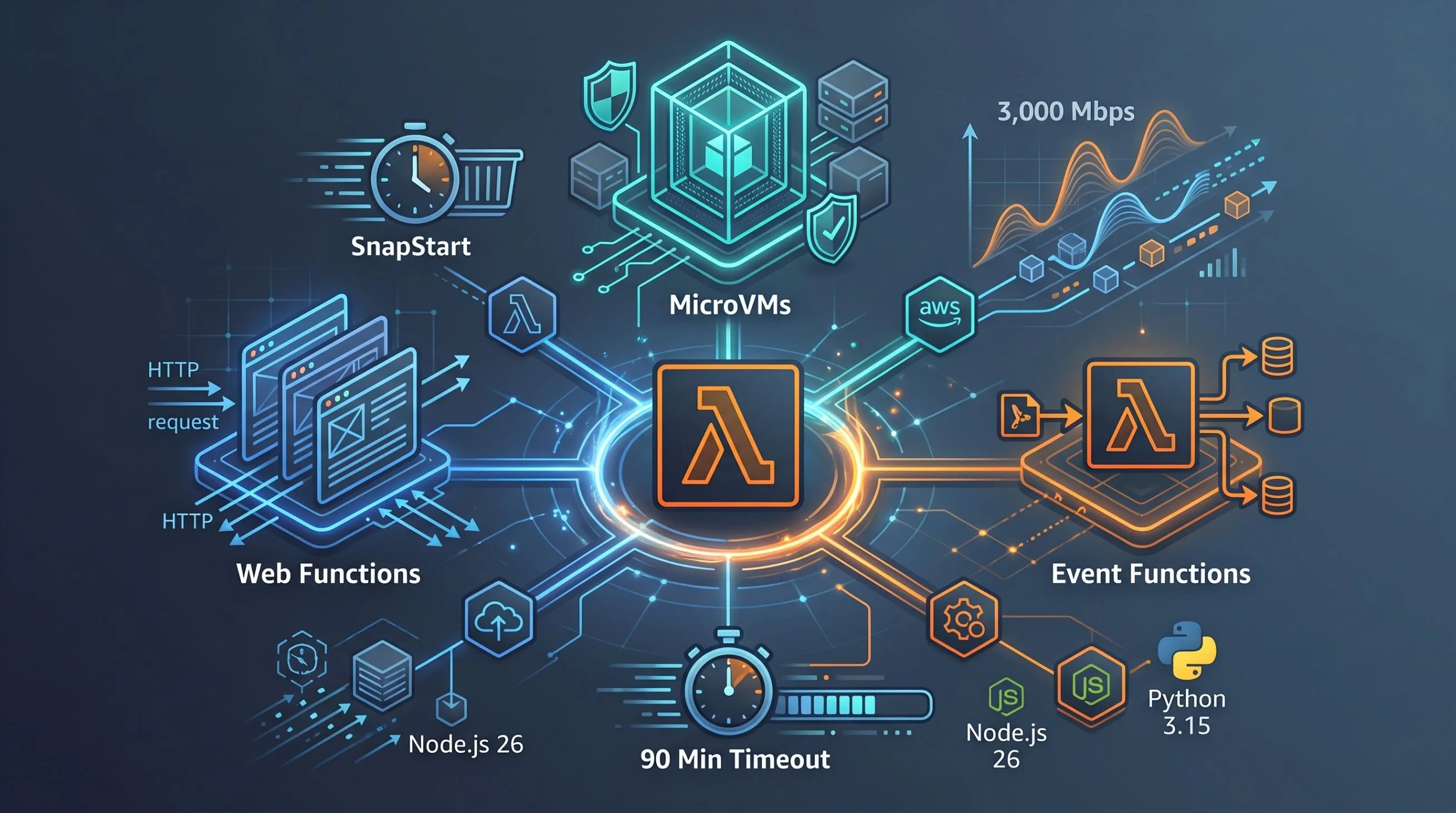
- Lambda Web Functions – A native serverless compute option tailored for HTTP workloads. If you use standard web frameworks like Express or Hono, you can run them on Lambda without code changes or adapters.
- Multi‑concurrent execution: A single environment can serve up to 128 concurrent requests, keeping your application warm during traffic spikes.
- Active CPU billing: You pay only for the active CPU time your code uses; waiting on downstream databases or API calls consumes very little CPU, reducing compute costs for I/O‑heavy applications.
- Opt‑in multi‑region endpoints: Replicate your code and route users to the nearest region based on latency.
- Lambda MicroVMs – Isolated, stateful sandbox environments built on Firecracker isolation technology. They are ideal for untrusted or user‑generated code, AI‑generated scripts, third‑party plugins, and self‑hosted control planes that require strict resource limits and permission boundaries.
- Lambda Event Functions – The traditional event‑driven, single‑concurrent handler model with wall‑clock billing. AWS now calls this model “Event Functions” to distinguish it from the newer execution options.
Major Performance and Architecture Enhancements
- SnapStart for Container Images – SnapStart now supports container‑image functions, cutting cold‑start times from several seconds to sub‑second levels. This makes latency‑sensitive workloads using custom containers much easier to run.
- Extended Timeouts for Managed Instances – Lambda Managed Instances, which bring Amazon EC2 economics to serverless compute with multi‑concurrency, now support asynchronous and event‑source‑mapping invocations for up to 90 minutes (up from 15 minutes). This enables heavy data processing, media transcoding, and batch workloads without re‑architecting your infrastructure.
- Scalable Network Bandwidth – Functions allocated 2,048 MB of memory or more can now scale network throughput from 625 Mbps up to 3,000 Mbps when running outside a VPC. The higher bandwidth reduces execution times and per‑invocation costs for latency‑sensitive processing.
- Durable Functions Expansion – Limits for durable operations and checkpoint payloads have increased. Durable Functions are now officially available in AWS GovCloud (US) Regions, allowing public‑sector builders to implement long‑running operations such as sagas and human‑in‑the‑loop waits.
- Public Preview Runtimes – AWS has launched public preview runtimes, letting developers test code against upcoming language versions before general availability. The program began with Node.js 26 and Python 3.15, offering an early feedback loop to shape runtime quality.
As serverless continues to blur the lines between traditional compute and managed services, these new execution models give you the flexibility to choose the exact compute style your application needs. Happy building!
Enjoyed reading this content? Let the author know!
Your likes, comments, shares, and saves help creators reach more builders.

Loading recommendations
Loading article