
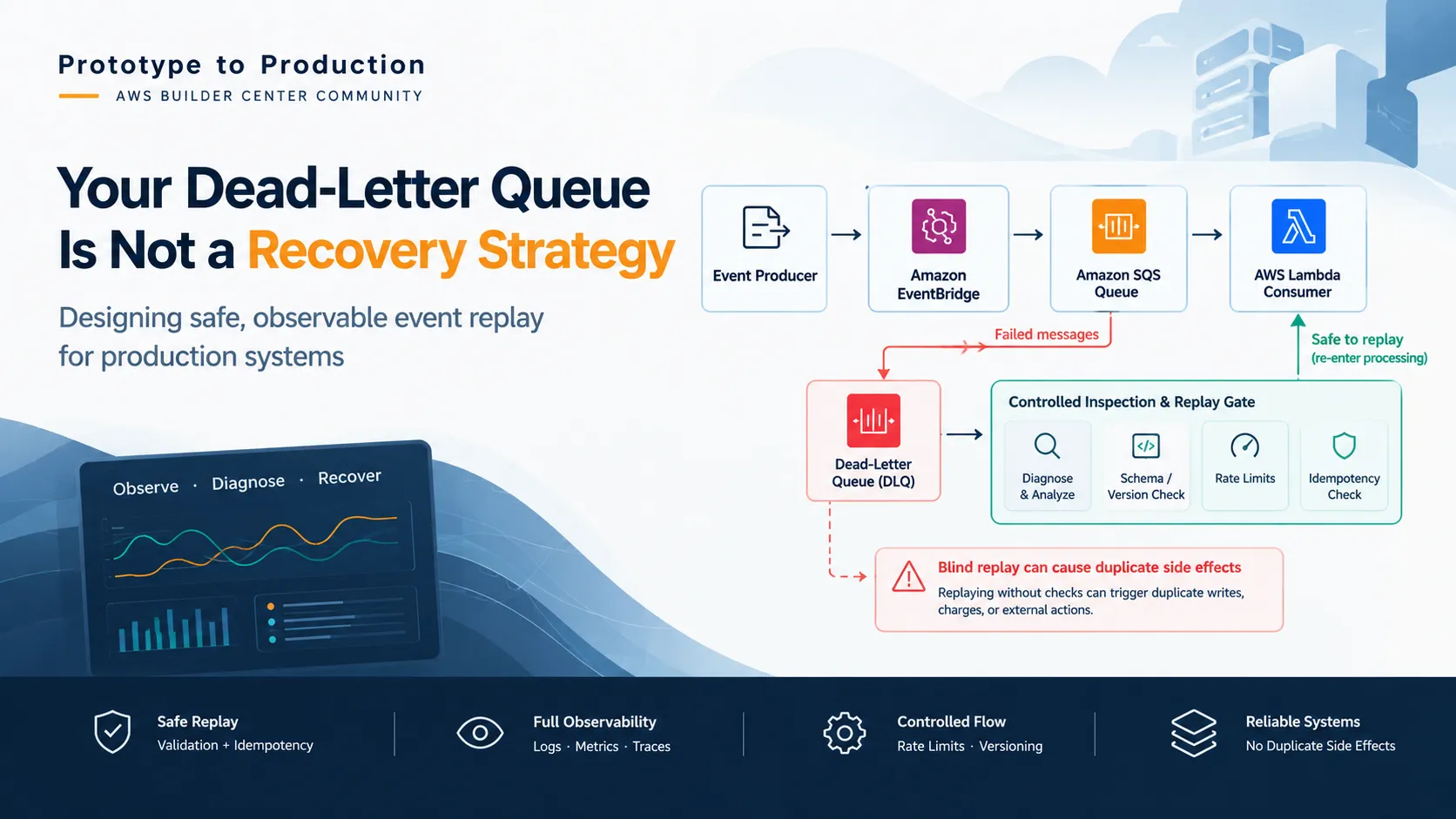
Your Dead-Letter Queue Is Not a Recovery Strategy
A dead-letter queue preserves failed messages, but recovery requires more than replaying them. Explore safe event replay, idempotency, schema evolution, retry control, and observability for resilient serverless systems on AWS.

Your Dead-Letter Queue Is Not a Recovery Strategy
A message reached your dead-letter queue (DLQ). The failure is contained, but is your system ready to recover?
Storing a failed event is not the same as safely processing it again.
The failure path
1
2
3
4
5
6
7
8
9
Producer
   ↓
EventBridge → SQS → Lambda
                  ↓ failure
                 DLQ
                  ↓
          Inspect → Validate
                  ↓
           Safe replay
A DLQ gives engineers a place to investigate messages that repeatedly fail. But blindly replaying them can introduce new failures.
Three risks engineers must address
1. Duplicate side effects
A message may have updated inventory or charged a customer before processing failed. Replaying it can repeat that action.
Use idempotency keys or durable event-processing records to prevent duplicate business effects.
2. Schema drift
The consumer may have changed since the event was originally produced. A previously valid payload might now be missing fields or use an incompatible schema.
Validate event versions and payloads before replay.
3. Recovery overload
Replaying thousands of messages at once can overwhelm a recovering database or downstream API.
Use controlled batches, rate limits, and monitoring to protect dependencies.
A safer recovery workflow
1
2
3
4
5
6
7
8
9
10
11
12
13
DLQ
 ↓
Inspect failure reason
 ↓
Classify transient vs permanent
 ↓
Validate schema and event identity
 ↓
Check idempotency
 ↓
Replay at a controlled rate
 ↓
Verify business outcome
AWS supports DLQs and retry controls for failed event processing. The correct configuration depends on the event source and failure mode; a DLQ should be paired with an operational process for investigation and recovery.
Production readiness checklist
- Failed messages trigger actionable alerts.
- Retry limits and retention are intentional.
- Consumers handle duplicate delivery safely.
- Event schemas are versioned.
- Replay is rate-limited and auditable.
- Reprocessed events are verified against business outcomes.
The key principle: A DLQ is a safety net, not a complete recovery plan.
Discussion
If you had 10,000 failed events waiting in production, what would you verify before replaying even one?
#PrototypeToProduction #AWS #Serverless #EventDrivenArchitecture #Reliability
Enjoyed reading this content? Let the author know!
Your likes, comments, shares, and saves help creators reach more builders.

Loading recommendations
Loading article