
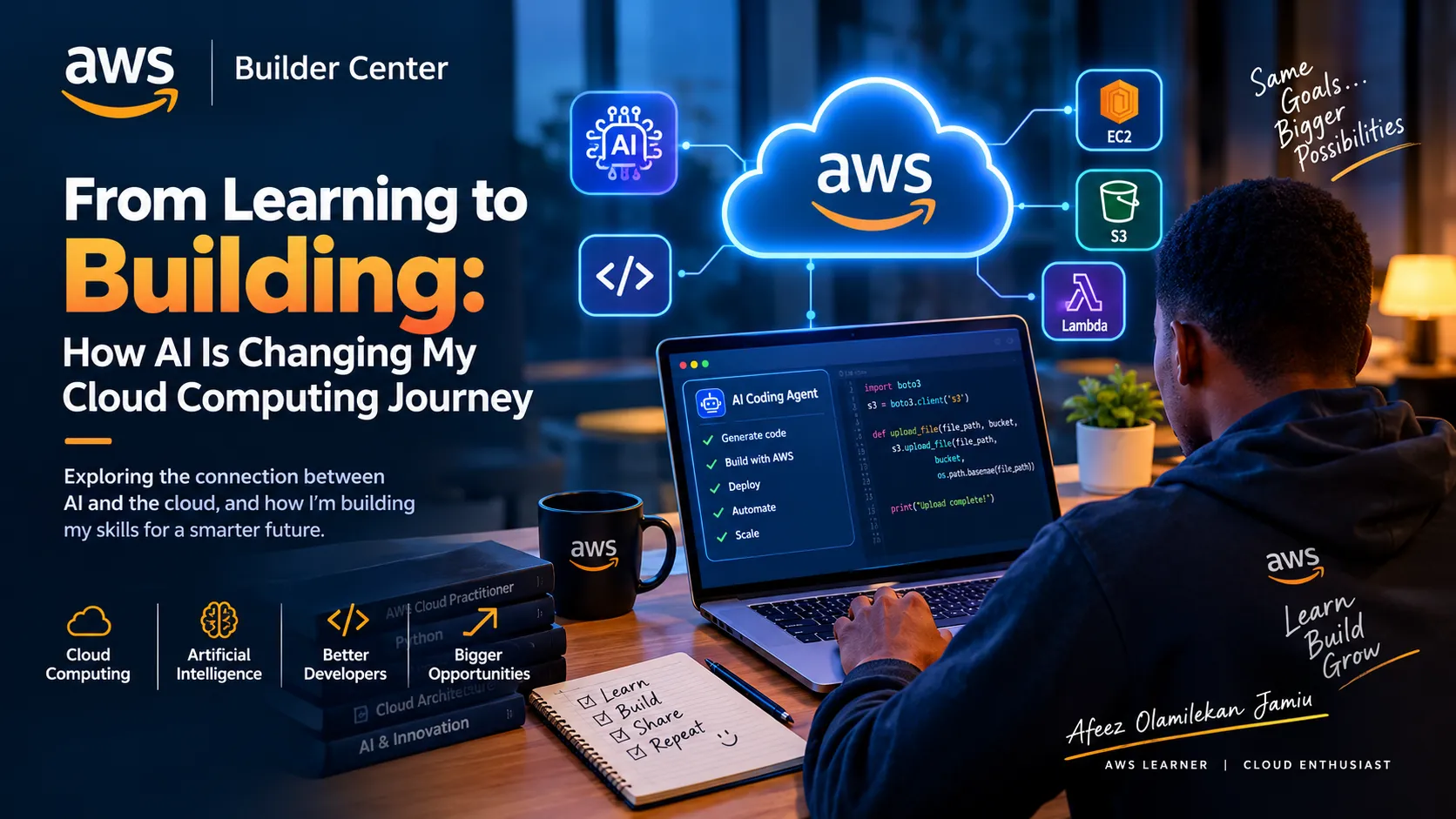
From Learning to Building: How AI Is Changing My Cloud Computing Journey
Explore how Artificial Intelligence (AI) is transforming cloud computing and creating new opportunities for developers and aspiring cloud engineers. In this article, I share my AWS learning journey, explain the role of AI coding agents in cloud development, and highlight practical steps for building cloud skills. Discover why continuous learning, hands-on projects, and responsible AI adoption are essential for the future of cloud engineering.

Introduction
Cloud computing is evolving rapidly, and artificial intelligence is opening new possibilities for developers, cloud engineers, and technology enthusiasts.
As someone building a career in cloud computing, I have become increasingly interested in how AI-powered tools can help developers work more efficiently, automate tasks, and build solutions on cloud platforms.
My journey is still in progress, but one thing is becoming clear: the future belongs to people who continuously learn, experiment, and turn knowledge into practical solutions.
Understanding the Connection Between AI and Cloud Computing
Artificial intelligence and cloud computing are two important areas of modern technology.
Cloud computing provides the infrastructure, storage, networking, and computing resources needed to run applications. AI introduces capabilities that can help applications analyze information, generate content, automate workflows, and support decision-making.
When these technologies work together, developers can build smarter applications without having to manage every aspect of the underlying infrastructure themselves.
For example, developers can explore how to:
Use AI coding assistants to accelerate software development.
Deploy AI-powered applications on cloud infrastructure.
Automate repetitive development and operational tasks.
Build applications that integrate with cloud services.
Improve application scalability, reliability, and security.
For aspiring cloud engineers, understanding this relationship is becoming an increasingly valuable skill.
Why AI Coding Agents Matter to Cloud Developers
One development that interests me is the emergence of AI coding agents.
Unlike tools that simply suggest code, coding agents can assist with more involved development tasks, depending on their capabilities, permissions, and configuration.
When connected to cloud environments, these agents can help developers explore workflows such as generating application code, preparing deployment configurations, and interacting with cloud development tools.
However, AI-generated code and infrastructure configurations still require human review. Security permissions, resource costs, application reliability, and potential errors must be considered before deploying anything to a real environment.
The goal is not to replace the developer. It is to help the developer become more productive while remaining responsible for the final result.
My AWS Learning Journey
My journey into cloud computing is driven by curiosity, consistency, and a desire to develop practical technical skills.
Through the AWS Builder Center community, I am exploring learning opportunities, discovering new technologies, and connecting with developments across the AWS ecosystem.
Participating in the Connect your AI coding agent to AWS weekend challenge was an encouraging experience. Being selected as one of the 100 randomly chosen winners motivated me to continue exploring the intersection of AI and cloud computing.
For me, the recognition is not the destination. It is encouragement to keep learning, experimenting, and building.
My next priority is to strengthen my understanding of AWS services and apply that knowledge through practical projects.
I believe that documenting this process can also help other beginners who are trying to find their place in the cloud computing ecosystem.
What Aspiring Cloud Engineers Can Do Today
If you are starting your own cloud journey, here are five practical steps I recommend:
- Build a strong foundation. Learn cloud computing concepts, including compute, storage, networking, identity and access management, and security.
- Explore AWS services. Start with services relevant to your goals, such as Amazon EC2, Amazon S3, AWS Lambda, and AWS Identity and Access Management (IAM).
- Experiment with AI development tools. Learn how AI coding assistants and agents can support software development and cloud workflows. Always review their output before using it.
- Build practical projects. Move beyond reading documentation. Create small projects, document your implementation, troubleshoot errors, and improve your solutions.
- Learn in public. Share your progress, explain what you have learned, and engage with other builders. Teaching others can strengthen your own understanding while helping you build a professional network.
You do not need to master every AWS service before starting your first project. Start small, learn from your mistakes, and improve with every iteration.
Looking Ahead
I am particularly interested in how AI-assisted development will influence cloud engineering, automation, and application deployment.
As these tools continue to evolve, I want to understand not only how to use them but also how to use them responsibly.
That means learning about security, cost management, infrastructure design, and the principles behind the tools I use.
My objective is to progress from learning cloud concepts to building useful solutions that demonstrate practical skills.
Every project, challenge, and technical lesson is another step toward that goal.
Conclusion
Cloud computing is more than learning services and memorizing technical definitions. It is about understanding problems, designing solutions, and continuously improving the way we build and operate technology.
AI is creating new opportunities for developers and cloud engineers, but curiosity, technical understanding, and responsible experimentation remain essential.
I am continuing my journey one lesson and one project at a time.
Learn. Build. Share. Repeat.
I look forward to connecting with other builders, learning from their experiences, and sharing more of my progress along the way.
Join the Conversation
How are you using AI in your cloud computing journey?
Are you experimenting with AI coding assistants, building AI-powered applications, or exploring ways to automate cloud infrastructure?
Share your experience in the comments. Let's learn and build together!
— Afeez Olamilekan Jamiu
Aspiring Cloud Engineer | AWS Learner | AI & Cloud Computing Enthusiast
Enjoyed reading this content? Let the author know!
Your likes, comments, shares, and saves help creators reach more builders.

Loading recommendations
Loading article