
Enterprise-Grade AI Agent Architecture Analysis on AWS: The Synergy of Amazon Bedrock and MCP
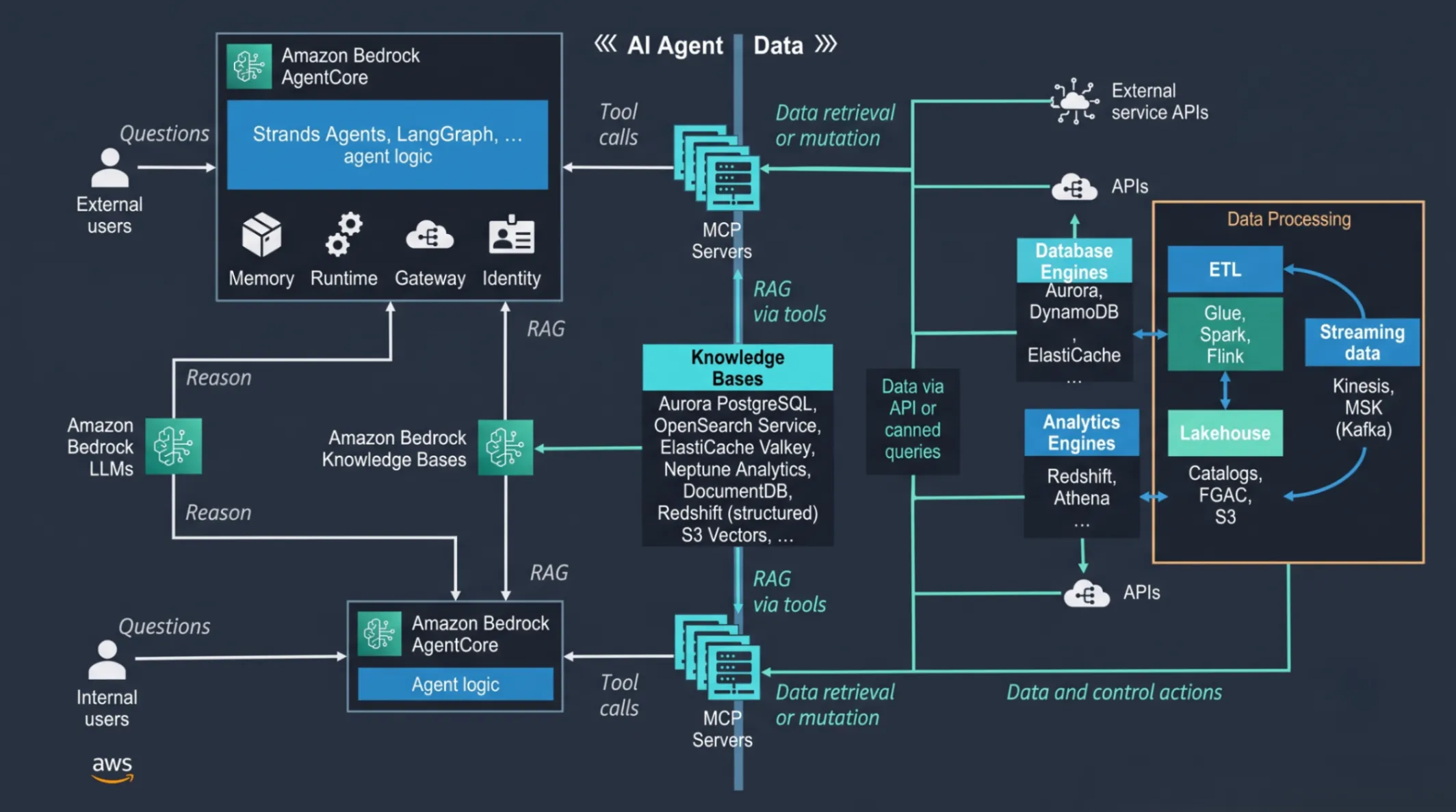
After attending AWS Cloud Day in Vietnam, I want to record the valuable insights I gained at the event. The evolution of Generative AI is rapidly shifting from standalone Large Language Models (LLMs) to autonomous AI Agents capable of reasoning, acting, and interacting directly with enterprise data. This architecture outlines a comprehensive and robust solution on the AWS platform, maximizing the Amazon Bedrock ecosystem in conjunction with the MCP (Model Context Protocol) communication standard.
1. Interaction & Orchestration Layer
The initial touchpoint of this architecture is the communication layer designed for two target groups: External users and Internal users.
The core orchestrator here is Amazon Bedrock AgentCore. This is not merely an API proxy, but a true "executive brain" featuring essential components:
- Agent Logic: Supports flexible frameworks like LangGraph and Strands Agents to define complex multi-step reasoning workflows and agent state graphs.
- Platform Management Modules: Includes Memory (conversational context storage), Runtime (execution environment), Gateway (request flow management), and Identity (authentication/authorization). Decoupling Identity allows the architecture to apply Fine-Grained Access Control right at the entry point.
2. Intelligence Core
Bedrock AgentCore does not reason on its own; it relies on Amazon Bedrock LLMs. Large Language Models act as the "reasoning engines" (represented by the Reason flow arrows). Upon receiving Questions from users, the Agent logic prompts the LLM to plan, decide which tools to invoke, and synthesize the final response.
3. Knowledge Management & RAG
An AI Agent is ineffective without enterprise context. This architecture solves that challenge through Amazon Bedrock Knowledge Bases.
A major strength of this design is its support for a diverse range of specialized databases and vector stores:
- Relational/Document Databases: Aurora PostgreSQL, DocumentDB.
- Specialized Search Engines: OpenSearch Service.
- In-memory & Graph: ElastiCache Valkey, Neptune Analytics (highly effective for Graph RAG).
- Analytics Data Warehouses: Redshift (structured data) and S3 Vectors.
The Agent can execute RAG (Retrieval-Augmented Generation) workflows directly from the Knowledge Bases to enrich the context before passing it to the LLM for reasoning, ensuring accuracy and minimizing hallucinations.
4. Tooling & Integration Layer
This is arguably the most fascinating and highly trending aspect of the architecture: The introduction of MCP Servers (Model Context Protocol).
Instead of hard-coding every API integration into the Agent, the system utilizes MCP as a standardized middleware layer. AgentCore issues Tool calls. The MCP Servers receive these calls and translate them into Data retrieval or mutation actions. Through the MCP layer, the Agent can:
- Execute RAG dynamically via various tools.
- Invoke External service APIs (e.g., Stripe, Salesforce, GitHub).
- Trigger internal APIs to deeply interact with the enterprise's core backend systems.
5. Data Processing & Analytics Foundation
To ensure APIs and Knowledge Bases are fueled with accurate and real-time data, the right side of the diagram features a massive and standardized AWS data ecosystem:
- OLTP & Caching Systems: Aurora, DynamoDB, and ElastiCache serve APIs with exceptionally low latency.
- Analytics Engines & Lakehouse: Utilizes Redshift and Athena, integrated with Data Catalogs, FGAC (Fine-Grained Access Control), and S3. This structure enables the storage and querying of unstructured/semi-structured data at a Petabyte scale.
- Data Processing (ETL & Streaming): Real-time data streams (Kinesis, MSK/Kafka) and batch/micro-batch processing (Glue, Spark, Flink) continuously cleanse, transform, and push data into the Lakehouse and Databases.
Overall Architectural Assessment
This blueprint excellently meets the standards of an Enterprise-Grade AI system:
- Decoupling (Separation of Concerns): The logic layer (AgentCore), intelligence layer (LLMs), action layer (MCP Servers), and data layer are completely isolated. This allows for replacing the LLM or upgrading a database without breaking the Agent's core logic.
- Actionability: By designing the Data retrieval or mutation layer through the MCP standard, the Agent is no longer just a "Read-only" assistant but operates as a functional "employee" capable of updating states and writing new data into the system via secure APIs.
- Scalability: Leveraging the full suite of AWS Managed and Serverless services (Bedrock, Aurora, DynamoDB, Serverless ETL), this architecture can auto-scale seamlessly from a handful of requests to millions of requests per day without infrastructure bottlenecks.
Conclusion: This diagram provides an exemplary blueprint for organizations looking to build practical, real-world Generative AI applications. It allows development teams to focus entirely on defining Agent Logic (core business workflows), while the cloud platform handles the heavy lifting of security, operations, and big data management.
Enjoyed reading this content? Let the author know!
Your likes, comments, shares, and saves help creators reach more builders.

Loading recommendations
Loading article