
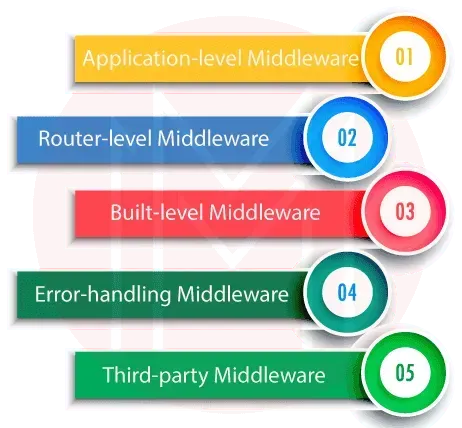
Types of Middleware in Backend Development
Middleware is a function or component that runs between receiving a request and sending a response. It is commonly used in backend frameworks such as Express.js to process requests, validate users, handle errors, and perform other tasks.

1. Types of Middleware
1. Application-Level Middleware
Middleware registered on an application instance to process incoming requests.
Example: Logging requests or checking authentication.
2. Router-Level Middleware
Middleware attached to a specific router to manage requests for particular routes.
Example: Protecting admin routes.
3. Built-in Middleware
Middleware provided by a framework.
Example in Express.js:
express.json() parses incoming JSON request bodies.4. Third-Party Middleware
Middleware installed from external packages.
Examples:
cors for cross-origin access control and morgan for HTTP request logging.5. Error-Handling Middleware
Middleware designed to catch and process errors in Express applications.
Example: Returning an appropriate error response when a request fails.
6. Authentication Middleware
Checks whether a user is authenticated before allowing access to protected resources.
Example: Verifying a session or access token.
7. Authorization Middleware
Checks whether an authenticated user has permission to perform a particular action.
Example: Allowing only administrators to delete users.
8. Validation Middleware
Checks incoming request data before it reaches business logic.
Example: Validating email addresses and required fields.
2. Example of Middleware in Express.js
1
2
3
4
5
6
7
8
9
10
11
12
13
14
15
16
17
18
19
20
21
22
23
24
25
const express = require("express");
const app = express();

// Built-in middleware
app.use(express.json());

// Application-level middleware
app.use((req, res, next) => {
  console.log(req.method, req.url);
  next();
});

// Route
app.get("/", (req, res) => {
  res.send("Hello World!");
});

// Error-handling middleware
app.use((err, req, res, next) => {
  res.status(500).json({
    message: "Internal Server Error"
  });
});

app.listen(3000);
In Express, middleware executes in registration order. Calling
next() passes control to the next middleware, while error-handling middleware receives errors passed through Express's error-handling mechanism.3. Why Is Middleware Important?
- Improves code reusability.
- Makes request processing organized.
- Supports authentication and authorization.
- Simplifies logging and error handling.
- Helps validate and process incoming data.
- Improves maintainability and security.
Conclusion
Middleware is an important part of backend development because it allows developers to process requests before they reach the main application logic. Understanding application-level, router-level, built-in, third-party, and error-handling middleware is especially useful when developing secure and maintainable web applications.
Enjoyed reading this content? Let the author know!
Your likes, comments, shares, and saves help creators reach more builders.

Loading recommendations
Loading article