
The Future of AIOps: Why Your Organization and Projects Can’t Afford to Wait
Discover how AIOps combines AI, Machine Learning, and Big Data to automate IT infrastructure, eliminate alert fatigue, and ensure your business operations never stop.

The Future of AIOps: Why Your Organization and Projects Can’t Afford to Wait
Modern technology environments generate data at extreme speeds. Cloud infrastructure, microservices, and continuous deployment pipelines create a massive volume of logs, metrics, and alerts. Traditional IT teams often struggle to manage this output. AIOps provides a practical solution to handle the scale.
This approach combines artificial intelligence, machine learning, and big data. It automates infrastructure management and optimizes everyday workflows. The primary goal involves detecting anomalies and running automated actions to keep company operations active without interruptions.
What Exactly is AIOps?
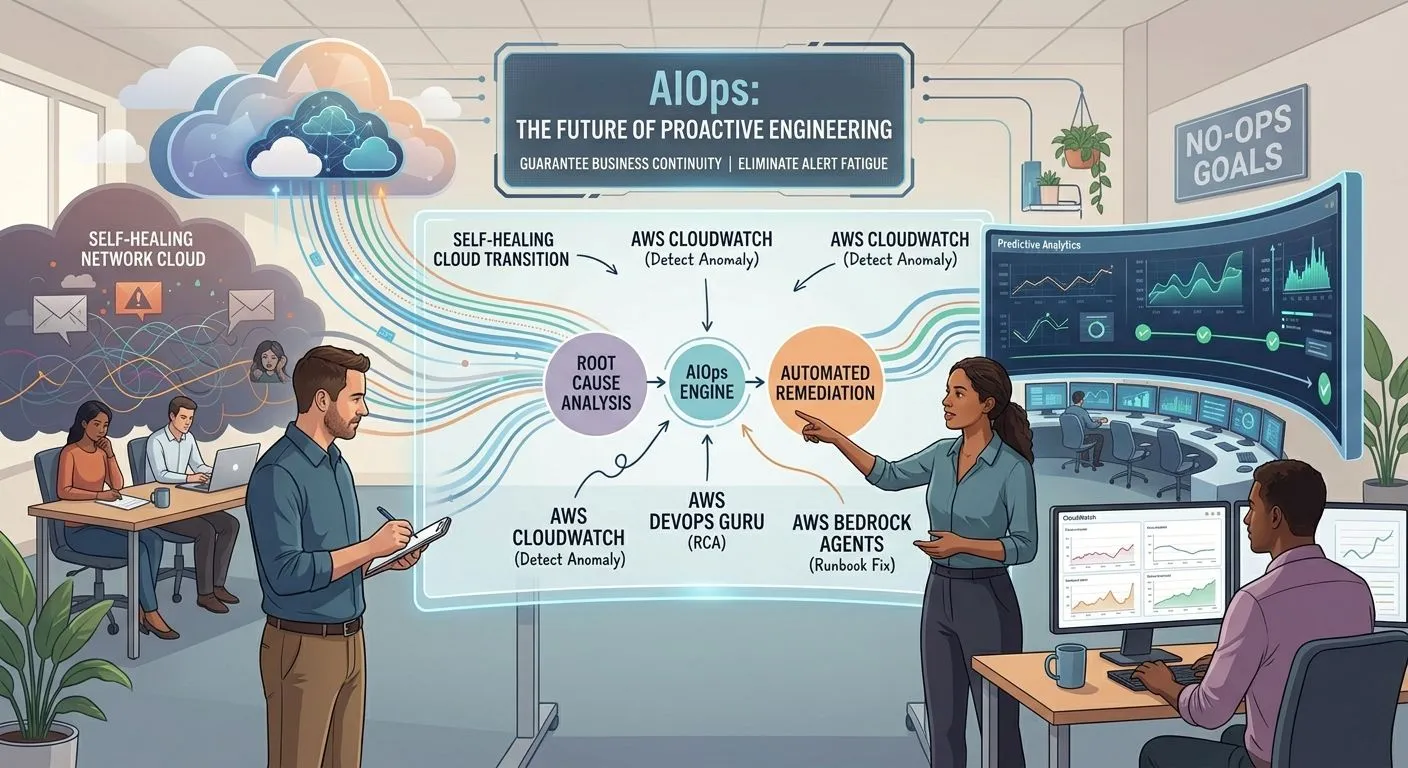
AIOps moves IT management away from constant firefighting toward proactive engineering. The system runs on three separate pillars.
The big data layer collects telemetry files from different departments. It turns logs, traces, and metrics into a single source of information.
Machine learning establishes normal behavior patterns for your specific systems. This enables the automatic detection of anomalies. Engineers no longer need to write thousands of rigid threshold rules manually.
Finally, automation engines handle the response. When the system flags an issue, it triggers scripts or workflows to fix the problem immediately.
Why Your Organization Needs to Adopt It
Managing an IT project or guiding a digital transformation requires clear operational advantages. AIOps delivers direct financial and technical benefits.
Business continuity improves because the system prevents downtime. When applications fail, businesses lose money and reputation. This technology finds small patterns before a crash happens, such as slow memory leaks or subtle API latency. It fixes the issue by scaling resources or restarting services before users notice.
Alert fatigue disappears. Monitoring tools often trigger thousands of notifications daily, creating mostly background noise. Engineers eventually miss dangerous warnings because of the volume. The platform filters out duplicates and groups related events into one clear incident.
Root cause analysis becomes faster. Finding the source of a breakdown in complex systems takes time. The software maps the infrastructure topology and points directly to the failure. This process reduces the mean time to repair from hours to seconds.
Human talent finds better uses. Engineering teams can stop spending nights fixing routine infrastructure bugs. They gain time to build new features and focus on strategic goals.
Implementing the Architecture via AWS
Organizations using Amazon Web Services can build this pipeline with native tools. AWS groups these products into observability and remediation.
Amazon DevOps Guru serves as the primary native option. It uses machine learning models to study metrics and system behavior. The service flags operational anomalies and gives recommendations for quick fixes.
Amazon CloudWatch includes anomaly detection capabilities. It uses historical data to build dynamic performance bands instead of fixed thresholds. Engineers can also search and summarize logs using normal language.
AWS Compute Optimizer evaluates resource history. It recommends the best sizing for instances, volumes, or functions. This keeps applications fast while lowering cloud spend.
Automated cleanup uses generative AI support. Amazon Q Developer works across the cloud platform to find the root cause of deployment failures and suggest code fixes.
Amazon Bedrock Agents run autonomous workflows using foundation models. Companies can store standard operating procedures in an Amazon S3 bucket. The agent reads the guide during an alert and runs a Lambda function to repair the setup.
AWS Systems Manager Incident Manager coordinates the final workflow. When DevOps Guru reports an anomaly, Incident Manager creates operational tasks and runs mitigation scripts instantly.
The Expected Evolution
The technology changes how companies view infrastructure. The industry is moving toward new operational standards.
Generative AI integration lets engineers talk to infrastructure using regular speech. A developer can ask why a specific service slowed down and receive a text explanation along with the patch.
No-Ops environments require zero human intervention for daily maintenance. The infrastructure updates itself, controls cloud expenses, and fixes security issues independently.
DevSecOps convergence expands the system focus. The tools will predict security breaches and compliance errors by reviewing behavioral shifts across network permissions in real time.
Using AIOps changes how businesses secure their digital revenue. Automating workflows and tracking systems with machine learning keeps organizations resilient. This approach ensures applications remain operational in competitive markets.
Enjoyed reading this content? Let the author know!
Your likes, comments, shares, and saves help creators reach more builders.

Loading recommendations
Loading article