
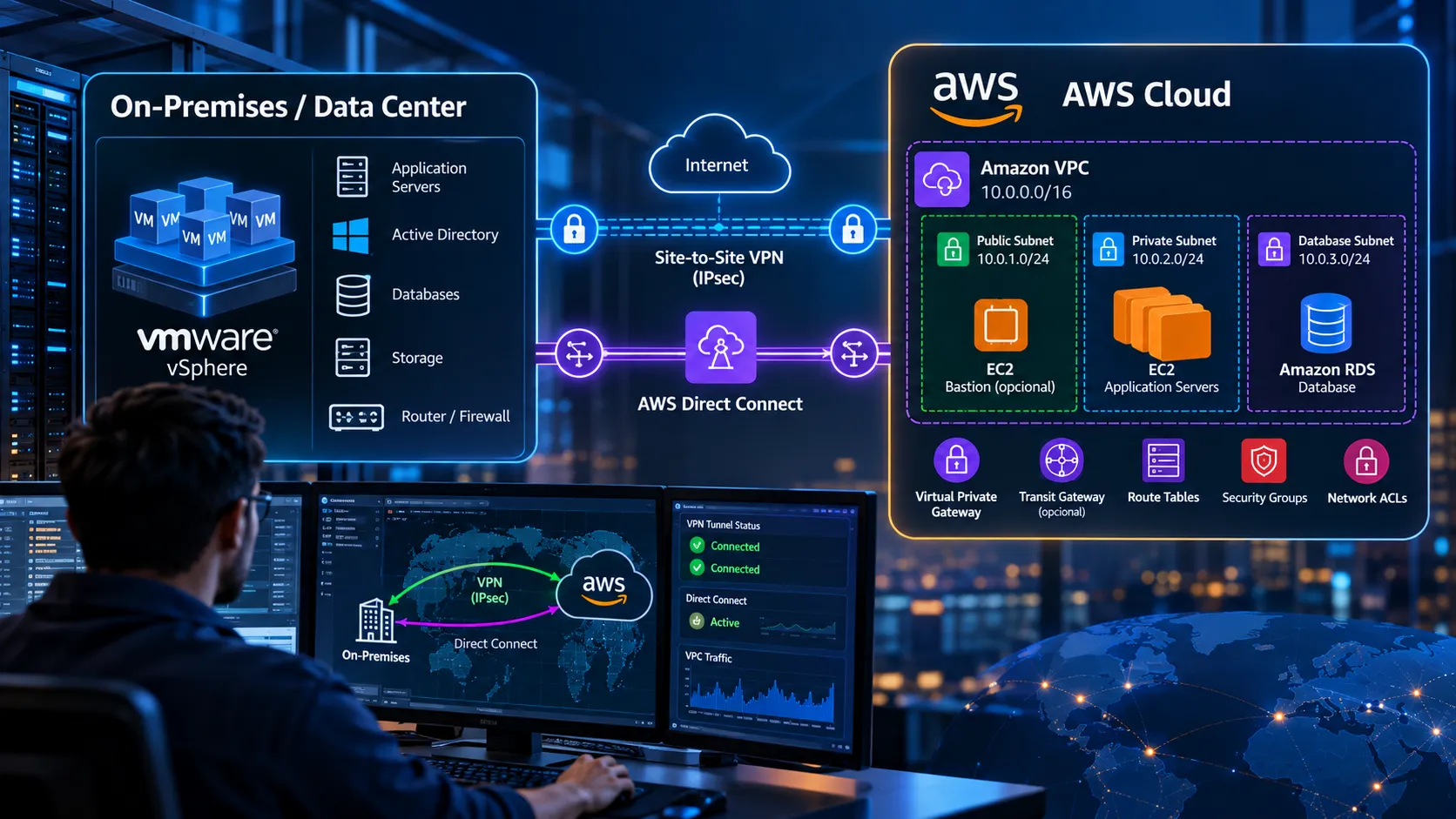
On-Premises to AWS: Understanding Hybrid Cloud Connectivity
Exploring how traditional data center infrastructure connects with AWS through hybrid cloud architectures, including Site-to-Site VPN, AWS Direct Connect, Amazon VPC, and secure network connectivity.

From On-Premises to AWS: Understanding Hybrid Cloud Connectivity
When learning AWS, one of the topics that caught my attention was hybrid cloud connectivity.
Coming from a traditional infrastructure and data center environment, I am familiar with physical servers, VMware virtualization, VLANs, routing, firewalls, and network availability.
However, moving to the cloud does not always mean replacing the entire on-premises infrastructure.
Many organizations continue operating critical workloads in their own data centers while integrating AWS services to expand their capabilities.
This is where hybrid cloud architectures become particularly interesting.
What Is a Hybrid Cloud Architecture?
A hybrid cloud architecture connects on-premises infrastructure with cloud environments, allowing applications, services, and data to operate across both.
For example, an organization might maintain its core business applications in a VMware environment while deploying new applications or additional infrastructure in AWS.
A simplified architecture could look like this:
1
2
3
4
5
6
7
8
9
10
11
12
13
14
15
16
On-Premises Data Center
        |
   VMware vSphere
        |
  Router / Firewall
        |
 Site-to-Site VPN
        |
  AWS Virtual Private
       Gateway
        |
     Amazon VPC
        |
   Private Subnet
        |
   Amazon EC2
The goal is to establish secure and reliable communication between environments without requiring an immediate migration of every workload.
AWS Site-to-Site VPN
One of the services that makes hybrid connectivity possible is AWS Site-to-Site VPN.
This service establishes encrypted IPsec VPN connections between an organization's network and its AWS environment.
From a traditional networking perspective, this concept is familiar.
In on-premises environments, VPN tunnels are commonly used to connect offices, branches, and data centers across different locations.
AWS extends this concept by allowing private networks to communicate with resources deployed inside an Amazon VPC.
For example, an application server hosted on VMware could communicate with an EC2 instance through a properly configured Site-to-Site VPN connection.
Important considerations include:
- Network addressing and avoiding overlapping CIDR ranges
- Routing configuration
- IPsec tunnel configuration
- Firewall rules
- High availability
- Monitoring and troubleshooting
Site-to-Site VPN typically provides two tunnels per connection to support redundancy, although the overall availability of the solution also depends on the on-premises configuration.
What Is AWS Direct Connect?
Another connectivity option is AWS Direct Connect.
Unlike Site-to-Site VPN, which commonly uses Internet connectivity, Direct Connect provides a dedicated network connection to AWS through supported connectivity locations and partners.
This can be useful for organizations that require more consistent network performance or need to transfer significant amounts of data between their data centers and AWS.
However, an important distinction is that Direct Connect does not encrypt traffic by default.
Organizations requiring encryption must implement additional security mechanisms, such as IPsec VPN over Direct Connect where supported.
From an infrastructure perspective, selecting between VPN and Direct Connect depends on business and technical requirements.
These may include bandwidth, latency, cost, availability, security, and operational complexity.
The Role of Amazon VPC
Amazon VPC is a fundamental component of hybrid architectures.
It provides the virtual network environment where AWS resources are deployed.
Within a VPC, administrators can define:
- IP address ranges
- Public and private subnets
- Route tables
- Security Groups
- Network ACLs
- Connectivity through gateways
For example, an organization could deploy application servers in private subnets and allow communication with its on-premises data center through a VPN connection.
This enables hybrid connectivity while reducing unnecessary public exposure.
What About VMware?
This is where hybrid cloud becomes particularly relevant to infrastructure administrators.
Organizations using VMware vSphere may have hundreds of virtual machines supporting business applications.
Migrating all those workloads immediately to AWS may not be practical because of technical dependencies, application compatibility, licensing, or operational requirements.
A hybrid approach allows organizations to evaluate workloads individually.
For example:
On-Premises Environment
- VMware ESXi hosts
- VMware vCenter
- Internal application servers
- Active Directory
- Existing storage infrastructure
AWS Environment
- Amazon EC2
- Amazon EBS
- Amazon VPC
- Amazon S3
- Amazon CloudWatch
Both environments can coexist while the organization gradually modernizes its infrastructure.
However, network connectivity alone does not provide workload migration or disaster recovery. Those capabilities require additional tools, procedures, and architecture decisions.
Security in Hybrid Environments
Security becomes especially important when connecting different infrastructure environments.
A hybrid architecture introduces additional communication paths that must be properly controlled.
Some important practices include:
- Applying least-privilege access policies
- Restricting unnecessary network traffic
- Using encryption where appropriate
- Monitoring connectivity and network events
- Maintaining clear routing and firewall configurations
- Implementing redundancy for critical connections
AWS Identity and Access Management (IAM) can control access to AWS resources, while network security controls regulate communication between workloads.
Both identity security and network security must be considered as part of the overall architecture.
Monitoring and Operational Management
Another important aspect is monitoring.
In a traditional data center, administrators commonly monitor servers, storage systems, virtualization platforms, and network equipment.
In AWS, services such as Amazon CloudWatch provide metrics, logs, and alarms for supported AWS resources and applications.
For hybrid environments, monitoring should cover both sides of the connection.
For example, if an application hosted on-premises cannot communicate with an EC2 instance, troubleshooting may involve:
- On-premises firewall configuration
- VPN tunnel status
- Routing tables
- VPC configuration
- Security Groups
- Network ACLs
- Application availability
The troubleshooting methodology remains familiar, even though the technologies and management tools are different.
My Perspective as an Infrastructure Professional
One of the things I appreciate about learning AWS is discovering how much traditional infrastructure knowledge remains relevant.
Understanding VLANs, IP addressing, routing, firewalls, virtualization, and availability provides a useful foundation for exploring hybrid cloud architectures.
The difference is that cloud environments introduce new ways to provision, manage, automate, and scale infrastructure.
For me, learning hybrid connectivity is an important step toward understanding how organizations can integrate existing data center investments with AWS services.
It also reinforces the idea that cloud adoption is not necessarily an immediate replacement of traditional infrastructure.
In many cases, it is a gradual process that requires careful planning, technical evaluation, and operational coordination.
Final Thoughts
Hybrid cloud connectivity is an important concept for infrastructure professionals transitioning toward AWS.
Services such as AWS Site-to-Site VPN, AWS Direct Connect, and Amazon VPC enable organizations to establish connectivity between traditional data centers and cloud environments.
Understanding these technologies helps bridge the gap between on-premises infrastructure and cloud architecture.
My next learning goal is to explore how AWS Transit Gateway, centralized routing, and hybrid network monitoring can simplify connectivity across more complex environments.
What has been your biggest challenge when connecting on-premises infrastructure with AWS?
Enjoyed reading this content? Let the author know!
Your likes, comments, shares, and saves help creators reach more builders.

Loading recommendations
Loading article